
Dependable heat for a Long Island Sound winter.
Rye sits at just 8 feet of elevation on the Sound, but a long, demanding heating season and winter lows averaging 23°F mean the heating season here lasts longer than the mild coastal setting suggests. We'll help you find a trusted local dealer who knows Rye's older housing stock and the gas-line realities of this stretch of Westchester.
Every Project Starts From One of These Five Situations
The practical choice for a historic coastal city.
Rye's climate reads mild on paper—it's climate zone 4A, right on Long Island Sound—but the heating season adds up to real demand each year, and winter lows averaging 23°F routinely dip into the teens during a Nor'easter. Wood isn't a realistic heat source for most Rye homeowners: there's no nearby public cutting land, lot sizes in neighborhoods like Rye Town Park and Milton Point are tight, and most of the city's housing stock—Colonials, Tudor Revivals, and shingle-style houses from the early 1900s—was built with small masonry fireboxes never meant to carry daily fuel loads. The oak, maple, birch, and ash that shade Rye's older streets make for nice shade trees, not a practical fuel supply.
That's part of why gas has become the default upgrade path here. Con Edison runs both the electric grid and natural gas service through most of Rye, so a direct-vent gas insert or fireplace is usually a straightforward tie-in rather than a new utility hookup. The one local wrinkle is Con Edison's residential electric rate, which at roughly $0.3424 per kWh is among the highest in the country—it makes electric-resistance heat an expensive everyday choice and pushes most homeowners toward gas for anything beyond occasional ambiance. Coastal salt air is the other factor a good installer accounts for: venting hardware near the Sound benefits from stainless steel components that won't corrode as fast as standard galvanized runs.
Three steps. No salesperson until you're ready.
Tell us about your project
Your zip code, your situation, and the fuel you're leaning toward—or let the answers point you to one.
See what's actually available
The brands dealers within 100 miles genuinely carry—real options, never a catalog mirage.
Get your dealer & Project Guide
A trusted local dealer, plus the free Project Guide & Parts List that names every component of the job.
Frequently Asked Questions
How much does a gas fireplace installation cost in Rye?
Most Rye installs run $5,500 to $12,000. The lower end covers a direct-vent insert dropping into an existing masonry firebox with a gas line already nearby—common in the city's older Colonials and shingle-style homes. The upper end applies to new construction or additions where a gas line has to be extended and venting run through an exterior wall, which can mean extra coordination with Con Edison on the utility side. Homes in historic districts sometimes add cost if venting placement needs to respect the building's facade.
Is a wood-burning fireplace still a reasonable option for my Rye home?
It's uncommon as a primary or even regular secondary heat source here, and for good reason—there's no nearby public land issuing cutting permits, most lots are too small to store and season a winter's worth of cordwood, and the original masonry fireboxes in Rye's older homes were built for occasional decorative fires, not daily burns. Some owners of historic houses keep the original firebox for a handful of fires a season, but when the goal is dependable heat, converting that same opening to a gas insert is the far more common move among Rye homeowners.
Do I need a permit to install a gas fireplace in Rye?
Yes. You'll need a building permit through the City of Rye Building Department, along with a gas line permit tied to a licensed gas-fitter if any new piping is involved. If your house sits in one of Rye's local historic districts, exterior venting changes may also need a sign-off on appearance, which a dealer familiar with the area will usually flag before work starts rather than after an inspection stalls the job.
What's the difference between a gas fireplace, insert, and stove for a house like mine?
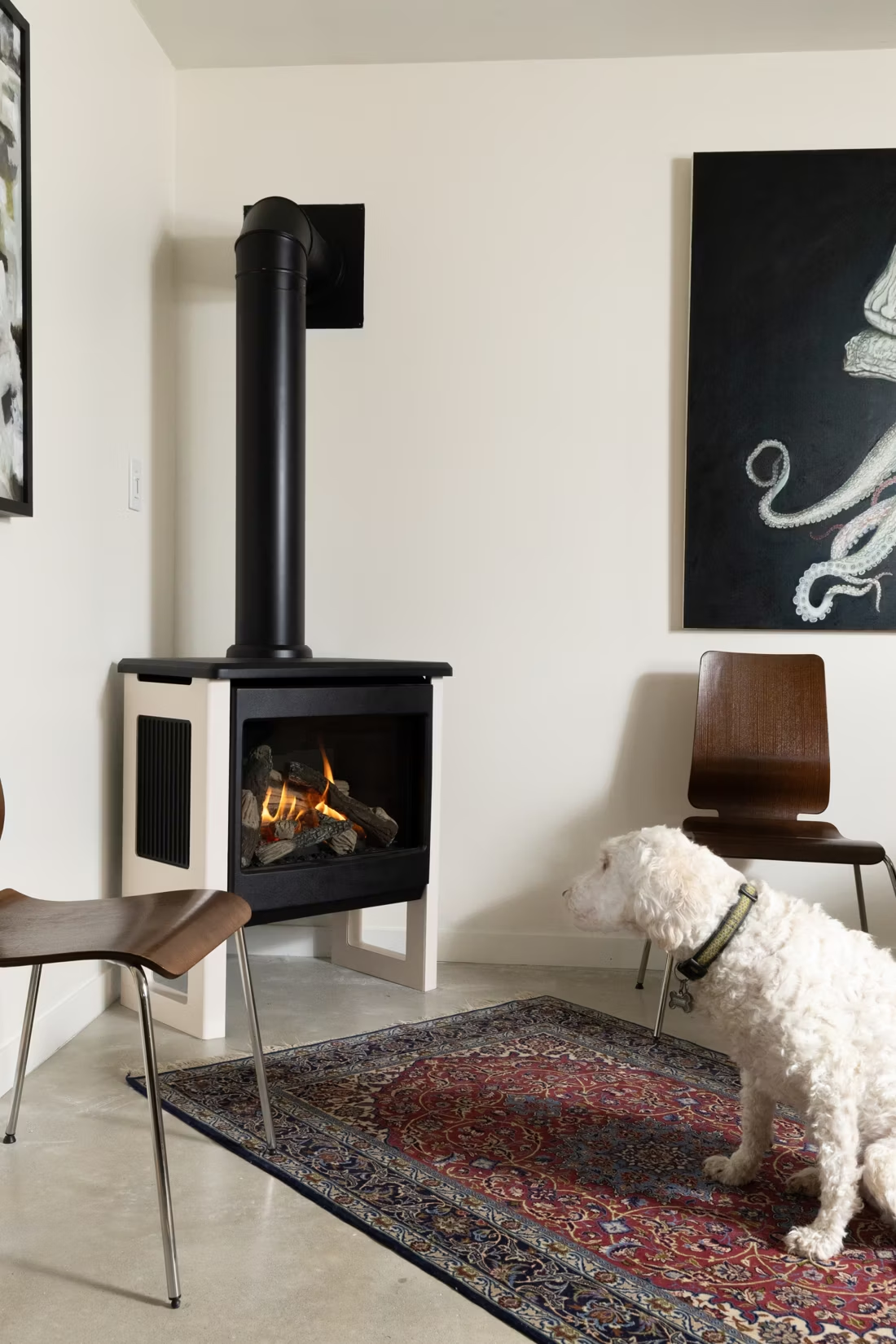
A gas fireplace is a built-in unit framed into a wall, which fits new construction or a gut remodel better than it fits Rye's older housing stock. A gas insert slides into an existing masonry firebox and is the most common retrofit here—it reuses the chimney chase already built into Colonials and Tudor Revivals around town. A gas stove is freestanding on a hearth pad and vents through a wall or existing flue, a good option in a sunroom or addition where there's no fireplace opening to work with at all.
Will a gas fireplace keep working if the power goes out during a storm?
Most will, which matters on the Sound where Nor'easters and the occasional remnant hurricane can knock out Con Edison service for days at a time. Units with intermittent pilot ignition (IPI) run their igniter and blower off a AA battery backup that kicks in automatically. Valor's lineup skips the battery altogether since the pilot's thermocouple generates its own current. If backup heat during an outage is a priority—and on a coastal street in Rye it's a reasonable thing to plan for—ask your dealer which ignition system is on the model you're considering.
Is everyone in Rye on natural gas, or does propane come into play?
Con Edison's gas mains reach most of the city, but a handful of waterfront properties and homes on the outer edges of Rye—particularly around Manursing Island and some of the more isolated shoreline lots—sit outside convenient gas-line access and run on propane instead. If your street already has gas service for the furnace or water heater, adding a fireplace is usually a simple tie-in; if not, a propane tank setup is the standard fallback and most insert models your dealer carries can run on either fuel.
Vented vs. vent-free gas fireplaces—does it matter in Rye?
It does. Direct-vent units pull combustion air from outside and exhaust it back outside through sealed pipe, and they're the standard most Westchester code officials and insurers expect. Vent-free units burn into the room and face stricter square-footage and installation limits under New York code, and in historic-district homes with smaller, tighter rooms, those limits can rule a vent-free unit out entirely. Nearly every installer working in Rye defaults to direct-vent for that reason.
How often does a gas fireplace need servicing in Rye?
Plan on an annual check, ideally in late summer or early fall before the first cold snap rather than January when every technician in Westchester is booked solid. A tune-up covers the burner, pilot assembly, gas connections, and glass, plus a check for any corrosion on venting components from the salt air off the Sound—a wear factor that inland Westchester towns don't deal with. Expect roughly $150-$275 for a standard visit.
Gas or electric—which makes more sense for a Rye home?
For actual heat output, gas wins clearly: Con Edison's residential electric rate runs about $0.3424 per kWh, among the highest in the country, which makes electric-resistance heat expensive to run for anything beyond occasional use. Electric fireplaces still make sense where venting isn't practical—a condo unit, an interior room, or a rental where a landlord won't allow gas line work—since they install for a few hundred to around $1,500 with no venting or gas permit at all. Most Rye homeowners end up choosing gas for a main living space and reserving electric units for secondary rooms.
What's the difference between an insert and a zero-clearance fireplace?
An insert is a fireplace that slides into a pre-existing wood-burning fireplace—if you don't have one, there's nothing to insert it into. A zero-clearance fireplace is built into a framed wall, which makes it the answer for remodels and new construction. Simple test: existing masonry fireplace means insert; blank or framed wall means zero-clearance.
Why is a fireplace insert so efficient?
An insert does two things: it seals the chimney completely, so you stop losing air you already paid to heat, and it radiates warmth into the room through the firebox and glass. Most add a heat-exchange fan that pulls cool room air underneath, wraps it around the hot firebox, and pushes it back out warm. Your home is more efficient before you've even lit the first fire.
What is an in-home preview and do I need one?
It's a visit where a hearth professional measures your space, confirms the model you picked actually works in your home, and walks the specs—framing, gas line, venting, finish work—before anything is ordered. Some details you just can't know until you see the house. Never make a down payment without one; it's the single most-skipped step that burns buyers.
Can I install a fireplace myself?
If you're putting a fire in your house on purpose, it's best to work with an expert. Unless you're genuinely experienced in framing, gas line, vent pipe, and the national code on clearances to combustibles, have a professional do it—and ideally the same company that sells you the fireplace, so warranty, service, and liability all live under one roof.
Nearby Dealers
Hearth shops serving Rye and the surrounding area. Every listing shows whether it is a WhyFire partner, a dealer we have verified as authorized for the brands we recommend, or a local business carrying hearth products. No manufacturer pays for placement. How we verify dealers →
We’ve paused dealer listings for this connection today. Enter your zip or postal code above to find dealers near you, or come back tomorrow.
Popular Gas Brands
Where each brand came from, what's inside it today, and every current model. No brand pays to be here. Not every dealer carries every brand, so enter your zip code to see what's sold near Rye.
Kozy Heat
Kozy Heat was founded in 1976 by Dudley Hussong in Lakefield, Minnesota, and incorporated as Hussong Manufacturing Co., Inc. in 1978.
28 gas models →Fireplace Xtrordinair
Fireplace Xtrordinair, now often called FireplaceX, is the fireplace brand of Travis Industries, Inc., of Mukilteo, Washington.
25 gas models →Town & Country
Town & Country Fireplaces is the luxury gas fireplace brand of Pacific Energy Fireplace Products Ltd., of Duncan, British Columbia.
14 gas models →Lopi
Lopi is a wood, pellet, and gas stove brand founded by Kurt Rumens in Bellevue, Washington, in 1979.
7 gas models →Forge & Flame
Forge & Flame is the stove brand Hearth & Home Technologies introduced in August 2023 to bring Vermont Castings, Harman, and Quadra-Fire under one name.
6 gas models →Vermont Castings
Vermont Castings was founded in 1975 by Duncan Syme, the designer, and his brother-in-law Murray Howell, the business partner, in Randolph, Vermont.
6 gas models →Get your free Project Guide & Parts List for a Rye gas fireplace.
Tell us about your home, whether you're already on Con Edison gas or working with propane, and we'll help you find a trusted local dealer and send a free Project Guide & Parts List with the exact vent kit and parts your project needs.
Find Your Fireplace →