
Clean, code-compliant gas heat for Manhattan homes.
From prewar brownstones with an existing flue to glass high-rises with none at all, Con Edison's gas network already reaches nearly every address in New York County. Find the right direct-vent unit for your building, and get matched with a local dealer who knows DOB permitting and co-op board process cold.
Every Project Starts From One of These Five Situations
The fuel built for Manhattan's building stock.
New York County—Manhattan—is home to roughly 1.7 million residents packed into 23 square miles, and its winters are moderate compared to true cold-climate territory: an average winter low near 28°F, about 4,553 heating degree days, and a Climate Zone 4A designation that's a fraction of what a city like Burlington, VT or Duluth, MN sees each winter. What makes Manhattan unusual isn't the weather—it's the buildings. A prewar brownstone on the Upper West Side might still have a working masonry chimney behind a bricked-up firebox. A 1960s co-op tower has no flue whatsoever. A new glass high-rise in Hudson Yards was engineered from day one around sealed, direct-vent mechanical systems. Any of these can get a gas fireplace—but the right unit and venting path is completely different in each case.
Manhattan sits in an EPA non-attainment area for air quality, which is part of why wood-burning appliances are essentially a non-factor here and pellet stoves are rare—few buildings can accommodate the exterior venting a solid-fuel appliance requires, and most co-op and condo boards won't approve one. Gas fills that gap. Con Edison's gas main network already serves nearly every occupied address in the county, so in most cases the fuel line already exists at your building—what actually determines your project is venting design, NYC Department of Buildings sign-off, and (for co-ops and condos) getting your board to approve the work.
Three steps. No salesperson until you're ready.
Tell us about your project
Your zip code, your situation, and the fuel you're leaning toward—or let the answers point you to one.
See what's actually available
The brands dealers within 100 miles genuinely carry—real options, never a catalog mirage.
Get your dealer & Project Guide
A trusted local dealer, plus the free Project Guide & Parts List that names every component of the job.
Frequently Asked Questions
How much does a gas fireplace installation cost in New York County?
Manhattan installs run higher than the national average, mostly because of labor access, building logistics, and approval overhead rather than the appliance itself. A direct-vent gas insert into an existing brownstone chimney, with gas already run to that floor, is the most affordable path—often in the $6,000–$12,000 range once venting, permitting, and finish work are included. A high-rise installation with no existing chimney, requiring new sidewall venting through an exterior wall and coordination with building management, typically runs higher, sometimes into the $15,000–$20,000+ range depending on floor height and how far the unit sits from an exterior wall. Co-op and condo application fees, engineer letters, and building-required insurance riders are a real line item here that homeowners in single-family markets never see—ask your dealer to walk through the full scope before you get a board vote scheduled.
Is wood heat an option anywhere in New York County?
Realistically, no—not as a practical heating choice. Manhattan's building stock offers almost no path to a code-compliant wood-burning installation: most buildings have no usable chimney, the borough sits in an air quality non-attainment area, and virtually every co-op and condo board prohibits solid-fuel combustion appliances outright. A handful of townhouses with intact, inspected masonry chimneys can occasionally support a wood-burning insert, but this is the exception, not a mainstream option. If you're drawn to the look and radiant feel of a wood fire, a direct-vent gas unit with a realistic log set gets you most of the way there without the flue, ash, or board headaches.
What permits and approvals do I need for a gas fireplace in Manhattan?
Two separate tracks run in parallel. First is the city: a gas fireplace installation requires a permit through the NYC Department of Buildings, plus a licensed master plumber for any new gas line work, and FDNY notification in some venting configurations. Second—and often the longer track—is your building: co-op and condo boards typically require an alteration application, an engineer's letter confirming the venting doesn't affect the building's structure or facade, and proof of contractor insurance before work starts. If your building sits within a Landmarks Preservation Commission historic district (Greenwich Village, the Upper East Side, SoHo-Cast Iron, and others), any exterior venting termination also needs LPC sign-off, which can add real time to the schedule. A dealer who's done this before in Manhattan buildings will sequence these steps correctly instead of hitting them one at a time.
Can I install a vent-free gas fireplace in my Manhattan apartment?
No. New York City's fire code prohibits unvented (vent-free) gas fireplaces entirely, regardless of room size or ventilation—this is one of the stricter rules in the country. Every gas fireplace or insert installed in New York County needs to be a vented unit: direct-vent (sealed combustion, drawing outside air and exhausting outside) is the standard choice, since it doesn't require an existing chimney and can vent straight through an exterior wall in a high-rise. B-vent units, which rely on a vertical flue, are more common in older buildings with an existing chimney chase. Any dealer working in the five boroughs should already know to steer you toward direct-vent or B-vent options only.
Do I need natural gas service, or can I convert an existing fireplace?
Con Edison provides natural gas throughout nearly all of Manhattan, and most prewar and postwar buildings already have gas risers serving individual units for cooking, so extending a line to a fireplace location is usually a matter of running new pipe within the apartment rather than bringing gas to the building. If you have an existing decorative or wood-era masonry fireplace, the most common project is a direct-vent gas insert that uses a stainless liner run through your existing flue—this preserves the mantel and opening you already have while meeting current code. Buildings with no gas service at a given riser, or older low-pressure systems, may need a licensed plumber to assess capacity before an installer can quote firmly.
What's the difference between a gas fireplace, insert, and gas stove for a Manhattan apartment?
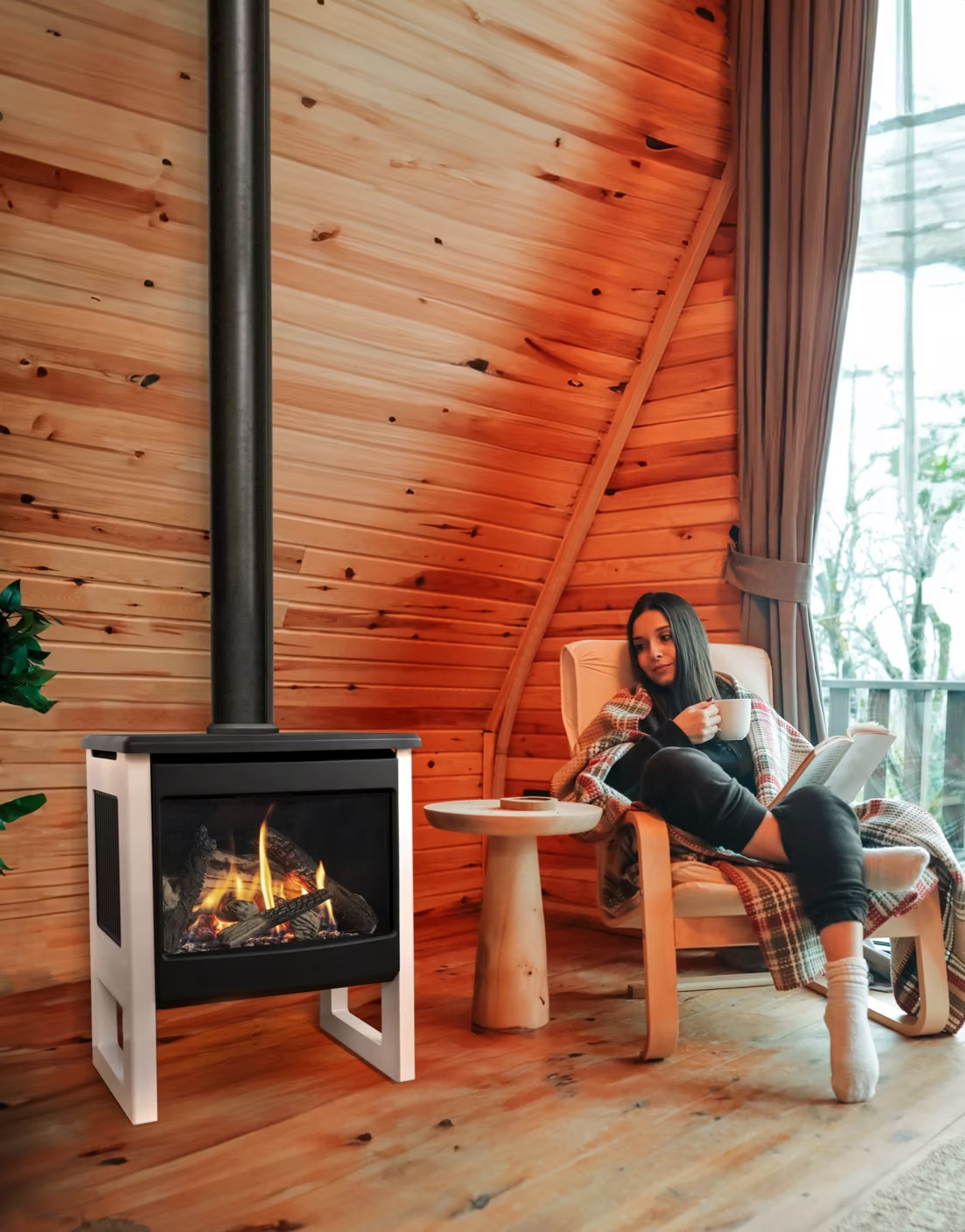
A gas insert drops into an existing masonry firebox and is the go-to choice for prewar brownstones and townhouses that already have a chimney opening. A built-in gas fireplace is framed into a wall as new construction—the standard approach in gut renovations and new-construction high-rises with no prior fireplace. A freestanding gas stove sits on the floor and is far less common in Manhattan simply because floor space is at a premium and most buildings prefer a flush, wall-mounted appearance. For the vast majority of New York County homeowners, the building's existing conditions—chimney or no chimney—decide this question before aesthetics do.
How often does a gas fireplace need to be serviced in an apartment building?
An annual inspection is recommended for any vented gas appliance, and it matters more in a Manhattan apartment than in a detached house because a venting problem can affect neighboring units in a shared wall or shaft. A certified technician checks the burner, pilot assembly, gas connections, and venting termination, and cleans the glass and firebox. Plan on roughly $150–$250 for a standard annual visit, and keep the paperwork—many co-op and condo boards ask for proof of service history at resale or during facade and mechanical inspections.
How does venting work for a gas fireplace in a high-rise with no chimney?
Direct-vent units solve this by drawing combustion air in and pushing exhaust out through a sealed pipe that runs a short distance to the nearest exterior wall—no vertical chimney required. In a high-rise, that means the fireplace typically sits against, or very near, an exterior wall so the vent run stays short and code-compliant. Building management often has specific rules about where a vent termination can face (away from operable windows, air intakes, or a neighbor's terrace), so this is coordinated with the building's engineer as part of the co-op or condo approval process, not left to the installer alone. Apartments without any exterior wall access in the intended fireplace location are the main case where a gas fireplace project isn't feasible.
Will my gas fireplace still work if Con Edison power goes out?
Most modern direct-vent gas fireplaces use an intermittent pilot ignition (IPI) system with a battery backup, so they'll still light and run during a Con Edison outage—useful during a summer heat-related grid event or a winter nor'easter. Keep fresh batteries in the unit; it's the one maintenance step people forget until the power's actually out. Some manufacturers, including Valor, use a self-powered pilot system that generates its own electricity from the thermocouple and never needs batteries at all—worth asking about if backup reliability during a multi-day outage matters to you. Either way, since the appliance itself runs on gas rather than electricity, you're not dependent on the grid for heat once it's lit.
Is my gas fireplace wasting gas?
If it was installed more than 15 years ago, probably. Older gas fireplaces keep a standing pilot light burning all the time, and that little flame can cost a couple hundred dollars a year. Newer models use pilot-on-demand ignition—the pilot lights only when you use the fireplace and goes out when you turn it off.
Why is a fireplace insert so efficient?
An insert does two things: it seals the chimney completely, so you stop losing air you already paid to heat, and it radiates warmth into the room through the firebox and glass. Most add a heat-exchange fan that pulls cool room air underneath, wraps it around the hot firebox, and pushes it back out warm. Your home is more efficient before you've even lit the first fire.
What is an in-home preview and do I need one?
It's a visit where a hearth professional measures your space, confirms the model you picked actually works in your home, and walks the specs—framing, gas line, venting, finish work—before anything is ordered. Some details you just can't know until you see the house. Never make a down payment without one; it's the single most-skipped step that burns buyers.
Can a fireplace actually lower my heating bill?
Yes—by creating a comfort zone. A furnace heats every square foot of the house just to warm the one room you're in; a gas fireplace on low burns roughly a sixth of the gas a typical furnace does. Set the furnace around 55–60 degrees as a baseline, then heat the rooms your family actually uses. Families who heat this way commonly save $20–$60 a month.
Find your gas fireplace in New York County.
Tell us about your building—brownstone, co-op, condo, or high-rise—and we'll match you with a trusted local dealer and send over a free Project Guide & Parts List: the exact vent kit, unit, and parts your Manhattan installation needs.
Find Your Fireplace →