
Pellet Heat for the Manhattan Homes Built to Handle It.
Pellet heat is a niche fit in a borough of high-rises and co-op boards—but for brownstones, townhouses, and lofts with a real flue, it's a legitimate way to cut heating costs against some of the highest electric rates in the country. We'll match you with a trusted local dealer who knows what Manhattan buildings actually allow.
Every Project Starts From One of These Five Situations
A niche fuel that works where brick meets a private flue.
Manhattan is not pellet-stove country in the way rural New England or upstate New York is—most of the borough's 1.6 million residents live in co-ops, condos, and rental high-rises where a solid-fuel appliance simply isn't possible without an exterior wall and a building board willing to sign off. But Manhattan is not a monolith. Townhouses in Chelsea and the West Village, brownstones in Harlem, Hamilton Heights, and Inwood (10040, 10033), and pre-war loft buildings in SoHo and Tribeca often have private exterior walls, existing masonry chimneys, or enough structural flexibility to support a direct-vent pellet insert or freestanding unit.
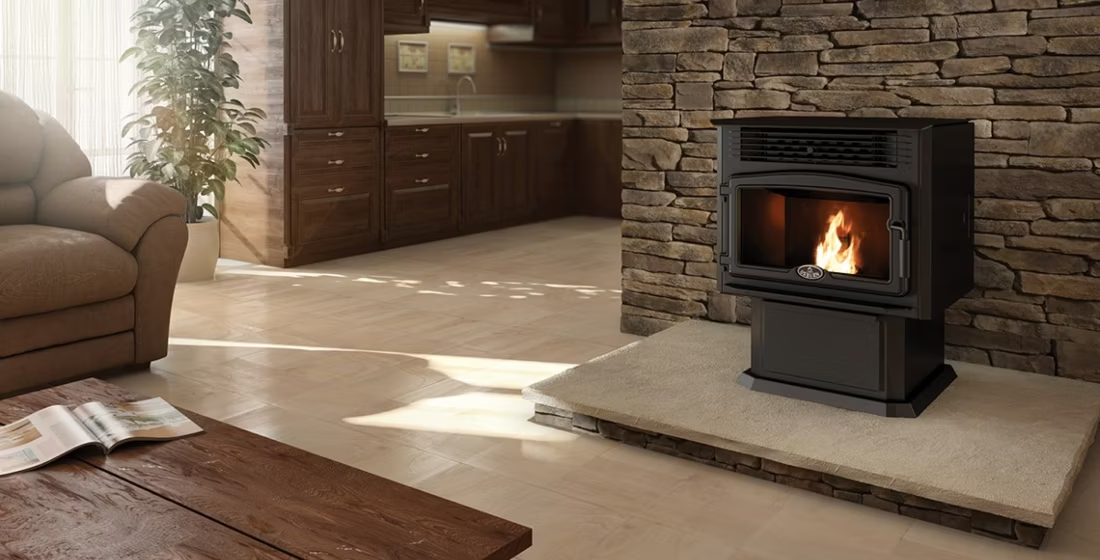
The economics make a real case for it. Con Edison's residential electric rate runs about $0.34 per kWh—nearly triple what homeowners pay in much of the country—which makes electric resistance heat expensive to run as a supplemental source. A pellet stove sourcing fuel from regional suppliers like Energex, Hamer Pellet Fuel, or Greene Team Pellet Fuel can offset that cost in a garden-level den, a top-floor duplex with roof access for venting, or a townhouse parlor floor. Manhattan sits in an EPA non-attainment area for air quality, so any unit installed here needs to meet current EPA emissions standards—a bar nearly every pellet stove on the market already clears, since pellet combustion burns markedly cleaner than cordwood by design.
Three steps. No salesperson until you're ready.
Tell us about your project
Your zip code, your situation, and the fuel you're leaning toward—or let the answers point you to one.
See what's actually available
The brands dealers within 100 miles genuinely carry—real options, never a catalog mirage.
Get your dealer & Project Guide
A trusted local dealer, plus the free Project Guide & Parts List that names every component of the job.
Frequently Asked Questions
How much does a pellet stove installation cost in Manhattan?
Expect a wider range than you'd see in most cities—roughly $3,800 to $8,500—because the variable isn't the stove itself, it's the building. A straightforward through-wall direct-vent install in a townhouse with an accessible exterior wall sits on the lower end. Core-drilling through brick or brownstone masonry, running venting up multiple stories, or coordinating scaffolding and DOB filings for a party-wall installation pushes costs toward the top. Local installers who've worked in pre-war Manhattan buildings before will usually quote a firmer number after seeing the space in person, since permit and access costs vary block to block.
Can I install a pellet stove in a Manhattan co-op or condo?
It depends entirely on the building, and this is the single biggest hurdle in Manhattan. Most co-op and condo boards require an alteration agreement, a licensed engineer's letter confirming the venting won't affect shared walls or flues, and proof of adequate insurance before approving any solid-fuel appliance. High-rise interior units without exterior wall access typically can't support one at all—there's simply nowhere for the vent to go. Ground-floor units, duplexes with private outdoor space, and townhouse-style co-ops in northern Manhattan have a much better shot. Ask your board's managing agent before you shop for a stove; it will save you from falling in love with a unit you can't install.
What permits do I need to install a pellet stove in Manhattan?
You'll need a permit through the NYC Department of Buildings for the installation itself, and depending on your building, sign-off from the FDNY for a solid-fuel-burning appliance. If you live in a co-op or condo, add your board's own alteration approval to that list—it usually has to come before the DOB filing, not after. Because Manhattan is an EPA non-attainment area, the unit itself also needs to meet current EPA 2020 NSPS emissions standards, which the vast majority of pellet stoves sold today already satisfy. A local installer familiar with Manhattan buildings will typically manage the DOB and FDNY paperwork as part of the job.
Where can I buy pellet fuel in Manhattan?
Storage is the real constraint here, not availability. Brands like Energex, Hamer Pellet Fuel, and Greene Team Pellet Fuel are all sold regionally, but most are stocked at hearth shops and hardware suppliers in the outer boroughs or in New Jersey and Connecticut, then delivered into Manhattan by pallet or by the bag. Expect to pay a bit more per ton than suburban buyers do once delivery into the city is factored in, and plan your storage—a basement storage room, a closet, or under-stair space—before you buy in bulk, since a ton of bagged pellets takes up real square footage that's at a premium here.
What's the best pellet stove for a small Manhattan apartment or townhouse room?
Compact, direct-vent models built for tight footprints are the right category to look at—brands like Harman, Enviro, and US Stove all make units sized for a single room rather than whole-home heating. In Manhattan, the deciding factor is almost always the vent path: a through-wall direct-vent kit needs a clear shot to an exterior wall, so a stove that vents horizontally with a short run is usually easier to install in a townhouse parlor or a garden-level unit than one requiring a long vertical chimney run. A local dealer can walk your space and tell you which vent configuration actually works before you pick a model.
Is a pellet stove worth it given Manhattan's high electric rates?
For supplemental heat, often yes. At roughly $0.34 per kWh through Con Edison—well above the national average—running electric resistance heaters or an all-electric system through a New York winter gets expensive fast, even with Manhattan's relatively moderate 4,553 heating degree days. A pellet stove burning fuel from a regional supplier can meaningfully offset that cost in the room where you spend the most time, particularly in a den, a garden unit, or a top-floor space that runs cold. It won't replace central heat in a high-rise, but as a zone-heating strategy in a townhouse or duplex, the fuel-cost math generally favors pellets over electric resistance heat.
Are there air-quality rules that affect pellet stoves in Manhattan?
Manhattan is designated an EPA non-attainment area, which means any new solid-fuel appliance installed here needs to meet current EPA 2020 NSPS emissions standards. This works in pellet stoves' favor: because pellets are a manufactured, low-moisture fuel that burns more completely than cordwood, pellet stoves are among the cleanest-burning solid-fuel appliances available and easily meet the standard. If you're weighing wood against pellet for a Manhattan property, the air-quality rules alone tend to steer the decision toward pellet.
How often does a pellet stove need servicing in a Manhattan installation?
Plan on an annual service that includes cleaning the burn pot, auger, and hopper, plus an inspection of the venting—this matters more in Manhattan than elsewhere because vent runs frequently pass through party walls, floor cavities, or shared masonry in townhouses and pre-war buildings, where a blockage or leak is a bigger problem than in a detached house. Heavy daily use over a full winter may call for a mid-season cleaning of the burn pot and glass. Given how few technicians in the city regularly work on pellet units in these building types, it's worth using the same installer for annual service who understands your building's specific venting setup.
Pellet vs. wood—which is realistic for a Manhattan home?
For nearly everyone in Manhattan, this isn't really a close call. Genuine wood-burning is largely off the table on the island—most existing masonry fireplaces are decorative or capped, there's no practical way to source or store cordwood at scale, and co-op boards are far more resistant to open wood-burning than to a sealed, direct-vent pellet appliance. Pellet stoves solve the fuel-logistics problem (bagged fuel instead of cords), burn cleaner in a non-attainment area, and are generally easier to get approved by a board or DOB reviewer because they're a sealed combustion appliance. If you have a genuine wood-burning masonry fireplace in a townhouse and want to keep it as-is, that's the rare exception—but for anyone adding a new solid-fuel appliance, pellet is almost always the more realistic path in Manhattan.
Why is a fireplace insert so efficient?
An insert does two things: it seals the chimney completely, so you stop losing air you already paid to heat, and it radiates warmth into the room through the firebox and glass. Most add a heat-exchange fan that pulls cool room air underneath, wraps it around the hot firebox, and pushes it back out warm. Your home is more efficient before you've even lit the first fire.
Why is my open fireplace making my house colder?
Open fireplaces suck—literally. As the fire burns, it consumes air your furnace already paid to heat and pulls it out through the chimney, so the house is actually colder after the fire goes out than before you lit it. An insert fixes this: it seals the chimney, puts fixed glass across the front, and turns that hole in your house into a real heat source.
Can I install a fireplace myself?
If you're putting a fire in your house on purpose, it's best to work with an expert. Unless you're genuinely experienced in framing, gas line, vent pipe, and the national code on clearances to combustibles, have a professional do it—and ideally the same company that sells you the fireplace, so warranty, service, and liability all live under one roof.
Can a fireplace actually lower my heating bill?
Yes—by creating a comfort zone. A furnace heats every square foot of the house just to warm the one room you're in; a gas fireplace on low burns roughly a sixth of the gas a typical furnace does. Set the furnace around 55–60 degrees as a baseline, then heat the rooms your family actually uses. Families who heat this way commonly save $20–$60 a month.
Nearby Dealers
Hearth shops serving Manhattan and the surrounding area. Every listing shows whether it is a WhyFire partner, a dealer we have verified as authorized for the brands we recommend, or a local business carrying hearth products. No manufacturer pays for placement. How we verify dealers →
Big Apple Fireplaces
Harris Hearth And Home
D & D Design Center
All Shore Appliance
Flue Tech
Costello's Hearth & Spa - Garden City Park
Hot Concepts Fireplaces
County Woodstoves Inc
The Valley Fireplace
Mcnamara Fireplace And Stove
L&r Fireplace & Barbecue
Westchester Fireplace
Kjb Fireplaces
Light N Grid
Fireplace And Outdoor Living
Pellet Brands Stocked Around Manhattan
Manufacturers will point you to the nearest stocking dealer.
Find your pellet fireplace in Manhattan.
Tell us about your building—townhouse, brownstone, co-op, or loft—and we'll match you with a trusted local dealer who knows what Manhattan buildings actually allow, plus a free Project Guide & Parts List with the exact parts, including the vent kit, your space needs.
Find Your Fireplace →