
Instant Heat for Tug Hill's Long, Snow-Bound Winters.
From Lowville to Croghan to Harrisville, most Lewis County homes run on propane rather than piped natural gas—and a well-installed gas fireplace still delivers instant, reliable warmth when the Tug Hill snow bands roll in. Find the right unit and connect with a trusted local dealer.
Every Project Starts From One of These Five Situations
Dependable heat for one of the snowiest corners of the East.
Lewis County sits in Zone 6A, tucked against the Tug Hill Plateau, where lake-effect bands off Lake Ontario routinely bury the county in some of the heaviest snowfall totals in the eastern United States. With just over 2,500 residents spread across small towns and open farmland—Lowville, Croghan, Turin, Denmark, Copenhagen, Constableville, Harrisville, Glenfield, and West Leyden among them—the housing stock ranges from older farmhouses to newer construction, and heating needs to hold up through months of sustained cold and repeated storm cycles.
Piped natural gas is limited or unavailable across most of Lewis County, so propane is the fuel that actually runs most gas appliances here, delivered by tank from regional suppliers rather than a utility main. That doesn't change what a gas fireplace or insert can do for a home: flip-of-a-switch heat, no wood splitting or ash hauling, and—with the right ignition system—a unit that keeps working when a Tug Hill storm knocks the power out for a day or more. For homes with an existing but rarely-used masonry fireplace, a propane insert is often the single biggest comfort upgrade available without touching the furnace.
Three steps. No salesperson until you're ready.
Tell us about your project
Your zip code, your situation, and the fuel you're leaning toward—or let the answers point you to one.
See what's actually available
The brands dealers within 100 miles genuinely carry—real options, never a catalog mirage.
Get your dealer & Project Guide
A trusted local dealer, plus the free Project Guide & Parts List that names every component of the job.
Frequently Asked Questions
How much does a gas fireplace installation cost in Lewis County?
Most gas fireplace and insert installations in this part of New York run in the $4,000 to $10,000 range, with the spread driven by the unit itself, the venting path, and whether propane infrastructure is already in place. Because most of Lewis County runs on propane rather than natural gas mains, homes without an existing tank should budget an extra $500 to $1,500 for tank setup and the initial fill, handled through a local propane supplier. A direct-vent insert going into an existing masonry fireplace in Lowville or Croghan, with propane already on site, sits toward the lower end; a new built-in unit in a remodel with fresh venting and gas line work runs higher. A local dealer will give you a firm number after seeing the space.
Can I convert my existing wood fireplace to gas?
Yes, and it's a common project in Lewis County's older farmhouses, many of which have a masonry fireplace that's rarely used because keeping it fed with split oak or maple all winter is a lot of work. A propane insert slides into the existing firebox, uses the current chimney as a liner-protected vent path, and turns that fireplace into real, controllable heat. Since natural gas isn't an option for most addresses here, expect the installer to size the insert for propane and coordinate tank placement if you don't already have one on the property.
Do I need natural gas to install a gas fireplace, or can I use propane?
In Lewis County, propane is the default answer for almost everyone. Piped natural gas service doesn't reach most of the county's towns and rural roads, so the vast majority of "gas fireplace" installations here are actually propane systems, fed by an aboveground or buried tank from a regional supplier. This isn't a downgrade—modern propane fireplaces and inserts perform identically to natural gas models, just with a different fuel source and orifice sizing. If you're near a village center where gas service might exist, your installer can confirm what's actually running to your street before you commit to a unit.
Will my gas fireplace work during a power outage?
Most modern propane fireplaces are built to handle exactly this. Units with IPI (intermittent pilot ignition) run on a small battery backup that kicks in the moment power drops, so the fireplace still lights and operates normally. That matters in Lewis County—Tug Hill lake-effect events can dump feet of snow in a single system and knock out power for a day or more in outlying areas around Harrisville, Glenfield, and West Leyden. Valor fireplaces take a different approach: their pilot generates its own electricity through the thermocouple, so there's no battery to check or replace. Ask your local dealer about the ignition system on any unit you're considering, especially if you're outside town.
What's the difference between a gas fireplace, gas insert, and gas stove?
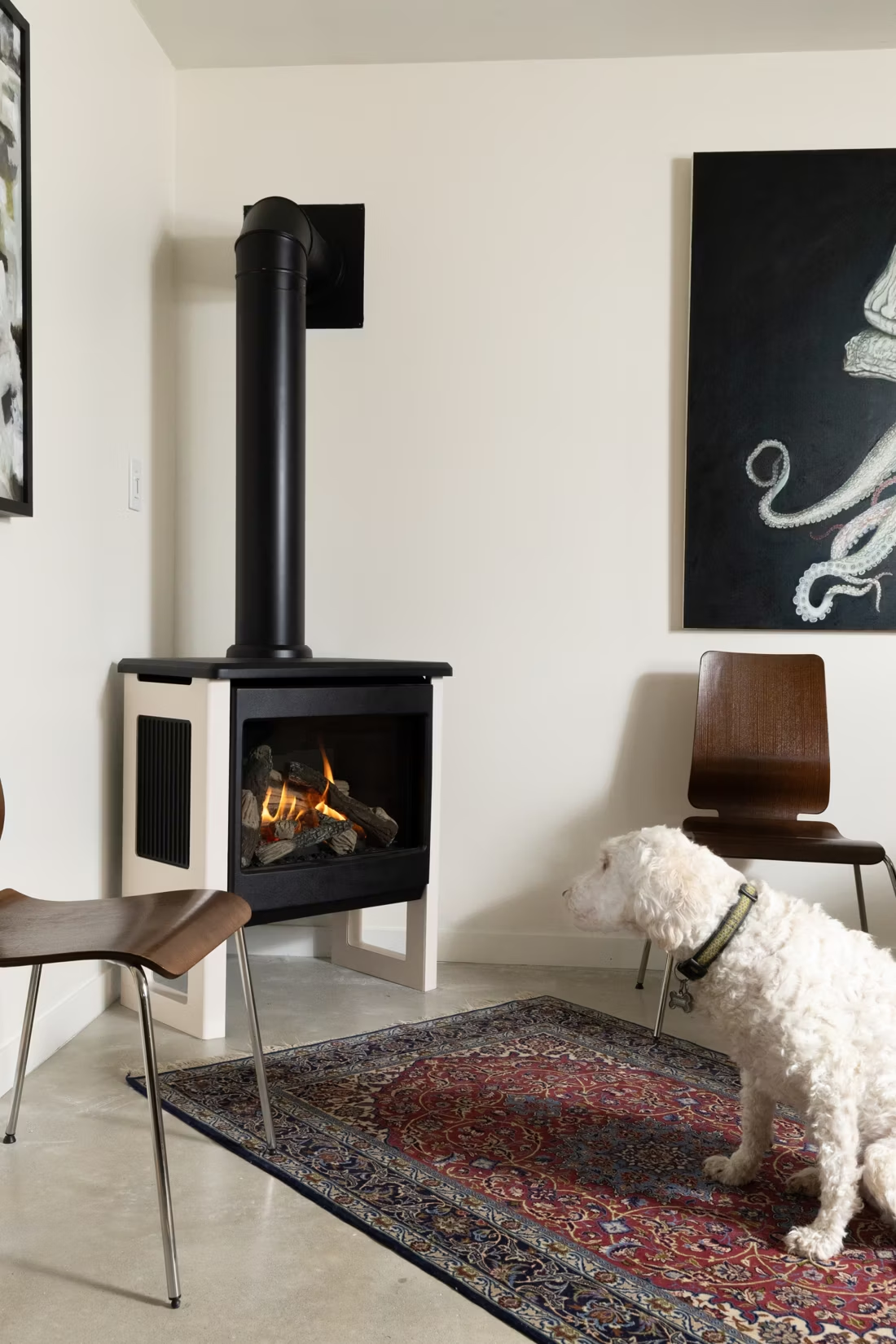
A gas fireplace is a fully framed-in unit for new construction or a remodel where there's no existing masonry opening. A gas insert is built to drop into an existing wood fireplace, sealing it up and venting through the current chimney—the common choice for Lewis County's older homes with an underused hearth. A gas stove is a freestanding cabinet unit, often chosen for a room without any existing fireplace, like a finished basement or an addition. For most homeowners here with an old farmhouse fireplace that's more decorative than functional, the insert is the straightforward upgrade.
Do I need a permit to install a gas fireplace in Lewis County?
Permitting in Lewis County is handled at the town level rather than through a single county office, so requirements and turnaround can vary depending on whether you're in Lowville, Croghan, Turin, or one of the smaller townships. A building permit is typically required for new venting or framing work, and any propane line or tank connection needs to be run by a licensed propane technician. Most hearth dealers who work regularly in the county already know their local code enforcement contacts and will pull the necessary permits as part of the installation, so you're not chasing down separate approvals yourself.
What's the difference between vented and vent-free gas fireplaces?
Vented (direct-vent) units draw combustion air from outside and exhaust it back outside through a sealed pipe—they're the standard, code-friendly choice everywhere, including Lewis County. Vent-free units burn fuel directly into the room without external venting; they're technically more fuel-efficient but release some combustion byproducts indoors and come with strict room-sizing and ventilation rules under New York code. Given how tightly sealed a lot of older Lewis County farmhouses get buttoned up for winter, and how long the heating season runs at this latitude, direct-vent units are the far more common and generally recommended pick—they don't ask you to make any tradeoffs on indoor air quality during months when the windows aren't opening anyway.
How often should my gas fireplace be serviced?
Plan on an annual inspection, ideally before the first hard cold snap of the season. A technician checks the burner, pilot assembly, gas connections, and venting, and cleans the glass and interior components. This is a much smaller job than wood-stove chimney sweeping, but it matters just as much for safety and efficiency—propane systems in particular benefit from a yearly check of the regulator and line connections given how much a Lewis County heating season actually runs the unit.
Gas vs. wood or pellet—which is right for my home?
Wood is the traditional standby here, with oak, maple, birch, and ash all common on Lewis County woodlots, and it keeps working with zero electricity during a Tug Hill power outage. Pellet stoves—running on regional brands like Energex, Hamer Pellet Fuel, or Greene Team Pellet Fuel—are cleaner and easier to load but need power for the auger and blower, so they go down with the grid. Gas, mainly propane in this county, gives you instant on-off heat and zero ash or wood handling, and with a battery-backup or self-powered ignition system it can also ride out an outage. A lot of Lewis County households end up with two: propane for daily convenience in the main living space, and wood or a pellet stove somewhere else as backup and backup-to-the-backup.
Can I put a TV above my fireplace?
Yes—with an asterisk. Fireplaces are hot and TVs don't like heat. Either put a mantel between them to deflect rising warmth, or choose a fireplace with heat-management technology that creates a cool zone on the wall above—the wall stays around 125 degrees, barely warm, while the room still gets full heat. If you like clean lines and don't want a mantel, heat management is the answer.
Are new gas fireplaces really better than old ones?
Two ways, and they're both big. Looks: modern gas fireplaces are realistic enough that it's hard to believe they aren't burning wood. Cost: old units burn a standing pilot year-round (roughly $200 a year), while new ones use pilot-on-demand ignition and modern burners. Add remote controls and thermostat operation, and the day-to-day experience isn't close.
Does a fireplace add value to my home?
On average, a fireplace adds back to the home about the same amount you spent installing it. Add the monthly savings from heating the rooms you actually use instead of the whole house—often hundreds of dollars a year—and the value case is strong before you even count what a fire does for how your family uses the room.
How much should I budget for a fireplace?
For an average home—covering the fireplace, the vent pipe, and basic installation—a budget between $3,900 and $5,500 gives you a lot of options across wood, gas, and pellet. By the time you add finish work, gas line, and electrical, the average complete installation lands between $5,000 and $12,000 all-in. In a remodel or new build, a good rule is to put about 2.5% of the total project cost toward the fireplace.
Find your gas fireplace in Lewis County.
Tell us about your home and we'll match you with the right propane or gas fireplace, insert, or stove, plus a free Project Guide & Parts List and a trusted local dealer to install it.
Find Your Fireplace →