
Find your electric fireplace in Erie County.
Zero-clearance heat and real ambiance for Erie County's older housing stock and lake-effect winters—no chimney, no gas line, no venting required. Find the right unit and connect with a trusted local dealer.
Every Project Starts From One of These Five Situations
The no-venting option for a region full of homes that can't fit one.
Erie County runs from Buffalo's downtown grid neighborhoods out through Amherst, Cheektowaga, West Seneca, and the lakefront towns south to Hamburg and Orchard Park—over a million people across climate zone 5A, where winter lows average 19°F and the county racks up roughly 6,466 heating degree days a year. Lake-effect snow off Lake Erie can bury a driveway overnight, and a lot of the county's housing stock predates central air, let alone a masonry chimney. Older two-family homes in the city, condos in Amherst, and apartments across the county often have nowhere to run a flue—which is exactly where electric fireplaces earn their keep.
Natural gas from National Fuel Gas remains the dominant heating fuel across Erie County, and electric fireplaces here are almost never the primary heat source for a whole house. What they do well is zone heat and honest ambiance: a bedroom that's always cold, a finished basement rec room, a condo association that won't allow venting through a shared wall. Because they plug into a standard outlet or a dedicated 120V/240V circuit with no combustion, no gas line, and no chimney sweep, they're also the fastest and least disruptive project on this list—which matters in a county where a lot of the building stock is a century old and every wall has a story.
Three steps. No salesperson until you're ready.
Tell us about your project
Your zip code, your situation, and the fuel you're leaning toward—or let the answers point you to one.
See what's actually available
The brands dealers within 100 miles genuinely carry—real options, never a catalog mirage.
Get your dealer & Project Guide
A trusted local dealer, plus the free Project Guide & Parts List that names every component of the job.
Frequently Asked Questions
How much does an electric fireplace installation cost in Erie County?
A plug-in freestanding or wall-mount electric fireplace runs $300 to $800 for the unit, with no real installation cost beyond hanging it—most homeowners in Buffalo's older two-family homes go this route because it requires no electrical work. A built-in electric insert or a linear wall unit that needs a dedicated 240V circuit typically runs $1,500 to $4,000 installed, including a licensed electrician's time to run the circuit. Recessed units built into new framing or a remodeled fireplace surround land at the higher end, especially in older Buffalo homes where knob-and-tube wiring sometimes needs updating before a new circuit can be added.
How much heat can I actually expect from an electric fireplace in a Buffalo winter?
Most electric fireplaces top out around 5,000 BTU (roughly 1,500 watts), enough to noticeably warm a single room of 400 to 600 square feet—but not enough to offset a whole house through a lake-effect cold snap at 19°F. In Erie County's climate zone 5A, with 6,466 heating degree days a year, electric units are best planned as zone heat for one room, not as a replacement for the furnace. If you're trying to warm an entire finished basement or an open-concept living area, ask a local dealer about combining a larger linear unit with your existing forced-air or hot-water heat rather than expecting it to carry the load alone.
Do I need an electrician to install an electric fireplace?
For a plug-in unit on a standard 120V outlet, no—it's a DIY-friendly install. For a built-in or wall-mounted unit that draws close to 1,500 watts continuously, a dedicated circuit is strongly recommended, and that means a licensed electrician. In Erie County's older housing—especially in Buffalo, Lackawanna, and Tonawanda where a lot of homes still have older panels—an electrician will also confirm your panel has room for the added load before running the new circuit. Local hearth dealers who sell built-in units typically coordinate the electrical work as part of the install rather than leaving you to hire separately.
What's the difference between an electric fireplace, insert, and stove?
An electric fireplace is a built-in or wall-mounted unit, often with a linear look, installed into a wall or a framed surround—common in newer condos and remodels around Amherst and Orchard Park. An electric insert is sized to slide into an existing masonry fireplace opening, letting a homeowner in one of Buffalo's older houses keep the original mantel and surround while retiring an unused wood-burning box. An electric stove is a freestanding cabinet-style unit that sits on the floor, plugs in, and can be moved between rooms—a popular choice for renters and for homes where a permanent installation isn't practical.
Do I need a permit to install an electric fireplace in Erie County?
A plug-in unit that doesn't touch your home's wiring generally doesn't require a permit anywhere in Erie County. Adding a new dedicated electrical circuit for a built-in or wall unit typically does require an electrical permit, pulled through your local municipality's building department—Buffalo, Amherst, Cheektowaga, and the other towns each handle this separately rather than through a single county office. Most licensed electricians and hearth dealers pull the permit as part of the job, so it's rarely something the homeowner has to manage directly.
Will an electric fireplace keep my house warm if the power goes out?
No—this is the honest tradeoff. Electric fireplaces need power to run, so during a lake-effect ice storm or a wind event that knocks out National Grid service, an electric unit goes dark along with everything else. That's a real consideration in Erie County, where extended outages do happen during severe winter weather. Homeowners who want heat that survives an outage typically pair an electric fireplace for everyday ambiance and zone heat with a wood or pellet stove elsewhere in the house—wood in particular needs no electricity to run, and oak, maple, and ash from local firewood suppliers burn reliably through a multi-day outage.
How much does it cost to run an electric fireplace on my electric bill?
National Grid residential electric rates in the Buffalo area run roughly 15 to 20 cents per kWh depending on supply charges and time of year. A typical 1,500-watt electric fireplace run on high for 5 hours a day costs somewhere around 75 cents to $1.50 per day, or roughly $25 to $45 a month if used daily through the coldest stretch of the season. Most units let you run the flame effect without the heater engaged, which cuts that cost to a few cents a day—a common choice for ambiance-only use in warmer months.
How much maintenance does an electric fireplace need?
Very little compared to wood or gas. There's no chimney to sweep, no venting to inspect, and no combustion byproducts to worry about. Maintenance is mostly dusting the unit, occasionally cleaning the glass front, and replacing LED components if the flame effect dims after years of use—most manufacturers rate the LEDs for 20,000+ hours. If a built-in unit ever trips a breaker repeatedly, that's worth a call to an electrician rather than the hearth dealer, since it usually points to a circuit or panel issue rather than the fireplace itself.
Electric vs. wood, gas, or pellet—which is right for my Erie County home?
Electric wins on installation simplicity and flexibility—no venting, no gas line, works in condos and rentals, and can go into rooms nothing else could reach. It loses on raw heat output and on power-outage reliability, which matters given Erie County's lake-effect storm season. Natural gas, widely available through National Fuel Gas across the county, delivers real heat instantly and still needs power for ignition on most models but recovers faster after an outage. Wood, burned from local oak, maple, birch, or ash, and pellet stoves running regional brands like Energex or Hamer Pellet Fuel both deliver serious heat independent of the grid (wood more so than pellet, since pellet stoves need electricity for the auger). A lot of Erie County homeowners end up with electric for ambiance in a living room or bedroom and a wood or gas appliance elsewhere for real heating capacity.
Does an electric fireplace need a vent or chimney?
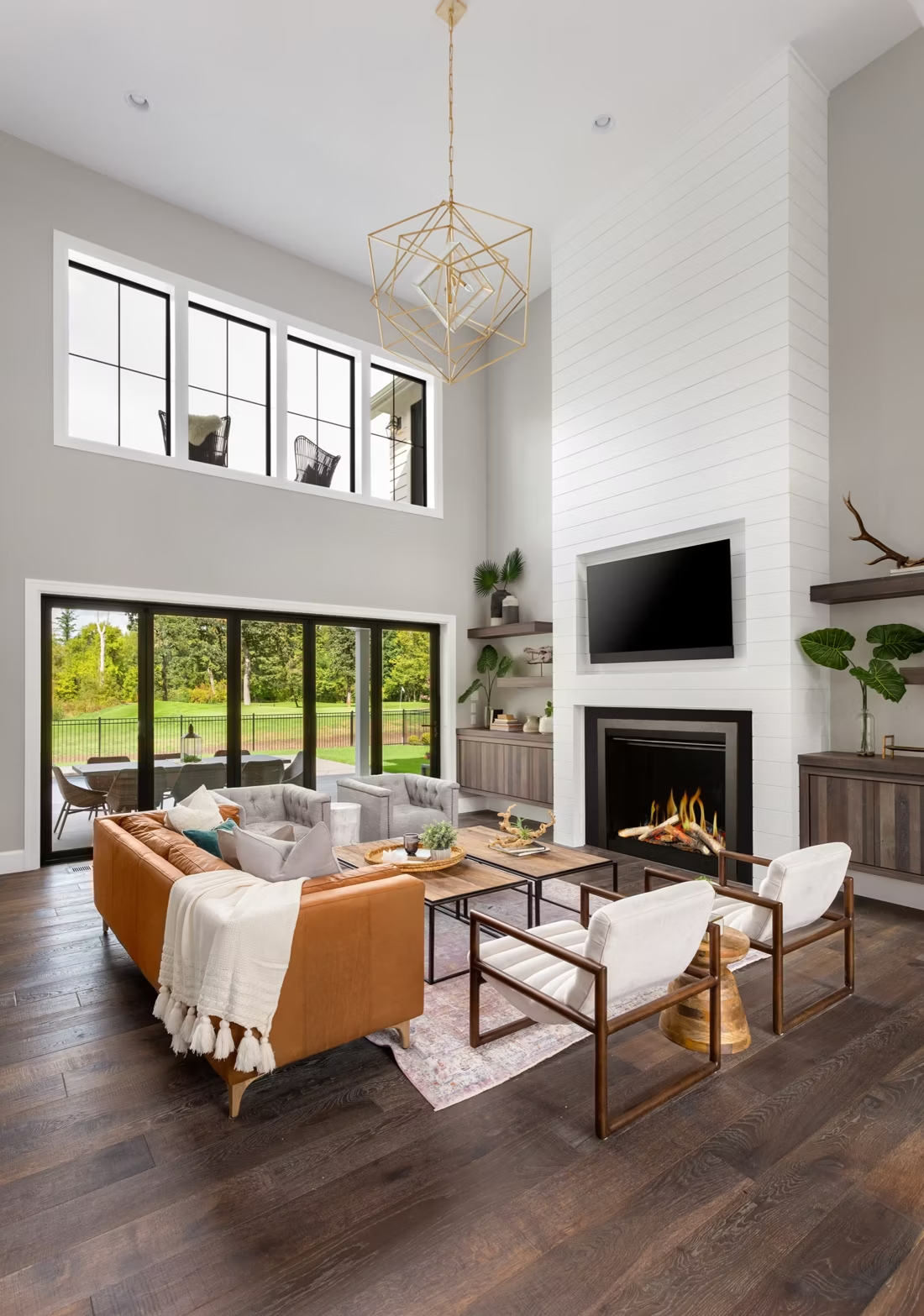
No—that's its superpower. An electric fireplace needs a wall and an outlet, period. No vent pipe, no gas line, no clearances to design around, which is why it works in bedrooms, offices, apartments, and walls where venting a gas or wood unit would be impractical or impossible. Installation is typically the simplest and least expensive of any fireplace type.
Can I put a TV above my fireplace?
Yes—with an asterisk. Fireplaces are hot and TVs don't like heat. Either put a mantel between them to deflect rising warmth, or choose a fireplace with heat-management technology that creates a cool zone on the wall above—the wall stays around 125 degrees, barely warm, while the room still gets full heat. If you like clean lines and don't want a mantel, heat management is the answer.
How much should I budget for a fireplace?
For an average home—covering the fireplace, the vent pipe, and basic installation—a budget between $3,900 and $5,500 gives you a lot of options across wood, gas, and pellet. By the time you add finish work, gas line, and electrical, the average complete installation lands between $5,000 and $12,000 all-in. In a remodel or new build, a good rule is to put about 2.5% of the total project cost toward the fireplace.
What is an in-home preview and do I need one?
It's a visit where a hearth professional measures your space, confirms the model you picked actually works in your home, and walks the specs—framing, gas line, venting, finish work—before anything is ordered. Some details you just can't know until you see the house. Never make a down payment without one; it's the single most-skipped step that burns buyers.
Stove and Fireplace Dealers in Erie County
Home Comforting Consultants, Inc.
Find your electric fireplace in Erie County.
Tell us a bit about your home and we'll match you with the right electric fireplace, insert, or stove—and hand you a free Project Guide & Parts List with the exact parts and your recommended local dealer.
Find Your Fireplace →