
Add clean, no-hassle electric warmth to your East Aurora home.
No chimney, no gas line, no venting—just plug-in or hardwired heat that fits East Aurora's mix of century-old village homes and newer additions.
Every Project Starts From One of These Five Situations
Simple heat for a village of historic homes and additions.
East Aurora's housing stock skews old—Craftsman bungalows and Victorians near the Roycroft Campus, farmhouses along the village edges, many with knob-and-tube wiring, masonry fireplaces that haven't drawn a fire in decades, or additions built without a chimney or gas stub at all. At 921 feet elevation with average winter lows near 15°F and a long, cold heating season each year, this is a real cold-climate location, but that doesn't mean every room needs a full-blown combustion appliance. Electric fireplaces and inserts solve a narrower, very common problem here: a finished basement, a sunroom addition, a bedroom, or a dead fireplace opening that needs supplemental warmth and ambiance without new venting or gas line work.
New York State Electric & Gas (NYSEG) serves East Aurora, at a residential rate around $0.1775 per kWh—noticeably higher than the national average, which matters if you're weighing an electric unit as anything beyond zone or supplemental heat. Most plug-in electric fireplaces and inserts require no permit at all; a built-in unit that needs a dedicated 20-amp circuit typically means an electrician pulls a permit through the Village of East Aurora Building Department. For homeowners restoring an old masonry fireplace that's been capped off for years, an electric insert is often the fastest and least invasive way to bring a dead firebox back to life.
Three steps. No salesperson until you're ready.
Tell us about your project
Your zip code, your situation, and the fuel you're leaning toward—or let the answers point you to one.
See what's actually available
The brands dealers within 100 miles genuinely carry—real options, never a catalog mirage.
Get your dealer & Project Guide
A trusted local dealer, plus the free Project Guide & Parts List that names every component of the job.
Frequently Asked Questions
How much does an electric fireplace installation cost in East Aurora?
Plug-in electric fireplace inserts and stoves—the kind that slide into an existing firebox or sit against a wall—typically run $400 to $1,200 installed, since they use a standard 120V outlet and need no electrician. Built-in electric fireplaces set into new framing, or units requiring a dedicated 20-amp circuit run from your panel, usually land between $1,200 and $2,800 once electrical work is included. Given East Aurora's older housing stock, budget toward the higher end if your panel needs a new circuit added rather than an existing outlet nearby.
Is an electric fireplace enough heat for an East Aurora winter?
Not as your only heat source. With average winter lows around 15°F and a long, cold heating season, East Aurora needs a real furnace or boiler running behind the scenes regardless of what's in the living room. Electric fireplaces are best understood as zone heat—closing the gap in one room, taking the chill off a sunroom addition, or supplementing a bedroom on the coldest nights—not as a replacement for central heat. At NYSEG's residential rate of about $0.1775/kWh, running a 1,500-watt unit continuously would cost roughly 27 cents an hour, which adds up fast if you're trying to heat more than a single room with it.
Do I need a permit for an electric fireplace in East Aurora?
Most plug-in electric fireplaces and stoves don't require any permit—they run off a standard household outlet just like a space heater or window AC unit. If you're installing a built-in unit that requires a new dedicated circuit or panel work, an electrician will typically pull an electrical permit through the Village of East Aurora Building Department. Because there's no combustion, no gas line, and no venting involved, electric installs are generally the simplest and fastest permitting path of any fireplace fuel type.
Can I put an electric insert into my old masonry fireplace?
Yes—this is one of the most common projects in East Aurora's older homes, especially Craftsman and Victorian houses near the village center where the original wood-burning fireplace hasn't been used in years, sometimes because the chimney was never relined or the flue has deteriorated. An electric insert slides into the existing firebox opening, uses the outlet already there or a new one added nearby, and restores the visual focal point of the room—flame effect, glow, sometimes heat—without touching the chimney at all. It's a fraction of the cost of relining a flue for wood or gas use.
What's the difference between an electric fireplace, insert, and stove?
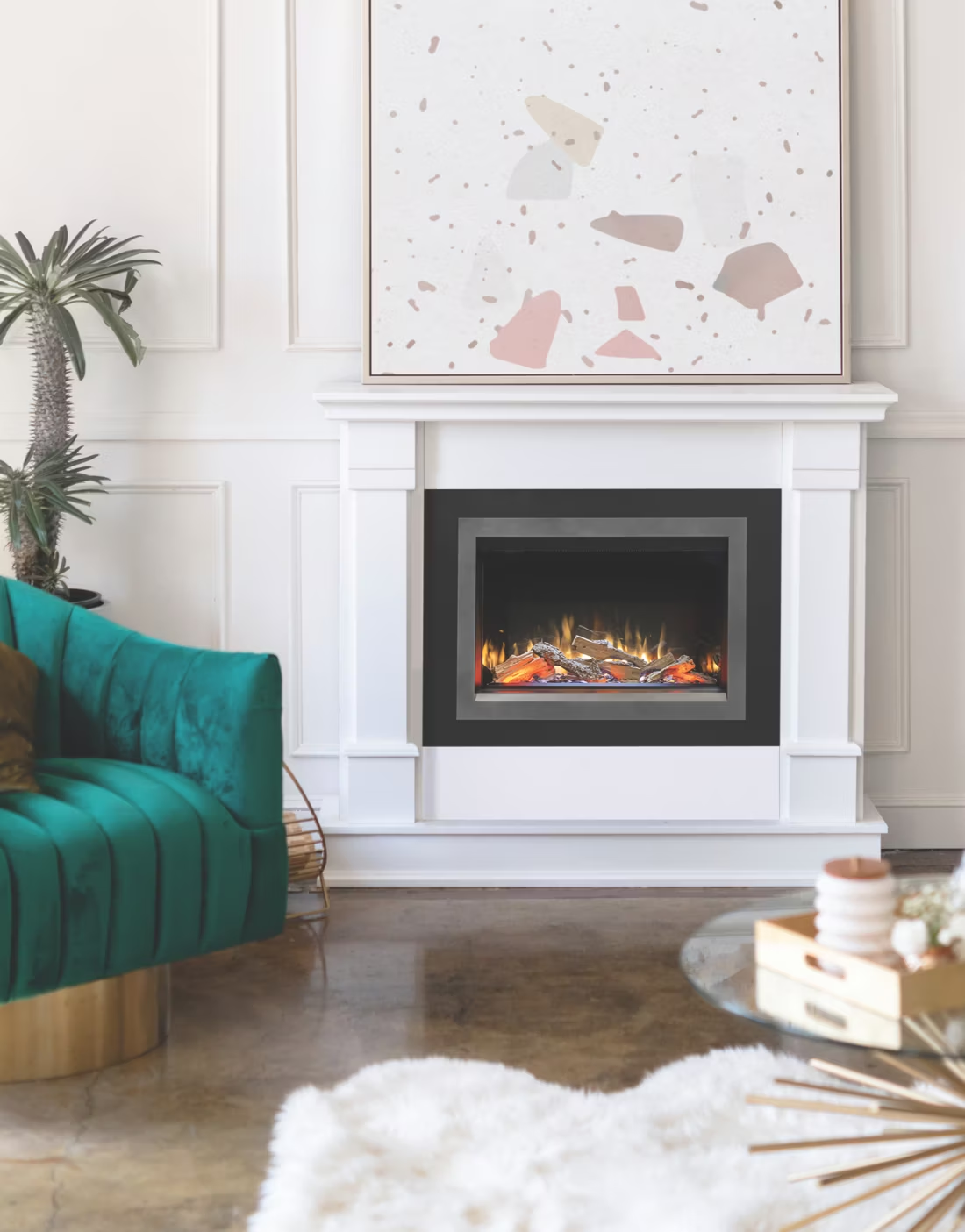
An electric fireplace is usually a built-in unit set into framing or a wall, designed to look like a traditional fireplace. An electric insert is sized to slide into an existing masonry firebox, which is the common route for East Aurora's older homes with dead fireplaces. An electric stove is a freestanding cabinet-style unit, styled like a wood stove, that you can place against nearly any wall with an outlet nearby. All three use the same basic heating elements—the choice mostly comes down to whether you have an existing fireplace opening to fill or a blank wall to work with.
Electric vs. gas—which fits my East Aurora home better?
Gas fireplaces require a gas line and proper venting but deliver real, sustained heat output that can meaningfully offset furnace use during the coldest stretches of an East Aurora winter. Electric fireplaces skip the gas line and venting entirely, install in a fraction of the time, and cost less upfront—but they're realistically zone heat, not a meaningful dent in a long, cold heating season. For a room with an existing gas stub or an easy vent path, gas often makes more sense long-term. For a finished basement, an addition without gas service nearby, or a fireplace opening you just want to bring back to life without construction, electric is usually the simpler, cheaper answer.
What will an electric fireplace actually cost me to run?
Most electric fireplace heaters draw around 1,500 watts on the heat setting. At NYSEG's residential rate of roughly $0.1775 per kWh, that works out to about 27 cents per hour of heater use—call it $2 to $3 for a typical evening with the heat on, closer to pennies an hour if you're just running the flame effect without heat. That's a reasonable cost for supplemental warmth in one room, but it's worth keeping in mind if you're tempted to lean on an electric unit to avoid running your furnace—the math doesn't favor electric resistance heat as a primary source in this climate.
What are good electric fireplace brands for East Aurora homes?
Dimplex and Napoleon both make widely available electric insert and built-in lines that fit standard masonry firebox openings common in East Aurora's older homes—useful since many local fireplaces were built to a handful of typical dimensions. For freestanding stove-style units in additions or basements without an existing firebox, brands like ClassicFlame offer smaller footprints that don't require any construction. A local dealer can measure your specific opening and confirm which trim kit or surround will actually fit before you buy anything.
Do people still use wood stoves in East Aurora instead of electric?
Some do, particularly on larger rural lots toward the Town of Aurora's outer edges where oak, maple, birch, and ash are plentiful and a homeowner might pull a $20-per-cord cutting permit from land like the Allegheny National Forest to the south. But within the village itself, tighter lot lines, insurance considerations, and the lack of a working chimney in many older homes make wood a less practical retrofit than it once was. Electric fills that gap well for village residents—no smoke, no ash, no insurance conversation, and no need for a chimney that may not have been swept in twenty years.
Can I put a TV above my fireplace?
Yes—with an asterisk. Fireplaces are hot and TVs don't like heat. Either put a mantel between them to deflect rising warmth, or choose a fireplace with heat-management technology that creates a cool zone on the wall above—the wall stays around 125 degrees, barely warm, while the room still gets full heat. If you like clean lines and don't want a mantel, heat management is the answer.
Do electric fireplaces actually produce heat?
Yes—most put out around 4,800–5,000 BTUs from a standard outlet, which comfortably warms a bedroom, office, or den as a comfort-zone heater. What they won't do is carry a whole house the way wood, gas, or pellet can. Think of electric as ambiance-first with honest supplemental heat: flames on with no heat in July, flames plus warmth in January.
How much should I budget for a fireplace?
For an average home—covering the fireplace, the vent pipe, and basic installation—a budget between $3,900 and $5,500 gives you a lot of options across wood, gas, and pellet. By the time you add finish work, gas line, and electrical, the average complete installation lands between $5,000 and $12,000 all-in. In a remodel or new build, a good rule is to put about 2.5% of the total project cost toward the fireplace.
Should the dealer who sells my fireplace also install it?
Ideally, yes. A fireplace project involves vent pipe, gas line, electrical, and often tile or stone. Hire three or four separate trades and you own the liability and the game of telephone between them. One company selling and installing means one accountable party, start to finish—ask about factory training, on-time completion records, and what happens if an inspection fails.
Nearby Dealers
Hearth shops serving East Aurora and the surrounding area. Every listing shows whether it is a WhyFire partner, a dealer we have verified as authorized for the brands we recommend, or a local business carrying hearth products. No manufacturer pays for placement. How we verify dealers →
We’ve paused dealer listings for this connection today. Enter your zip or postal code above to find dealers near you, or come back tomorrow.
Popular Electric Brands
Where each brand came from, what's inside it today, and every current model. No brand pays to be here. Not every dealer carries every brand, so enter your zip code to see what's sold near East Aurora.
Fireplace Xtrordinair
Fireplace Xtrordinair, now often called FireplaceX, is the fireplace brand of Travis Industries, Inc., of Mukilteo, Washington.
5 electric models →DaVinci
DaVinci Custom Fireplaces is a brand of Travis Industries, Inc., of Mukilteo, Washington, the company behind Lopi and Fireplace Xtrordinair.
5 electric models →Kozy Heat
Kozy Heat was founded in 1976 by Dudley Hussong in Lakefield, Minnesota, and incorporated as Hussong Manufacturing Co., Inc. in 1978.
3 electric models →Forge & Flame
Forge & Flame is the stove brand Hearth & Home Technologies introduced in August 2023 to bring Vermont Castings, Harman, and Quadra-Fire under one name.
1 electric model →Electric Service in East Aurora
An electric fireplace's heater draws about 1,500 watts—pennies per hour at local rates.
New York State Elec & Gas Corp
Find your electric fireplace in East Aurora.
Tell us a bit about your home and we'll help you find the right electric fireplace, insert, or stove—plus a free Project Guide & Parts List with the exact parts and electrical requirements, and our recommended local dealer in East Aurora.
Find Your Fireplace →