
Instant, elegant heat for Bronxville's historic homes.
On tight village lots where a woodpile and chimney maintenance rarely make sense, a direct-vent gas fireplace delivers real flame and real warmth on demand. We'll help you find a local dealer who knows Bronxville's older housing stock.
Every Project Starts From One of These Five Situations
Direct-vent gas fits Bronxville's compact, historic housing stock.
Bronxville is a half-square-mile village of about 6,570 people, built up mostly in the 1900s–1930s with Tudor Revival and Colonial homes set close together on narrow, walkable streets. With a winter heating season that keeps furnaces working hard for months and a 23°F average winter low, it's genuinely cold—colder than most of the five boroughs, though nothing like Burlington, VT or Duluth, MN. Wood stoves are essentially absent here; between small lots, shared sightlines with neighbors, and a village aesthetic that discourages visible stovepipe or stacked cordwood, homeowners overwhelmingly heat with gas and electric rather than wood.
Con Edison serves Bronxville with both electric and natural gas, so most streets already have gas service available at the curb. That matters because Con Edison's residential electric rate—currently around $0.34/kWh—is high enough that electric resistance heating is rarely used as a primary source; it's mostly reserved for small electric fireplace inserts used for ambiance in bedrooms or dens. Gas, by contrast, is the practical workhorse: a direct-vent gas insert dropped into an existing masonry fireplace in a 1920s Tudor gives you real heat output without asking anyone to maintain a chimney flue for wood.
Three steps. No salesperson until you're ready.
Tell us about your project
Your zip code, your situation, and the fuel you're leaning toward—or let the answers point you to one.
See what's actually available
The brands dealers within 100 miles genuinely carry—real options, never a catalog mirage.
Get your dealer & Project Guide
A trusted local dealer, plus the free Project Guide & Parts List that names every component of the job.
Frequently Asked Questions
How much does a gas fireplace installation cost in Bronxville?
Most gas fireplace and insert installations in Bronxville run from roughly $5,500 to $12,000, depending on the unit and how much gas line and venting work is involved. A gas insert going into an existing masonry fireplace with a stainless liner and a gas line already run to that room sits toward the lower end. New direct-vent construction—punching venting through an exterior wall of an older Tudor or brick Colonial, plus a fresh gas line—runs higher. Homes in Bronxville's local historic district may also need sign-off if the vent termination is visible from the street, which a local installer will factor into the quote.
Can I convert my existing wood-burning fireplace to gas?
Yes, and it's one of the most common projects in Bronxville's prewar housing stock. Many of the village's Tudor and Colonial Revival homes were built with a wood-burning masonry fireplace that's rarely, if ever, used for actual wood fires today. A gas insert with a stainless steel liner run through the existing flue converts that fireplace into a clean, on-demand heat source without changing the room's appearance from the mantel out. Expect the work to fall in the same $5,500–$12,000 range, with the final number depending mostly on whether a new gas line has to be run to that room.
Do I need natural gas, or is propane more common in Bronxville?
Natural gas is the standard here—Con Edison provides gas service throughout the village, and most homes already have a gas meter for heating, hot water, or cooking. That makes adding a gas fireplace straightforward in the vast majority of cases, since there's usually an existing gas line somewhere in the house to tap into. Propane is uncommon in Bronxville and generally only comes up for detached structures or unusual situations where running a new gas line isn't practical.
Will my gas fireplace still work if the power goes out?
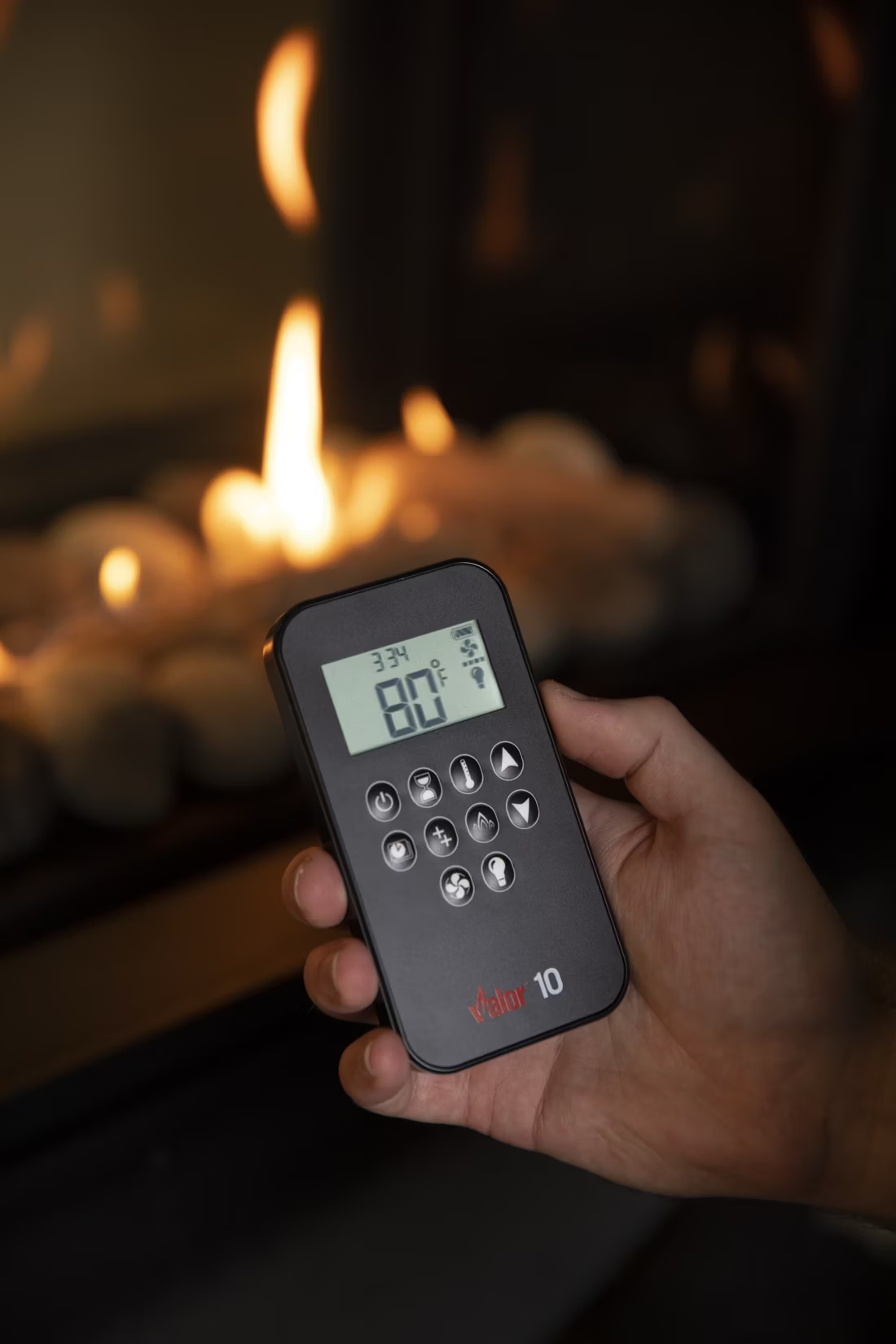
Most modern direct-vent gas fireplaces will, yes. Units with intermittent pilot ignition (IPI) run on a battery backup and light on demand even without grid power—which is worth having, since Bronxville's tree-lined streets mean Con Edison outages do happen during nor'easters and heavy ice storms. Valor's line goes a step further: their pilot assembly generates its own electricity via a thermocouple, so there's no battery to remember to replace. Ask your installer which ignition system a given model uses before you buy.
Gas fireplace vs. gas insert vs. gas stove—which fits my house?
A gas insert slides into an existing masonry fireplace opening and uses the chimney you already have—the natural choice for Bronxville's older homes with a wood-burning firebox that's gone unused for years. A built-in gas fireplace is a fully framed unit, best suited to a renovation or an addition without an existing hearth. A freestanding gas stove sits directly on the floor and vents through a wall or ceiling—less common here given how few Bronxville homes have the open floor plan or clearance a stove needs, but occasionally used in finished basements.
Do I need a permit to install a gas fireplace in Bronxville?
Yes. The Village of Bronxville Building Department requires a permit for gas fireplace installations, and the gas line portion must be done by a licensed gas fitter. If the home sits within Bronxville's local historic district and the venting will be visible from the street or a public way, expect an additional review step before the permit is issued. A local hearth dealer who's worked in the village before will already know which streets fall under that extra layer of review.
What's the difference between vented and vent-free gas fireplaces?
Vented, direct-vent gas fireplaces draw combustion air from outside and exhaust it back outside through sealed venting—they're the standard, code-friendly choice everywhere including Bronxville. Vent-free (ventless) units burn gas directly into the room with no outside venting; New York allows them under specific room-size and ventilation rules, but very few installers in the Bronxville/lower Westchester market recommend them, especially in the kind of smaller, tightly built rooms common in the village's older homes. For nearly every project here, direct-vent is the right call, and it's what local dealers will steer you toward.
How often does a gas fireplace need to be serviced?
Plan on an annual inspection, ideally before the heating season starts. A technician checks the burner, pilot or ignition system, venting, and gas connections, and cleans the glass and interior. Local gas appliance service providers typically charge $150 to $250 for this visit—modest compared to the cost of a burner that's drifted out of adjustment or a venting issue going unnoticed through a Bronxville winter.
Should I go with gas, wood, or electric in a Bronxville home?
Wood is honestly not a realistic option for most Bronxville properties—the village's small, closely spaced lots and historic-district aesthetic mean wood stoves and stacked cordwood are essentially absent, even though oak, maple, birch, and ash are the common firewood species elsewhere in Westchester. Electric fireplaces work fine for ambiance and small supplemental warmth, but Con Edison's roughly $0.34/kWh residential rate makes electric heat expensive to run for real BTU output. That leaves gas as the practical choice for most homes here: instant on-off operation, real heat output, and—in a village full of prewar fireplaces that haven't held a wood fire in decades—a natural upgrade path using the chimney that's already there.
What do I measure to size a fireplace insert?
Four numbers tell you what fits: the front width, the front height, the back width, and the overall depth of your existing fireplace opening. Grab a tape measure, jot those down, and snap a photo of the wall—those two things do more to move your project forward than anything else you can do today.
Does a gas fireplace work when the power is out?
Yes—modern gas fireplaces have a battery backup for the ignition system that lasts for weeks, so no power equals no problem. Your furnace can't say that: no electricity, no blower, no heat. It's one of the most common reasons families add a fireplace, and worth confirming on any model you're considering.
Can a fireplace actually lower my heating bill?
Yes—by creating a comfort zone. A furnace heats every square foot of the house just to warm the one room you're in; a gas fireplace on low burns roughly a sixth of the gas a typical furnace does. Set the furnace around 55–60 degrees as a baseline, then heat the rooms your family actually uses. Families who heat this way commonly save $20–$60 a month.
Does a fireplace add value to my home?
On average, a fireplace adds back to the home about the same amount you spent installing it. Add the monthly savings from heating the rooms you actually use instead of the whole house—often hundreds of dollars a year—and the value case is strong before you even count what a fire does for how your family uses the room.
Nearby Dealers
Hearth shops serving Bronxville and the surrounding area. Every listing shows whether it is a WhyFire partner, a dealer we have verified as authorized for the brands we recommend, or a local business carrying hearth products. No manufacturer pays for placement. How we verify dealers →
We’ve paused dealer listings for this connection today. Enter your zip or postal code above to find dealers near you, or come back tomorrow.
Popular Gas Brands
Where each brand came from, what's inside it today, and every current model. No brand pays to be here. Not every dealer carries every brand, so enter your zip code to see what's sold near Bronxville.
Kozy Heat
Kozy Heat was founded in 1976 by Dudley Hussong in Lakefield, Minnesota, and incorporated as Hussong Manufacturing Co., Inc. in 1978.
28 gas models →Fireplace Xtrordinair
Fireplace Xtrordinair, now often called FireplaceX, is the fireplace brand of Travis Industries, Inc., of Mukilteo, Washington.
25 gas models →Town & Country
Town & Country Fireplaces is the luxury gas fireplace brand of Pacific Energy Fireplace Products Ltd., of Duncan, British Columbia.
14 gas models →Lopi
Lopi is a wood, pellet, and gas stove brand founded by Kurt Rumens in Bellevue, Washington, in 1979.
7 gas models →Forge & Flame
Forge & Flame is the stove brand Hearth & Home Technologies introduced in August 2023 to bring Vermont Castings, Harman, and Quadra-Fire under one name.
6 gas models →Vermont Castings
Vermont Castings was founded in 1975 by Duncan Syme, the designer, and his brother-in-law Murray Howell, the business partner, in Randolph, Vermont.
6 gas models →Find your gas fireplace in Bronxville.
Tell us about your home—including whether you've got an existing masonry fireplace to convert—and we'll put together a free Project Guide & Parts List with the right unit, vent kit, and a trusted local dealer to install it.
Find Your Fireplace →