
No chimney, no gas line, no problem in William Paterson University.
Zone heat and real ambiance for the condos, garden apartments, and campus-area homes around 07470—no venting, no masonry, installed by a trusted local dealer.
Every Project Starts From One of These Five Situations
The easiest fireplace to add to a 07470 home.
The 07470 zip code is built almost entirely around the William Paterson University campus in Wayne Township, Passaic County—a small, dense residential footprint of just over 1,400 people, heavy on faculty housing, garden apartments, and condos rather than detached single-family lots. Winters here average lows around 22 degrees F with a solidly cold winter season, a real New Jersey winter but nowhere near the extremes of a place like Burlington, VT. Air quality concerns are minimal, so there's no wood-smoke curtailment issue to think about here—but the housing stock itself is the bigger factor: many units near campus don't have a chimney, don't allow gas line penetrations, or answer to an HOA that restricts structural changes.
That's exactly where electric fireplaces do their best work. Public Service Electric & Gas (PSE&G) serves the area at a residential rate of about $0.1981 per kWh, which runs above the national average and is worth factoring in if you're weighing electric as a primary heat source versus a supplemental, zone-heating unit for a bedroom, den, or living room. Because electric units need no venting and no gas line—just an outlet or, for larger built-ins, a dedicated circuit—most installations near William Paterson University are done in a single afternoon with none of the permitting or masonry work a wood or gas project would require.
Three steps. No salesperson until you're ready.
Tell us about your project
Your zip code, your situation, and the fuel you're leaning toward—or let the answers point you to one.
See what's actually available
The brands dealers within 100 miles genuinely carry—real options, never a catalog mirage.
Get your dealer & Project Guide
A trusted local dealer, plus the free Project Guide & Parts List that names every component of the job.
Frequently Asked Questions
How much does an electric fireplace installation cost near William Paterson University?
A plug-in electric fireplace or insert that uses an existing outlet typically runs $300 to $1,200 installed, including the unit and any minor trim work. A built-in wall unit or a mantel package with a recessed electric insert—the more common choice for condos and apartments near campus that want a real focal-point fireplace—runs $1,500 to $3,500, with the range driven mostly by whether a licensed electrician needs to run a new dedicated 20-amp circuit and by any custom mantel or surround carpentry. Because there's no venting or gas line to install, electric is consistently the least expensive fireplace category in this zip code.
Do I need a permit to install an electric fireplace in Wayne Township?
A simple plug-in unit that draws from an existing outlet typically doesn't require a permit. If your installer adds a new dedicated circuit or does any panel work, the Wayne Township Building Department requires an electrical permit, which a licensed electrician pulls as part of the job. Since William Paterson University's 07470 zip code is largely condos and rental housing, it's also worth checking with your property manager or HOA before any wall-mounted or built-in installation—even though there's no venting involved, some buildings still require sign-off on wall penetrations for a recessed unit.
What size electric fireplace do I need for a condo or apartment near campus?
Most electric fireplaces are rated to comfortably heat 400 to 1,000 square feet as supplemental zone heat, which covers the typical living room or bedroom in the garden apartments and condos common around William Paterson University. For a single room, a 1,500-watt insert or wall unit is usually enough to take the chill off on a 22-degree night without running your whole HVAC system. If you're hoping to heat an open-concept living/dining space, look for a larger insert or two smaller units rather than expecting one unit to cover it—electric heat output tops out around 5,000 to 5,200 BTU regardless of size or price.
Will an electric fireplace actually lower my heating bill?
It can, but only if you use it the way it's designed to be used—as zone heat for the room you're actually in, with the thermostat for the rest of the house turned down. At PSE&G's residential rate of roughly $0.1981 per kWh, running a 1,500-watt unit for several hours a night costs more per BTU than natural gas, so an electric fireplace isn't the cheapest way to heat an entire home. Where it saves money is letting you stop heating rooms you're not using—a bedroom or den with the fireplace on and the rest of the apartment at a lower setpoint.
What happens to my electric fireplace during a power outage?
It goes off, along with the lights. Unlike a wood stove, an electric fireplace has no battery backup and no way to operate without utility power, which is worth knowing given that PSE&G service in Passaic County can see outages during nor'easters and summer storms. If backup heat during outages matters to you, an electric fireplace should be considered ambiance and supplemental comfort rather than an emergency heat source—a consideration worth discussing with a local dealer if you're deciding between fuel types.
Built-in, insert, or mantel package—what's actually available near William Paterson University?
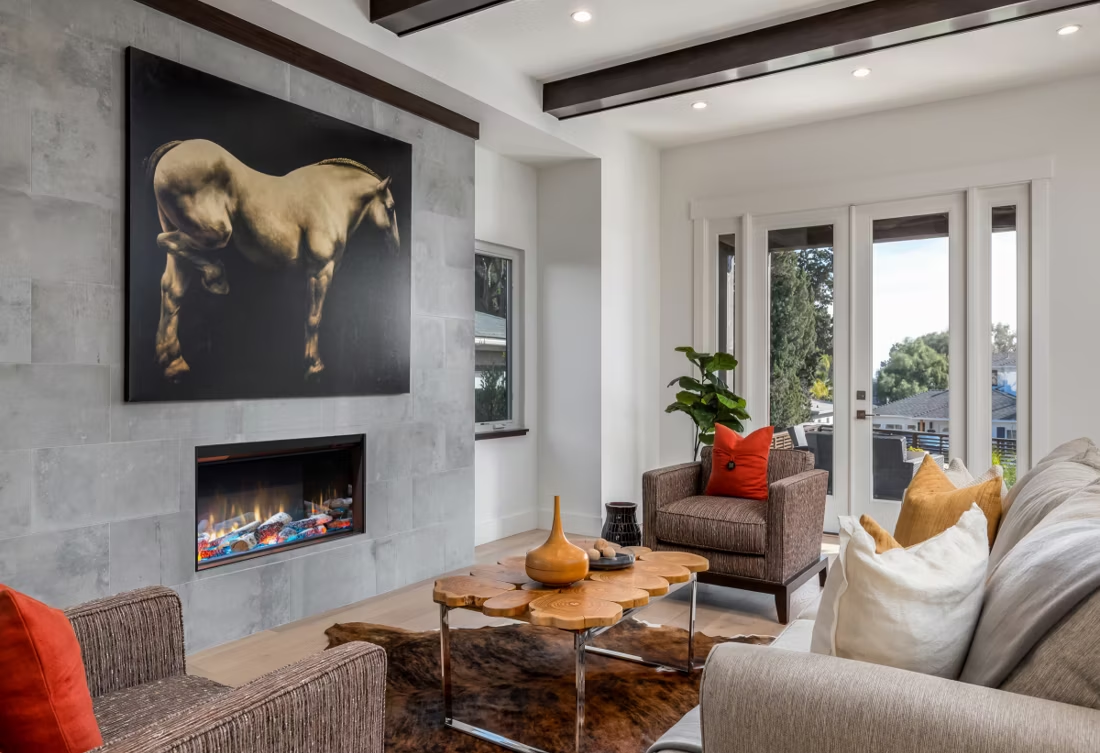
Given the condo- and apartment-heavy housing near campus, the most common installs are recessed wall units set into a stud-wall cavity, or freestanding mantel packages that pair an electric insert with a surround and don't require any wall modification at all—a good option for renters. Built-in linear electric fireplaces are also popular in newer renovations and offer the cleanest, most modern look. A trusted local dealer can walk your specific unit—rental, owned condo, or single-family—and tell you honestly which format fits without a construction project.
How much maintenance does an electric fireplace need?
Very little, which is one of its biggest advantages over wood or gas. There's no chimney to sweep, no annual gas-line inspection, and no ash or soot. Maintenance is limited to occasionally dusting the unit, wiping the glass, and replacing the LED ember bed light (most last 5+ years of typical use) or the internal fan if it eventually wears out. There's no yearly service call required for safety compliance the way there is with a wood stove or gas insert.
Can I install an electric fireplace if my building doesn't allow chimneys or gas lines?
Yes—this is precisely the situation electric fireplaces solve. Because there's no combustion, no venting, and no gas line, electric units are typically allowed in buildings and HOAs near William Paterson University where wood stoves or gas fireplaces would be prohibited or require costly structural work. A plug-in or mantel-package unit needs no building modification at all, and even a recessed wall unit only requires a stud-wall opening and, if needed, a new circuit—both minor compared to running a Class A chimney or a gas line through a shared wall.
Electric vs. gas—which makes more sense for a home in this area?
Gas delivers more heat output and, in a climate this cold, can genuinely offset part of a heating bill—but it requires a gas line, venting, and often a permit through Wayne Township, none of which is realistic in many of the rental and condo units near campus. Electric skips all of that: it installs in an outlet or on a simple dedicated circuit, costs a fraction as much upfront, and works anywhere power reaches. For most 07470 households, especially renters and condo owners, electric is the practical choice; a single-family homeowner with an existing gas line already at the house may find gas worth the extra install cost for real heating capacity.
Can I put a TV above my fireplace?
Yes—with an asterisk. Fireplaces are hot and TVs don't like heat. Either put a mantel between them to deflect rising warmth, or choose a fireplace with heat-management technology that creates a cool zone on the wall above—the wall stays around 125 degrees, barely warm, while the room still gets full heat. If you like clean lines and don't want a mantel, heat management is the answer.
Does an electric fireplace need a vent or chimney?
No—that's its superpower. An electric fireplace needs a wall and an outlet, period. No vent pipe, no gas line, no clearances to design around, which is why it works in bedrooms, offices, apartments, and walls where venting a gas or wood unit would be impractical or impossible. Installation is typically the simplest and least expensive of any fireplace type.
Can a fireplace actually lower my heating bill?
Yes—by creating a comfort zone. A furnace heats every square foot of the house just to warm the one room you're in; a gas fireplace on low burns roughly a sixth of the gas a typical furnace does. Set the furnace around 55–60 degrees as a baseline, then heat the rooms your family actually uses. Families who heat this way commonly save $20–$60 a month.
How much should I budget for a fireplace?
For an average home—covering the fireplace, the vent pipe, and basic installation—a budget between $3,900 and $5,500 gives you a lot of options across wood, gas, and pellet. By the time you add finish work, gas line, and electrical, the average complete installation lands between $5,000 and $12,000 all-in. In a remodel or new build, a good rule is to put about 2.5% of the total project cost toward the fireplace.
Nearby Dealers
Hearth shops serving William Paterson University of New Jersey and the surrounding area. Every listing shows whether it is a WhyFire partner, a dealer we have verified as authorized for the brands we recommend, or a local business carrying hearth products. No manufacturer pays for placement. How we verify dealers →
Kjb Fireplaces
Mcnamara Fireplace And Stove
Fireplaces By Design
Flue Tech
Light N Grid
Chimney Sweep Energy Barn
County Woodstoves Inc
Fire Design
N & N Services
Westchester Fireplace
Big Apple Fireplaces
Harris Hearth And Home
Timberline Speciality Products
Timberline Stoves
Fireplaces R Us
Valley Mason Supply
Hot Concepts Fireplaces
Paradise Pool & Spa Inc.
Costello's Hearth & Spa - Bernardsville
Electric Service in William Paterson University of New Jersey
An electric fireplace's heater draws about 1,500 watts—pennies per hour at local rates.
Public Service Elec & Gas Co
Find your electric fireplace in William Paterson University.
Tell us a bit about your space and we'll match you with the right electric fireplace, insert, or wall unit—plus a free Project Guide & Parts List and a trusted local dealer near Wayne to install it.
Find Your Fireplace →