
Instant Heat for Ocean County's Long Winters.
Vista Center's heating season rivals much colder inland regions, with winter lows near 23°F. A properly sized gas fireplace or insert gives you real heat at the flip of a switch—find the right unit and a trusted local dealer to install it.
Every Project Starts From One of These Five Situations
Consistent warmth without tending a fire.
Vista Center sits on the flat coastal plain of Jackson Township at just 120 feet of elevation, but that low elevation doesn't mean a mild winter—the area still racks up a heating season on par with much colder inland regions, with average winter lows around 23°F. That's a meaningfully colder season than most of the Jersey Shore, closer to what homes further inland deal with, and it's enough to make supplemental zone heat a real line item in most household budgets from November through March.
New Jersey Natural Gas serves most of the developed parts of Jackson Township, including the neighborhoods around Vista Center, which makes a direct-vent gas fireplace or insert a practical option for most homeowners here—no chimney maintenance, no fuel storage, and heat that starts working the moment you need it. For the more rural pockets toward the Pine Barrens edge where gas mains don't reach, propane fills the same role. Either way, a well-matched gas unit turns an underused living room fireplace into the room's actual heat source on a cold night, and it keeps working even when the power blinks during a winter nor'easter—assuming you pick a model with the right ignition system.
Three steps. No salesperson until you're ready.
Tell us about your project
Your zip code, your situation, and the fuel you're leaning toward—or let the answers point you to one.
See what's actually available
The brands dealers within 100 miles genuinely carry—real options, never a catalog mirage.
Get your dealer & Project Guide
A trusted local dealer, plus the free Project Guide & Parts List that names every component of the job.
Frequently Asked Questions
How much does a gas fireplace installation cost in Vista Center?
Most gas fireplace and insert installations in the Jackson Township area run somewhere between $4,000 and $10,000, depending on the unit, the venting path, and whether new gas line work is needed. A direct-vent insert going into an existing masonry fireplace with a gas line already nearby sits toward the lower end. A new built-in unit for a room without an existing fireplace—where framing, venting, and a fresh gas line run all have to happen—lands in the middle to upper end. Homes relying on propane instead of New Jersey Natural Gas service sometimes add cost for tank placement. A local retailer will give you a firm number after seeing the space.
Can I convert my existing wood-burning fireplace to gas?
Yes, and it's a common project for older homes in and around Vista Center that still have a masonry fireplace built for wood but rarely use it. A gas insert typically runs through the existing chimney with a stainless liner, so you keep the look of the original fireplace while gaining real, controllable heat output. Expect $4,500 to $9,000 for the conversion depending on the insert model and whether the home already has a gas line nearby. If you're on New Jersey Natural Gas service, this is usually the more straightforward and less expensive path compared to a propane setup.
Do I need natural gas, or can I run a fireplace on propane?
Either works, and which one makes sense mostly comes down to where in Jackson Township you're located. New Jersey Natural Gas reaches most of the developed area around Vista Center, so if your home already has a gas water heater, range, or furnace, adding a fireplace is a relatively simple tie-in. For homes on the fringes near the Pine Barrens where gas mains don't run, propane is the standard fallback—either from an existing tank or a new one set by a local propane supplier. Nearly every gas fireplace or insert sold locally can be configured for either fuel; your installer sets the correct orifice and regulator for whichever you have.
Will a gas fireplace still work if the power goes out?
Most modern gas fireplaces will, which matters here—Jersey Central Power & Light outages aren't unusual in Ocean County during nor'easters and summer storms. Units with IPI (intermittent pilot ignition) run on small internal batteries that kick in automatically when the power drops, so the fireplace still lights on demand. You just have to remember to keep those batteries fresh. Valor fireplaces handle this differently: their pilot assembly generates its own electricity through a thermocouple, so there's no battery to forget at all. If backup heat during an outage is a priority for your home, ask specifically about the ignition system before you buy.
What's the difference between a gas fireplace, gas insert, and gas stove?
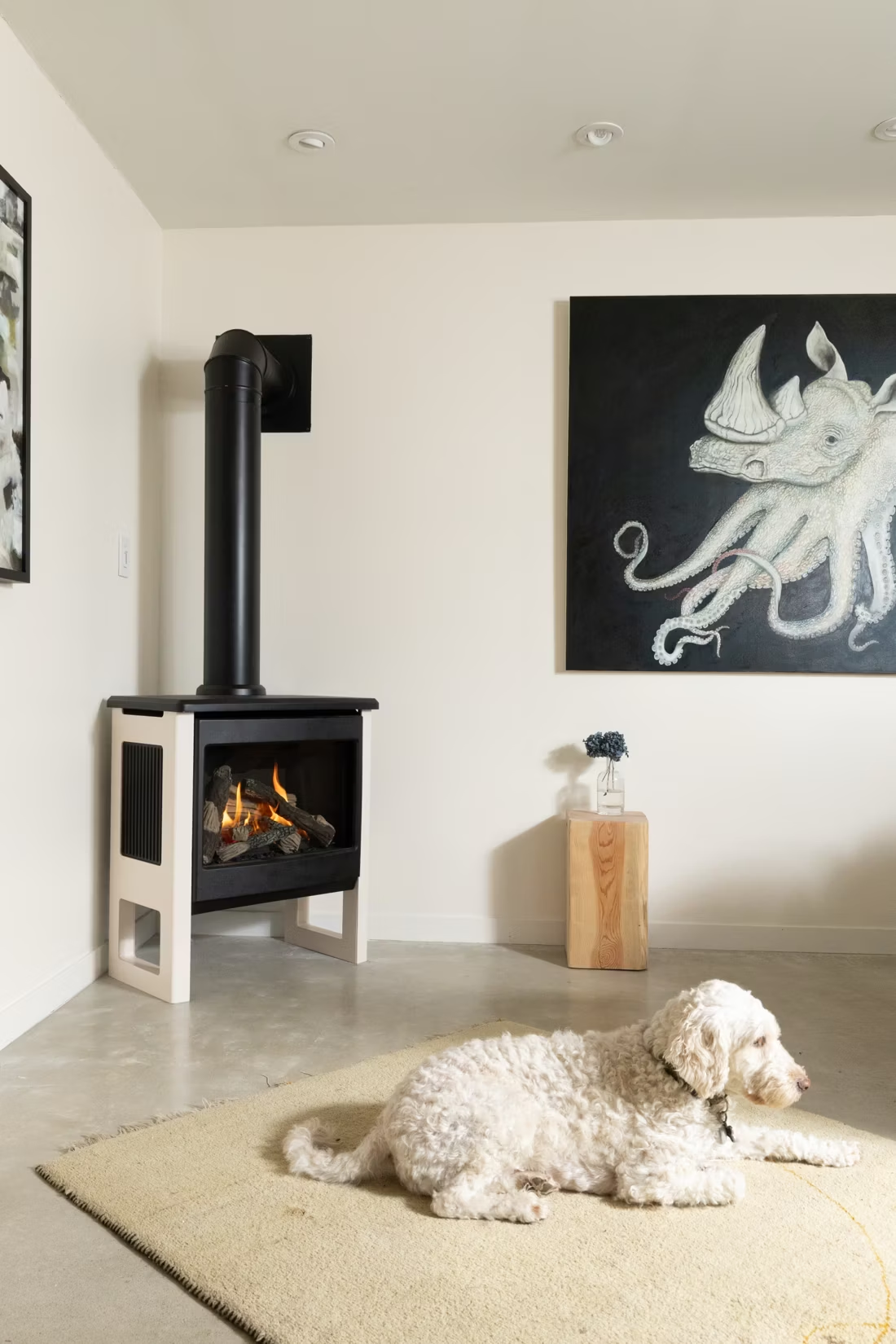
A gas fireplace is a fully built-in unit framed into a wall—the right call for new construction or a remodel where there's no existing fireplace opening. A gas insert is sized to slide into an existing masonry firebox, sealing it up and using the chimney as the vent path, which is the more common project for older Vista Center homes with a fireplace they don't use anymore. A gas stove is a freestanding cast-iron or steel unit that sits on the floor like a wood stove but burns gas—a good option when you want a stove's look and radiant feel without an existing masonry opening to work with.
Do I need a permit to install a gas fireplace in Vista Center?
Yes. Jackson Township requires a construction permit for gas fireplace installations, along with a separate gas line permit if new piping is being run to the unit. The gas line work has to be done by a licensed gas fitter, which is one of the main reasons to go through a certified hearth dealer rather than a general handyman—they coordinate the gas line, venting, and inspection sign-off as one job instead of leaving you to manage separate trades and separate permit applications.
What's the difference between vented and vent-free gas fireplaces?
Vented (direct-vent) gas fireplaces pull combustion air from outside and exhaust it back outside through a sealed pipe, so nothing from the fire ends up in your living space. Vent-free units burn directly into the room with no external venting at all—more efficient on paper, but they release some water vapor and combustion byproducts into the air you're breathing. New Jersey's construction code is stricter than many states on vent-free installations, with tight limits on room size, oxygen depletion sensors, and where they can be used, and plenty of local jurisdictions won't sign off on them at all. For that reason, nearly every installer working around Vista Center defaults to direct-vent units, and that's the option worth planning around unless your dealer tells you otherwise.
How often does a gas fireplace need to be serviced?
Plan on an annual inspection, ideally before the first cold snap in late fall. A technician checks the burner, pilot assembly, venting, and gas connections, and cleans the glass and firebox interior—it's a much smaller job than a wood chimney sweep, but skipping it is how you end up with a pilot that won't hold or a fireplace that trips its safety shutoff mid-winter. Most gas service providers serving Ocean County charge somewhere in the $150 to $250 range for a standard annual visit.
Should I go with gas instead of a wood-burning fireplace?
For most homes in Vista Center, yes. Wood heat isn't common here the way it is further inland or upstate—most local homes rely on gas or oil as primary heat, and firewood culture (oak, hickory, and maple are the common regional species) tends to show up more as an occasional backyard fire pit than a heating strategy. Gas gives you instant, thermostat-controlled heat with no ash, no chimney sweeping, and no wood storage, which fits how most homes here are actually built and used. If you already have a masonry fireplace and want the ambiance of real wood on occasion, that's a valid reason to keep it—but as a heat source for a New Jersey winter, gas is the more practical fit for the vast majority of Vista Center homeowners.
Can I put a TV above my fireplace?
Yes—with an asterisk. Fireplaces are hot and TVs don't like heat. Either put a mantel between them to deflect rising warmth, or choose a fireplace with heat-management technology that creates a cool zone on the wall above—the wall stays around 125 degrees, barely warm, while the room still gets full heat. If you like clean lines and don't want a mantel, heat management is the answer.
What's the difference between radiant and convective fireplace heat?
Most fireplaces are a thin metal box—they heat fine, but you rely on the fan to move the warmth into the room. Radiant models use a thick cast-ceramic firebox, about an inch and a quarter thick, that soaks up the fire's heat and radiates roughly 25–30% more warmth into the room with no fan running. If you watch TV in the same room or want heat in a power outage, radiant is worth asking about.
Does a fireplace add value to my home?
On average, a fireplace adds back to the home about the same amount you spent installing it. Add the monthly savings from heating the rooms you actually use instead of the whole house—often hundreds of dollars a year—and the value case is strong before you even count what a fire does for how your family uses the room.
Can I install a fireplace myself?
If you're putting a fire in your house on purpose, it's best to work with an expert. Unless you're genuinely experienced in framing, gas line, vent pipe, and the national code on clearances to combustibles, have a professional do it—and ideally the same company that sells you the fireplace, so warranty, service, and liability all live under one roof.
Nearby Dealers
Hearth shops serving Vista Center and the surrounding area. Every listing shows whether it is a WhyFire partner, a dealer we have verified as authorized for the brands we recommend, or a local business carrying hearth products. No manufacturer pays for placement. How we verify dealers →
We’ve paused dealer listings for this connection today. Enter your zip or postal code above to find dealers near you, or come back tomorrow.
Popular Gas Brands
Where each brand came from, what's inside it today, and every current model. No brand pays to be here. Not every dealer carries every brand, so enter your zip code to see what's sold near Vista Center.
Kozy Heat
Kozy Heat was founded in 1976 by Dudley Hussong in Lakefield, Minnesota, and incorporated as Hussong Manufacturing Co., Inc. in 1978.
28 gas models →Fireplace Xtrordinair
Fireplace Xtrordinair, now often called FireplaceX, is the fireplace brand of Travis Industries, Inc., of Mukilteo, Washington.
25 gas models →Town & Country
Town & Country Fireplaces is the luxury gas fireplace brand of Pacific Energy Fireplace Products Ltd., of Duncan, British Columbia.
14 gas models →Lopi
Lopi is a wood, pellet, and gas stove brand founded by Kurt Rumens in Bellevue, Washington, in 1979.
7 gas models →Forge & Flame
Forge & Flame is the stove brand Hearth & Home Technologies introduced in August 2023 to bring Vermont Castings, Harman, and Quadra-Fire under one name.
6 gas models →Vermont Castings
Vermont Castings was founded in 1975 by Duncan Syme, the designer, and his brother-in-law Murray Howell, the business partner, in Randolph, Vermont.
6 gas models →Find your gas fireplace in Vista Center.
Tell us a bit about your home and we'll put together a free Project Guide & Parts List—the exact parts, vent kit, and a trusted local dealer to install your gas fireplace or insert.
Find Your Fireplace →