
Real ambiance for Union County homes, no chimney required.
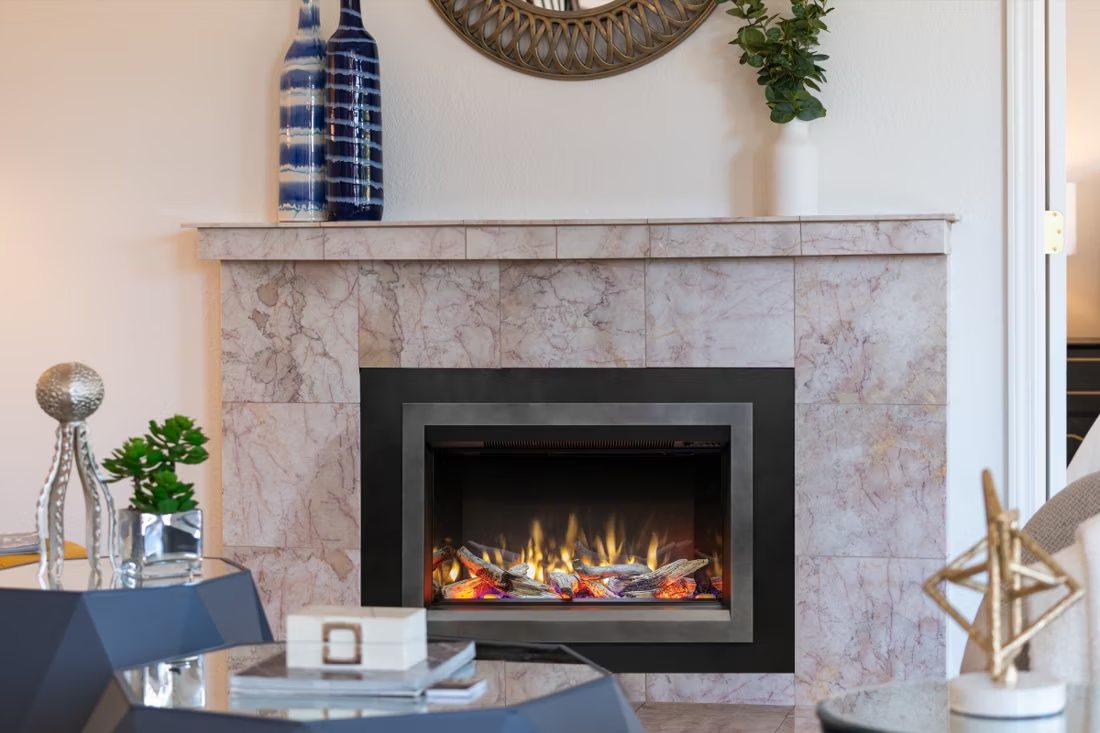
From Elizabeth high-rises to Westfield colonials, electric fireplaces give Union County homeowners a fast, flame-effect upgrade without venting, gas lines, or masonry work. Get matched with a trusted local dealer.
Every Project Starts From One of These Five Situations
A mild winter climate with a housing stock built for plug-in heat.
Union County sits in climate zone 4A with a winter about as demanding as a typical mid-Atlantic season and average winter lows around 26°F—a moderate cold, nothing close to the sub-zero stretches you'd see in Duluth or Burlington. That means an electric fireplace here isn't fighting to be a primary heat source; it's doing exactly what it's built for: supplemental warmth in a den or bedroom, ambiance in a living room, and zone heat for the rooms people actually occupy on a 30-degree evening. Union County's mix of housing—dense multi-family buildings in Elizabeth and Union Township, condos and townhomes in Cranford and Rahway, and older single-family homes in Westfield and Summit—lines up well with electric units, since most installs need nothing more than an existing outlet or a straightforward 120V or 240V circuit.
This is also a market where wood and pellet heat make little practical sense—there's no meaningful cutting or foraging tradition in this densely populated part of New Jersey, and air quality here isn't the constraint it is in other regions, so there's no local push toward wood-burning as an alternative. Electric fills a real gap instead: it works in condo association buildings and rental units where a masonry chimney or gas line isn't an option, it satisfies the fire-code restrictions common in multi-family construction throughout the county, and it lets homeowners add a fireplace to a room that was never built for one—a finished basement, a converted attic bedroom, an interior wall with no flue access at all.
Three steps. No salesperson until you're ready.
Tell us about your project
Your zip code, your situation, and the fuel you're leaning toward—or let the answers point you to one.
See what's actually available
The brands dealers within 100 miles genuinely carry—real options, never a catalog mirage.
Get your dealer & Project Guide
A trusted local dealer, plus the free Project Guide & Parts List that names every component of the job.
Frequently Asked Questions
How much does an electric fireplace installation cost in Union County?
Most electric fireplace installations in Union County run $400 to $1,200. A plug-in insert or wall-mount unit on a standard 120V outlet sits at the low end—often just the cost of the unit plus mounting. Built-in units that require a dedicated 240V circuit, in-wall recessed installation, or an electrician to run new wiring land at the higher end, especially in older Westfield or Summit homes with older panels that may need a load assessment first. Condo and co-op installs in Elizabeth or Union Township sometimes carry an added step for building approval, but the electrical work itself is typically less involved than a gas or wood project since there's no venting to design.
Do electric fireplaces actually put out heat, or are they just for looks?
They put out real heat—most units are rated for 4,000 to 5,000 BTU, enough to noticeably warm a single room in the 26°F average lows Union County sees in the depth of winter. They won't replace a furnace for a whole house, but as supplemental heat in a bedroom, home office, or finished basement, they perform well. The flame effect and the heat function operate independently on most models, so you can run the visual with the heater off in shoulder-season months—useful in a county where a lot of the year sits in that 40s-to-60s range where you want the ambiance but not the extra warmth.
Can I install an electric fireplace in a condo or apartment in Union County?
In most cases, yes—and this is one of the biggest reasons electric is popular in the denser parts of the county like Elizabeth, Union Township, and Rahway. Because there's no venting, chimney, or gas line involved, electric units generally sidestep the fire-code and structural restrictions that make wood or gas fireplaces difficult or impossible in multi-family buildings. That said, condo associations and co-op boards sometimes have their own rules about wall modifications or dedicated circuits for built-in units, so it's worth checking your building's bylaws before a recessed installation. Plug-in freestanding or wall-mount units typically require no approval at all.
What's the difference between a plug-in electric fireplace and a built-in unit?
A plug-in unit—a freestanding stove-style model, a wall-mount, or a mantel insert—runs on a standard 120V household outlet and can usually be set up in an afternoon with no electrician involved. A built-in unit is recessed into a wall or custom surround, often requires a dedicated circuit (sometimes 240V for larger units), and needs a licensed electrician for the wiring even though there's no venting to install. For renters or condo owners in Union County who want flexibility, plug-in units are the easier path. For homeowners doing a basement finish or room addition in places like Cranford or Springfield, a built-in unit integrated into new construction tends to look more intentional and can be planned alongside the electrical rough-in.
Is wood or pellet heat an option anywhere in Union County?
Realistically, not much of one. Union County is one of the most densely populated parts of New Jersey, with no meaningful tradition of cutting or sourcing firewood locally and no regional infrastructure built around it—a stark contrast to rural counties where oak, hickory, and maple are staples of a wood-heat culture. A small number of older single-family homes, particularly in Westfield, Summit, or Mountainside, do have existing wood-burning fireplaces that homeowners keep for occasional use, but new wood stove installations are rare here. Pellet stoves face a similar gap—while brands like Energex and Hamer Pellet Fuel are available regionally, there's little local demand or dealer support for new pellet installations in this market. Electric and gas are the fuels that actually make sense for most Union County homeowners.
Do I need a permit for an electric fireplace in Union County?
Simple plug-in units generally don't require a permit since there's no structural, gas, or venting work involved. Built-in installations that require new electrical circuits typically do need an electrical permit, pulled by your licensed electrician as part of the job—this is standard practice and most installers handle it without you needing to coordinate anything separately. If you're in a condo or multi-family building anywhere from Elizabeth to Roselle, check with your building or HOA as well, since some require sign-off on wall modifications even when the municipality doesn't.
Will an electric fireplace work during a power outage?
No—this is the one real tradeoff. Because electric units run entirely on household power, they shut off the moment the power does, unlike a wood stove or a battery-backed gas fireplace with IPI ignition. For Union County, where outages tend to be short-duration storm events rather than the multi-day cold-season outages you'd see somewhere like rural Vermont, most homeowners treat this as an acceptable tradeoff for the convenience and lack of venting. If backup heat during outages is a priority, that's worth discussing with a local dealer who can walk you through gas alternatives with battery-backed ignition.
What size electric fireplace do I need for my room?
For ambiance-focused use, sizing is mostly about matching the unit width to your wall or mantel opening—most manufacturers list recommended room square footage on the spec sheet. For supplemental heat, a 4,000-5,000 BTU unit comfortably takes the edge off a 200-to-400-square-foot room during Union County's colder stretches. Larger open-concept living rooms, common in some of the newer construction around Berkeley Heights and New Providence, may need a higher-BTU unit or a second heat source to feel the difference. A local dealer can walk through your room dimensions and recommend a specific model rather than relying on generic size charts.
Electric vs. gas—which is right for my Union County home?
Gas delivers more real heat output, a more authentic flame, and—with battery-backed ignition on many models—continued operation during a power outage, but it requires venting or a gas line and a more involved installation. Electric is simpler and cheaper to install, works in condos and rentals where gas or venting isn't feasible, and gives you flame-effect ambiance with zero combustion byproducts, but it won't function without power and tops out around 5,000 BTU. For a Westfield or Summit single-family home already on natural gas, a gas insert is often worth the extra installation complexity. For a condo in Elizabeth, a rental in Rahway, or a basement room with no flue access, electric is usually the more practical answer. A local dealer can lay out both options for your specific space.
Does an electric fireplace need a vent or chimney?
No—that's its superpower. An electric fireplace needs a wall and an outlet, period. No vent pipe, no gas line, no clearances to design around, which is why it works in bedrooms, offices, apartments, and walls where venting a gas or wood unit would be impractical or impossible. Installation is typically the simplest and least expensive of any fireplace type.
Do electric fireplaces actually produce heat?
Yes—most put out around 4,800–5,000 BTUs from a standard outlet, which comfortably warms a bedroom, office, or den as a comfort-zone heater. What they won't do is carry a whole house the way wood, gas, or pellet can. Think of electric as ambiance-first with honest supplemental heat: flames on with no heat in July, flames plus warmth in January.
Can I install a fireplace myself?
If you're putting a fire in your house on purpose, it's best to work with an expert. Unless you're genuinely experienced in framing, gas line, vent pipe, and the national code on clearances to combustibles, have a professional do it—and ideally the same company that sells you the fireplace, so warranty, service, and liability all live under one roof.
Does a fireplace add value to my home?
On average, a fireplace adds back to the home about the same amount you spent installing it. Add the monthly savings from heating the rooms you actually use instead of the whole house—often hundreds of dollars a year—and the value case is strong before you even count what a fire does for how your family uses the room.
Get your Union County electric fireplace Project Guide & Parts List.
Tell us about your room and your electrical setup, and we'll match you with a trusted local Union County dealer plus a free Project Guide & Parts List—the right unit, the wiring requirements, and what it'll take to get it installed.
Find Your Fireplace →