
Fireplaces, Matched to Your Union County Home.
Fireplace resources for every town in Union County—from Elizabeth to Berkeley Heights—plus honest guidance if you're one of the few homeowners with an existing wood-burning masonry fireplace. Get matched with a trusted local hearth retailer who knows what's actually installable in your neighborhood.
Every Project Starts From One of These Five Situations
Dense NY-suburb living, gas-first heating in Union County, New Jersey.
Union County packs more than 407,000 people into roughly 103 square miles between Newark Liberty International Airport and the New York City skyline—one of the most densely built counties in New Jersey. Climate zone 4A brings a real but moderate heating season: 4,701 heating degree days and average winter lows around 26°F. That's a fraction of what a place like Burlington, VT sees each winter (closer to 7,500 HDD), which is part of why this county never developed a wood-heat culture the way colder, more rural regions did. PSE&G's gas and electric infrastructure runs under nearly every street here, and that existing network, more than the weather, shapes what homeowners actually install.
Oak, hickory, and maple grow throughout the county's parks and older residential lots, and a handful of homeowners with legacy masonry fireplaces in towns like Westfield or Summit still burn a cord or two a winter for ambiance. But most Union County municipalities—from Elizabeth's rowhome blocks to Linden's and Roselle's tight residential lots—simply don't have the clearances or storage space a modern wood or pellet installation needs. That's why wood and pellet are flagged as rare on this hub rather than treated as mainstream options. What you'll actually find here: gas fireplace and gas insert retailers, electric fireplace dealers, service technicians, and utility information covering all 21 municipalities in the county—Elizabeth, Plainfield, Rahway, Union Township, Cranford, Westfield, Summit, and everywhere in between.
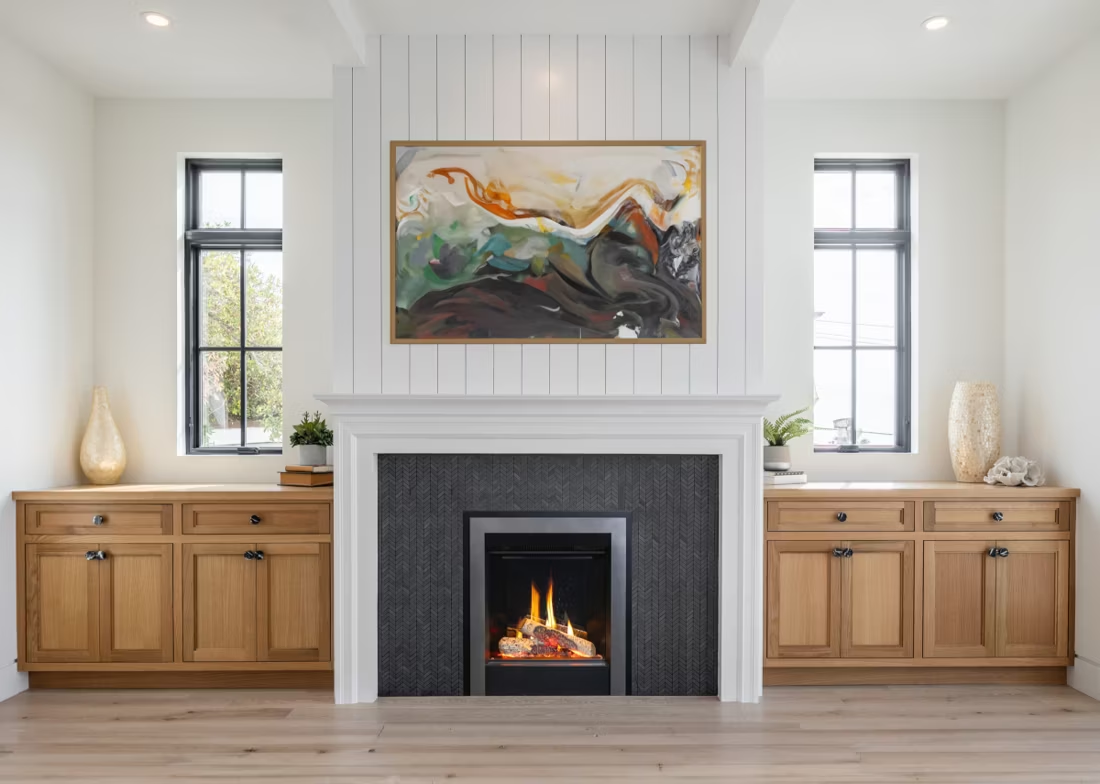
Four fuels. One honest answer for Union County.
Three steps. No salesperson until you're ready.
Tell us about your project
Your zip code, your situation, and the fuel you're leaning toward—or let the answers point you to one.
See what's actually available
The brands dealers within 100 miles genuinely carry—real options, never a catalog mirage.
Get your dealer & Project Guide
A trusted local dealer, plus the free Project Guide & Parts List that names every component of the job.
Frequently Asked Questions
Which fuel works best in Union County?
For the overwhelming majority of Union County homeowners, gas is the practical answer. PSE&G's gas distribution network already runs under nearly every street from Elizabeth to Berkeley Heights, which makes a gas fireplace or insert straightforward to hook up and cheap to run compared to alternatives. Electric fireplaces are the strong second choice—especially in Plainfield and Elizabeth apartments and condos where venting a gas or wood appliance isn't an option, or as supplemental heat in a finished basement in Cranford or Rahway. Wood is genuinely rare here: a small number of older single-family homes in towns like Westfield or Summit still have working masonry fireplaces and burn local oak, hickory, or maple for occasional ambiance, but almost no one is installing a new wood stove given the moderate 4,701 HDD winters and the lack of storage space on typical Union County lots. Pellet stoves are close to nonexistent—regional brands like Energex and Hamer Pellet Fuel exist for the occasional Mountainside or Berkeley Heights homeowner with more land, but it's not a category most local retailers stock heavily.
Do I need a permit to install a fireplace in Union County?
Yes, in most cases. New Jersey's Uniform Construction Code applies here, and permits for gas fireplaces, gas inserts, and gas stoves are issued through your individual municipal building department—Elizabeth, Plainfield, Union Township, and the other towns each run their own construction office rather than going through a single countywide desk. Gas line work requires a licensed New Jersey gas contractor and a separate inspection before the unit can be lit. Electric fireplaces generally don't need a permit for plug-in units, but a built-in electric fireplace that involves new wiring or a dedicated circuit does. If you're one of the rare Union County homeowners installing a wood-burning insert into an existing masonry chimney, your municipality will still require a permit and a chimney inspection. Most local retailers handle the permit filing as part of the installation quote, so it's worth asking upfront.
Are there air quality restrictions on wood burning in Union County?
Not in the way you'd see in a basin or mountain-valley community—Union County doesn't sit in the kind of terrain that traps winter inversions, and wood burning is uncommon enough here that the county has no formal advisory program. That said, several of the more densely built municipalities, including Elizabeth, Linden, and Roselle, have local nuisance and smoke ordinances that can apply to any solid-fuel appliance, particularly in attached or closely spaced housing. If you're one of the few homeowners with a working masonry fireplace or considering a wood insert, it's worth a quick call to your town's code enforcement office before burning regularly, especially if you have neighbors close by.
Can one local retailer handle gas and electric, and what about a rare wood or pellet request?
Most Union County hearth retailers built their showrooms around gas fireplace lines and electric units, because that's what the overwhelming majority of local customers are shopping for. Several can special-order a wood-burning insert for an existing masonry chimney in a Westfield or Summit colonial, but don't expect a running wood display like you'd find in a more rural, wood-heating county—it's simply not the demand here. Pellet stoves are handled even less commonly; if you specifically want one, ask upfront which retailers can source Energex, Hamer Pellet Fuel, or Greene Team Pellet Fuel product and install it, since it's a special-order category rather than a stocked line.
How does service scheduling work across Union County's towns?
Union County's compact geography—about 103 square miles from Elizabeth to Berkeley Heights—means service technicians based centrally, often near Cranford or Union Township, typically reach any municipality in the county within a 20-30 minute drive. That's a much tighter radius than you'd see in a sprawling rural county, so gas fireplace service calls and electric fireplace repairs generally get scheduled faster and without a travel surcharge. If you do have an older masonry wood fireplace, chimney sweeps covering Union County are fewer in number than gas techs, so it's worth booking annual inspection appointments in late summer before the fall rush.
What's the typical cost range for gas and electric fireplace installation in Union County?
Gas fireplace, insert, or stove installation typically runs $4,000-$10,000 depending on whether you're converting an existing masonry fireplace to a gas insert (lower end) or running new gas line and venting for a new-construction install (higher end)—labor rates in the NY metro area push costs slightly above what you'd see in less dense parts of New Jersey. Electric fireplace units run $250-$3,500 for the unit itself, plus $400-$1,500 in labor for anything beyond plug-and-play, which covers most wall-mount and built-in installations. Wood insert installation into an existing chimney, for the rare homeowner who wants it, generally runs $4,500-$8,000 including chimney relining. Pellet stove installs are infrequent enough locally that most retailers quote them case by case rather than off a standard rate card.
Wood, gas, pellet, or electric—how do I choose?
Match the fuel to your life, not the other way around. Wood: lowest fuel cost and total power-outage independence, but you're hauling and stacking. Gas: press a button, set a thermostat, no maintenance to speak of. Pellet: wood economics with automatic feeding, in exchange for weekly cleaning and a need for electricity. Electric: plugs in anywhere with honest supplemental heat. Nobody regrets the fuel that fits how they actually live.
Can I install a fireplace myself?
If you're putting a fire in your house on purpose, it's best to work with an expert. Unless you're genuinely experienced in framing, gas line, vent pipe, and the national code on clearances to combustibles, have a professional do it—and ideally the same company that sells you the fireplace, so warranty, service, and liability all live under one roof.
How much should I budget for a fireplace?
For an average home—covering the fireplace, the vent pipe, and basic installation—a budget between $3,900 and $5,500 gives you a lot of options across wood, gas, and pellet. By the time you add finish work, gas line, and electrical, the average complete installation lands between $5,000 and $12,000 all-in. In a remodel or new build, a good rule is to put about 2.5% of the total project cost toward the fireplace.
Can a fireplace actually lower my heating bill?
Yes—by creating a comfort zone. A furnace heats every square foot of the house just to warm the one room you're in; a gas fireplace on low burns roughly a sixth of the gas a typical furnace does. Set the furnace around 55–60 degrees as a baseline, then heat the rooms your family actually uses. Families who heat this way commonly save $20–$60 a month.
Stove and Fireplace Dealers in Union County
Listings include WhyFire partner dealers, dealers we have verified as authorized for the brands we recommend, and established local businesses that carry hearth products. Every listing shows which one it is. The ones marked Preferred run on WhyFire's software, so they can show you real pricing and book your appointment right here. No manufacturer pays for placement. How we verify dealers →
Fireplaces R Us
Hot Concepts Fireplaces
Harris Hearth And Home
Costello's Hearth & Spa - Bernardsville
Fire Design
D & D Design Center
Timberline Speciality Products
Timberline Stoves
Big Apple Fireplaces
Find your fireplace dealer in Union County.
Tell us about your Union County home and we'll match you with a trusted local dealer and send you a free Project Guide & Parts List—the exact parts, including the vent kit, and the recommended local dealer for your gas or electric fireplace project.
Find Your Fireplace →