
Add fireplace ambiance near Busch Campus—no chimney required.
For the apartments, rentals, and postwar homes that make up most of the 08854 corridor, an electric fireplace adds real heat and flame-look ambiance without a gas line, a chimney, or a landlord's blessing.
Every Project Starts From One of These Five Situations
The easiest fireplace upgrade for campus-area housing.
Busch Campus sits along the Raritan River in Piscataway Township, at just 74 feet of elevation in climate zone 4A. Winters here bring an average low around 23°F and a solid winter heating season stretching from fall into spring—cold enough to want supplemental heat in a bedroom or living room, but nowhere near the wood-stove territory of the upper Midwest or northern New England. The housing stock immediately around the university—graduate student apartments, rental duplexes, and single-family homes converted to multi-unit rentals—mostly lacks masonry chimneys and, in many leases, prohibits open-flame appliances outright. That's why wood stoves and pellet stoves are essentially absent here; there's neither the infrastructure nor the flexibility for either.
Electric fireplaces solve for exactly this housing mix. A plug-in unit needs nothing more than a standard outlet, and a larger built-in or insert needs only a dedicated circuit—no venting, no gas line, no masonry work, and nothing that alters the structure of a rental. Public Service Electric & Gas (PSE&G) serves the area at a residential rate around $0.1981/kWh, which is on the higher side nationally—a detail that matters when deciding whether an electric unit is your primary heat or a zone heater you run in one room while the thermostat stays lower elsewhere.
Three steps. No salesperson until you're ready.
Tell us about your project
Your zip code, your situation, and the fuel you're leaning toward—or let the answers point you to one.
See what's actually available
The brands dealers within 100 miles genuinely carry—real options, never a catalog mirage.
Get your dealer & Project Guide
A trusted local dealer, plus the free Project Guide & Parts List that names every component of the job.
Frequently Asked Questions
How much does an electric fireplace installation cost near Busch Campus?
A basic plug-in electric fireplace or wall-mount unit runs $150 to $600 and typically requires no installation labor at all—you set it against a wall or hang it and plug it into a standard 120V outlet. A built-in electric insert or a larger wall unit that needs a dedicated 240V circuit runs $1,200 to $3,500 installed, including an electrician to run the new circuit. Given how much of the housing near Rutgers is rental or multi-unit, the plug-in route is by far the more common choice—no landlord approval or structural work needed.
Do I need a permit to install an electric fireplace in Piscataway?
For a standard plug-in unit, no—it's an appliance, not a fixed installation, so Piscataway Township's Building Department doesn't require a permit. If you're having a built-in unit hardwired to a new dedicated circuit, that electrical work does require a permit pulled by a licensed electrician. Most local dealers can tell you within a few minutes which category your chosen unit falls into.
Can I install an electric fireplace if I'm renting near campus?
In most cases, yes, and it's one of the main reasons electric units are popular in this area. A plug-in or freestanding electric fireplace doesn't alter the wall, doesn't require venting, and can be unplugged and taken with you when the lease ends—which makes it one of the few heating upgrades a landlord near Busch Campus is likely to allow without objection. Built-in units that require cutting into a wall are a different conversation and generally need written landlord approval first.
Will an electric fireplace work if the power goes out?
No—unlike a gas fireplace with battery-backup ignition, an electric fireplace is fully dependent on grid power and will not operate during an outage. For the graduate housing and rentals around Busch Campus, that's usually an acceptable tradeoff since electric units are chosen for convenience and ambiance rather than as emergency backup heat. If outage-proof heat matters to you, a vented gas unit—also standard in this area—is worth comparing.
What does it cost to run an electric fireplace here?
At PSE&G's residential rate of roughly $0.1981 per kWh, a typical 1,500-watt electric fireplace running on high for eight hours costs about $2.35–$2.50 a day. Most owners run these units on a lower heat setting or flame-only mode for ambiance, which cuts that cost significantly. Given the rate here is above the national average, electric fireplaces are best used as supplemental zone heat in one room rather than as your only heat source through a full New Jersey winter.
What type of electric fireplace fits an apartment or small rental?
Wall-mount and freestanding electric stove-style units are the most practical fit for the apartments and smaller rentals common near Busch Campus—they need no structural modification and can be moved if you relocate. Electric inserts, which slide into an existing fireplace opening, work well for the pre-war and postwar single-family homes in the surrounding Piscataway neighborhoods that do have an old masonry firebox no longer in use. A local dealer can tell you within minutes which category fits your space.
What are good electric fireplace brands to look at?
Dimplex, Napoleon, Touchstone, and SimpliFire all make electric units with realistic flame technology that hold up well for daily use, ranging from simple wall-mounts to larger built-in inserts. Features worth comparing include flame-only mode (heat off, ambiance on—useful given local electric rates), remote or app control, and heater wattage sized to the room. A local dealer can walk you through which models are actually stocked and serviceable in the area, rather than relying on big-box guesswork.
Electric vs. gas—which is right for my home near Busch Campus?
Gas fireplaces are standard in this area too, and PSE&G supplies natural gas alongside electric service, so both are realistic options. Gas requires a gas line and venting, plus a permit through Piscataway Township, but delivers lower per-BTU running costs and can include battery-backup ignition for outages. Electric requires no venting or gas line at all, installs in an afternoon, and is the far easier path for renters—but at $0.1981/kWh it costs more to run as a primary heat source. For owner-occupied homes with existing gas service, gas is often the better long-term heat source; for rentals and apartments near campus, electric is usually the only practical choice.
Why don't I see wood stoves near Rutgers Busch Campus?
Wood and pellet stoves are essentially not part of the picture here, and that's by design of the housing stock rather than climate. The area's apartments, student rentals, and converted multi-family homes generally lack masonry chimneys, lease terms commonly restrict open-flame appliances, and there's no local firewood-cutting culture the way there is in more rural parts of New Jersey. Between electric and gas, both work within rental and code constraints—wood realistically doesn't for most housing in this zip code.
Can I put a TV above my fireplace?
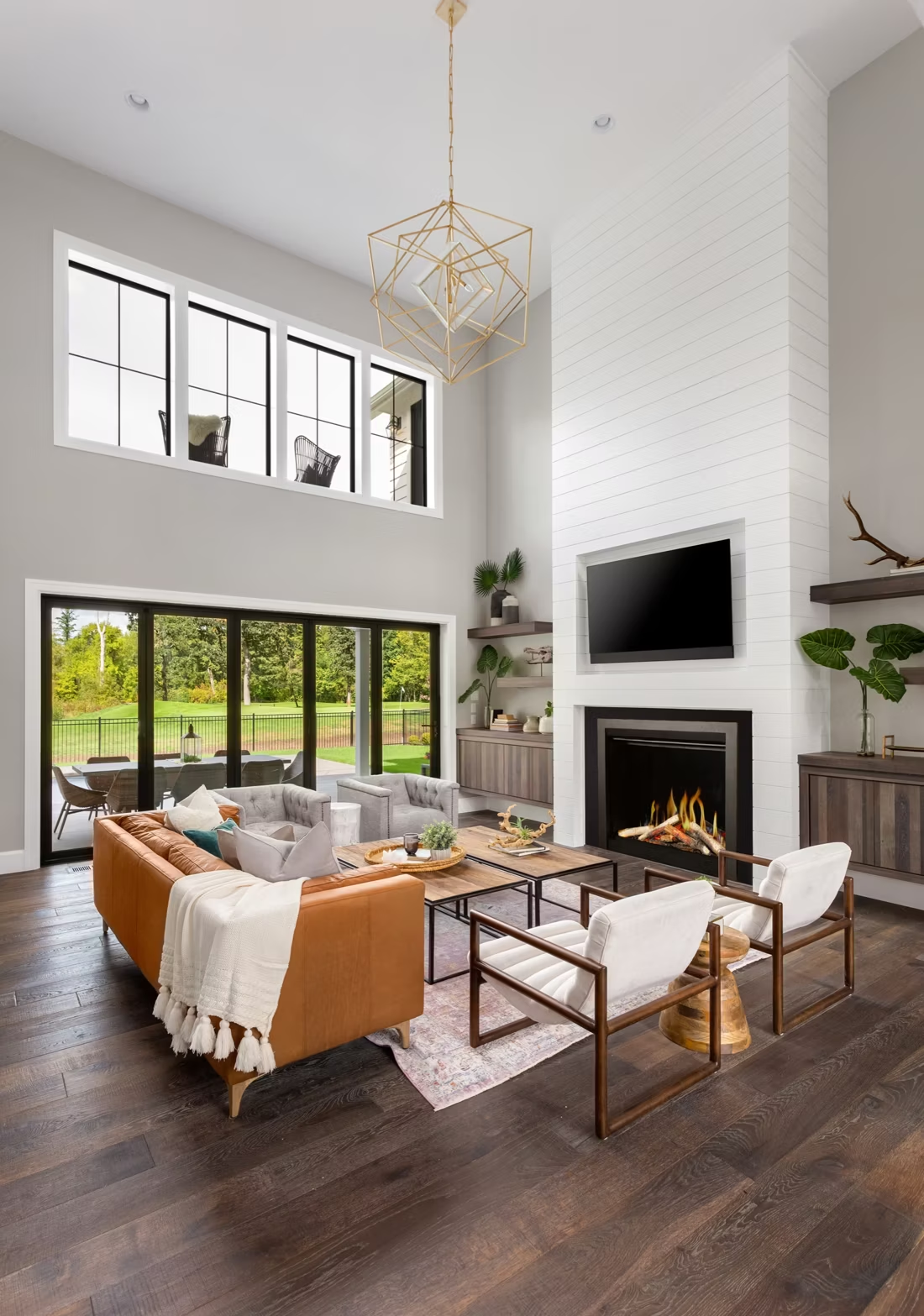
Yes—with an asterisk. Fireplaces are hot and TVs don't like heat. Either put a mantel between them to deflect rising warmth, or choose a fireplace with heat-management technology that creates a cool zone on the wall above—the wall stays around 125 degrees, barely warm, while the room still gets full heat. If you like clean lines and don't want a mantel, heat management is the answer.
How much does an electric fireplace cost to run?
With the heater on, a typical unit draws about 1,500 watts—at average electric rates that's roughly 20 cents an hour. Run the flame effect alone and it costs pennies; the flames are LED-driven and use about as much power as a light bulb. There's no pilot light, no fuel delivery, and essentially no maintenance.
Can I install a fireplace myself?
If you're putting a fire in your house on purpose, it's best to work with an expert. Unless you're genuinely experienced in framing, gas line, vent pipe, and the national code on clearances to combustibles, have a professional do it—and ideally the same company that sells you the fireplace, so warranty, service, and liability all live under one roof.
How much should I budget for a fireplace?
For an average home—covering the fireplace, the vent pipe, and basic installation—a budget between $3,900 and $5,500 gives you a lot of options across wood, gas, and pellet. By the time you add finish work, gas line, and electrical, the average complete installation lands between $5,000 and $12,000 all-in. In a remodel or new build, a good rule is to put about 2.5% of the total project cost toward the fireplace.
Nearby Dealers
Hearth shops serving Rutgers University-Busch Campus and the surrounding area. Every listing shows whether it is a WhyFire partner, a dealer we have verified as authorized for the brands we recommend, or a local business carrying hearth products. No manufacturer pays for placement. How we verify dealers →
Fireplaces R Us
Costello's Hearth & Spa - Bernardsville
Appliance Brokers, Ltd.
Hot Concepts Fireplaces
Island Renovations
Harris Hearth And Home
My Deck, Llc
Flemington Supply Co. Inc
Fireside Pros/Awning Design
Builders Architectural Millwork
Central Jersey Masonry & Chimney Sweep
Electric Service in Rutgers University-Busch Campus
An electric fireplace's heater draws about 1,500 watts—pennies per hour at local rates.
Public Service Elec & Gas Co
Find your electric fireplace near Rutgers University-Busch Campus.
Tell us a bit about your home or rental and we'll match you with a trusted local dealer and send you a free Project Guide & Parts List—the exact unit, mounting or circuit needs, and next steps for your space.
Find Your Fireplace →