
The Fireplace Upgrade Lambertville's Old Homes Actually Allow.
No flue, no masonry, no Historic Preservation Commission review—just real heat and ambiance for a Delaware River rowhouse. Find the right unit and connect with a trusted local dealer.
Every Project Starts From One of These Five Situations
No Flue, No Masonry, No Historic-District Fight.
Lambertville is a tightly packed 19th-century river town—narrow lots, shared party walls, and a historic district that governs what you can change on the outside of a building. A lot of the Victorian doubles and brick rowhouses along Union and Bridge Streets have decorative mantels sitting over fireboxes that were bricked shut decades ago, or never had a working flue to begin with. Winters here are real but not brutal—average winter lows around 19°F and a heating season similar to much of the mid-Atlantic—which means supplemental heat matters, but you don't need a wood-burning furnace to get through January.
An electric fireplace sidesteps the two things that make hearth projects complicated in a town like this: venting and exterior work. There's no chimney liner to run, no gas line to trench, and because nothing changes the building envelope, most installations don't trigger a Historic Preservation Commission review the way a new vent pipe or exterior flue would. Jersey Central Power & Light serves Lambertville at a residential rate around 14.97 cents per kWh, so running one is predictable and easy to budget for, whether it's supplemental heat for a chilly guest room or year-round ambiance in a front parlor that never had real fire access.
Three steps. No salesperson until you're ready.
Tell us about your project
Your zip code, your situation, and the fuel you're leaning toward—or let the answers point you to one.
See what's actually available
The brands dealers within 100 miles genuinely carry—real options, never a catalog mirage.
Get your dealer & Project Guide
A trusted local dealer, plus the free Project Guide & Parts List that names every component of the job.
Frequently Asked Questions
How much does an electric fireplace installation cost in Lambertville?
A plug-in insert or wall-mount unit that uses an existing outlet can run as little as $150 to $800 installed, since there's no venting or gas work involved. A built-in electric fireplace with a custom mantel surround, or a unit that needs a dedicated 120V or 240V circuit run by an electrician, typically lands between $1,500 and $4,500 depending on the cabinetry and electrical work. That's meaningfully less than wood or gas projects in town, mainly because you're skipping chimney liners, venting, and gas line permits entirely—the main cost driver becomes finish carpentry, not mechanicals.
Do I need a permit for an electric fireplace in Lambertville's historic district?
Usually not for the fireplace itself. Because an electric unit doesn't require venting or any change to the building's exterior, it generally falls outside what the Historic Preservation Commission reviews—that review is aimed at things like new windows, siding, or anything visible from the street. Where a permit does come into play is the electrical work: if you're adding a new dedicated circuit for a larger built-in unit, that requires an electrical permit through the Lambertville Construction Code Office. A licensed electrician handling the circuit will typically pull that permit as part of the job.
Can an electric fireplace go into my home's old bricked-over firebox?
Often, yes—this is one of the more common requests from Lambertville homeowners with a Victorian-era mantel and a firebox that's been sealed for decades. An electric insert sized to the existing opening can slide into that space and use the original masonry surround as its frame, so you get the look of the original hearth back without opening up a bricked chimney or hiring a mason. A local dealer will measure the firebox opening and depth first, since older Lambertville fireboxes vary quite a bit in size from house to house.
What will an electric fireplace actually cost to run on JCP&L power?
Most electric fireplaces draw around 1,500 watts on the heat setting, which at Jersey Central Power & Light's residential rate of about 14.97 cents per kWh works out to roughly 22 cents an hour to run on high heat. Used a few hours a night through a Lambertville winter, that's typically $15 to $30 a month in added electric cost—far less than most homeowners expect, and there's no fuel to buy or store. Running the flame effect alone, without heat, draws only 30-100 watts and costs pennies per hour.
What size electric fireplace do I need for a Lambertville home?
Most electric fireplaces are rated to comfortably heat 400 to 1,000 square feet as supplemental heat, which fits well with the room-by-room heating typical of Lambertville's older, smaller-footprint rowhouses—a parlor, a den, or a single bedroom rather than an entire open floor plan. For a front room in a rowhouse with 8- to 9-foot ceilings and original single-pane or early replacement windows, a standard 1,500-watt insert or wall unit is usually plenty. Larger, more open renovated spaces may do better with two smaller units zoned to different rooms rather than one oversized fireplace.
Will my electric fireplace work if the power goes out?
No—and this is worth being direct about. Electric fireplaces need grid power or a generator to run; when JCP&L service drops during a Delaware River ice storm or a summer squall line, the unit goes dark along with everything else in the house. If backup heat during outages is a real concern for your household, a wood stove or a battery-free gas unit is a better primary choice, with electric reserved for daily ambiance and zone heating rather than emergency backup.
Electric vs. gas vs. wood—which is right for a historic Lambertville home?
Wood offers the most authentic fire and works without electricity, and there's decent access to oak, hickory, and maple firewood in Hunterdon County—but it needs a working chimney or new Class A venting, which is a bigger project in a party-wall rowhouse. Gas gives instant, real heat and can run through a power outage with battery backup, but it requires either a natural gas line or a propane tank plus venting work that may draw more scrutiny in the historic district. Electric skips venting and gas lines entirely, installs faster and cheaper, and works well for homes where the fireplace is more about ambiance and supplemental warmth than primary heat. For a lot of Lambertville's older homes without an intact chimney, electric is simply the path of least resistance.
Are there any New Jersey rebates for electric fireplaces?
Not directly. New Jersey's Clean Energy Program and JCP&L efficiency incentives are generally aimed at heat pumps, insulation, and whole-home electrification upgrades—a standalone electric fireplace, which is a resistance-heat supplemental appliance, typically doesn't qualify on its own. Where it can indirectly help is efficiency: if a fireplace lets you zone-heat one room instead of running central heat for the whole house on a mild evening, that reduces overall energy use even without a rebate attached to the fireplace itself.
How much maintenance does an electric fireplace need?
Very little compared to wood or gas. There's no chimney to sweep, no gas line to inspect, and no combustion byproducts to worry about. Maintenance is mostly dusting the unit, occasionally replacing an LED light strip or ember bed bulb after several years of use, and keeping air intake vents on the back of built-in units clear of dust. Most units carry a manufacturer warranty of two to five years on electrical components, and a local dealer can usually source replacement parts like flame effect motors or remote controls if something needs repair down the road.
Do electric fireplaces actually produce heat?
Yes—most put out around 4,800–5,000 BTUs from a standard outlet, which comfortably warms a bedroom, office, or den as a comfort-zone heater. What they won't do is carry a whole house the way wood, gas, or pellet can. Think of electric as ambiance-first with honest supplemental heat: flames on with no heat in July, flames plus warmth in January.
Can I put a TV above my fireplace?
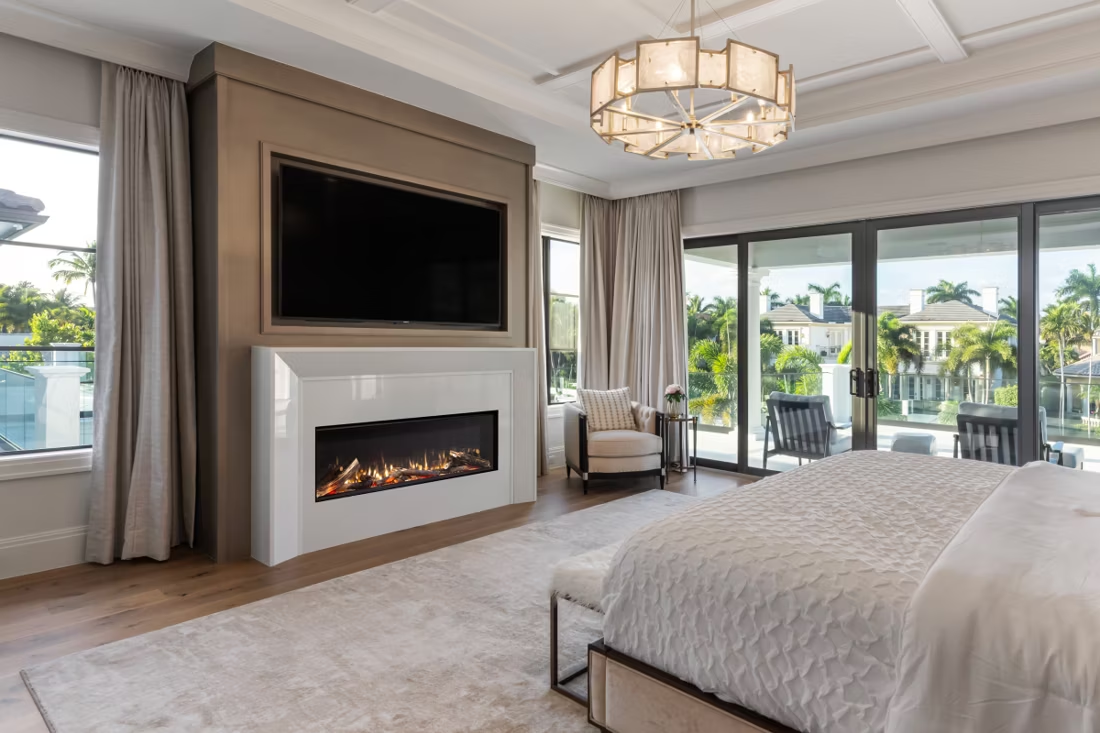
Yes—with an asterisk. Fireplaces are hot and TVs don't like heat. Either put a mantel between them to deflect rising warmth, or choose a fireplace with heat-management technology that creates a cool zone on the wall above—the wall stays around 125 degrees, barely warm, while the room still gets full heat. If you like clean lines and don't want a mantel, heat management is the answer.
How much should I budget for a fireplace?
For an average home—covering the fireplace, the vent pipe, and basic installation—a budget between $3,900 and $5,500 gives you a lot of options across wood, gas, and pellet. By the time you add finish work, gas line, and electrical, the average complete installation lands between $5,000 and $12,000 all-in. In a remodel or new build, a good rule is to put about 2.5% of the total project cost toward the fireplace.
Can a fireplace actually lower my heating bill?
Yes—by creating a comfort zone. A furnace heats every square foot of the house just to warm the one room you're in; a gas fireplace on low burns roughly a sixth of the gas a typical furnace does. Set the furnace around 55–60 degrees as a baseline, then heat the rooms your family actually uses. Families who heat this way commonly save $20–$60 a month.
Nearby Dealers
Hearth shops serving Lambertville and the surrounding area. Every listing shows whether it is a WhyFire partner, a dealer we have verified as authorized for the brands we recommend, or a local business carrying hearth products. No manufacturer pays for placement. How we verify dealers →
We’ve paused dealer listings for this connection today. Enter your zip or postal code above to find dealers near you, or come back tomorrow.
Popular Electric Brands
Where each brand came from, what's inside it today, and every current model. No brand pays to be here. Not every dealer carries every brand, so enter your zip code to see what's sold near Lambertville.
Fireplace Xtrordinair
Fireplace Xtrordinair, now often called FireplaceX, is the fireplace brand of Travis Industries, Inc., of Mukilteo, Washington.
5 electric models →DaVinci
DaVinci Custom Fireplaces is a brand of Travis Industries, Inc., of Mukilteo, Washington, the company behind Lopi and Fireplace Xtrordinair.
5 electric models →Kozy Heat
Kozy Heat was founded in 1976 by Dudley Hussong in Lakefield, Minnesota, and incorporated as Hussong Manufacturing Co., Inc. in 1978.
3 electric models →Forge & Flame
Forge & Flame is the stove brand Hearth & Home Technologies introduced in August 2023 to bring Vermont Castings, Harman, and Quadra-Fire under one name.
1 electric model →Electric Service in Lambertville
An electric fireplace's heater draws about 1,500 watts—pennies per hour at local rates.
Jersey Central Power & Lt Co
Find your electric fireplace in Lambertville.
Tell us a bit about your home and we'll help you find the right electric fireplace or insert—and hand you a free Project Guide & Parts List built around your space, plus a trusted local dealer to install it.
Find Your Fireplace →