
Clean, Instant Warmth for Red Willow County's Long Winters.
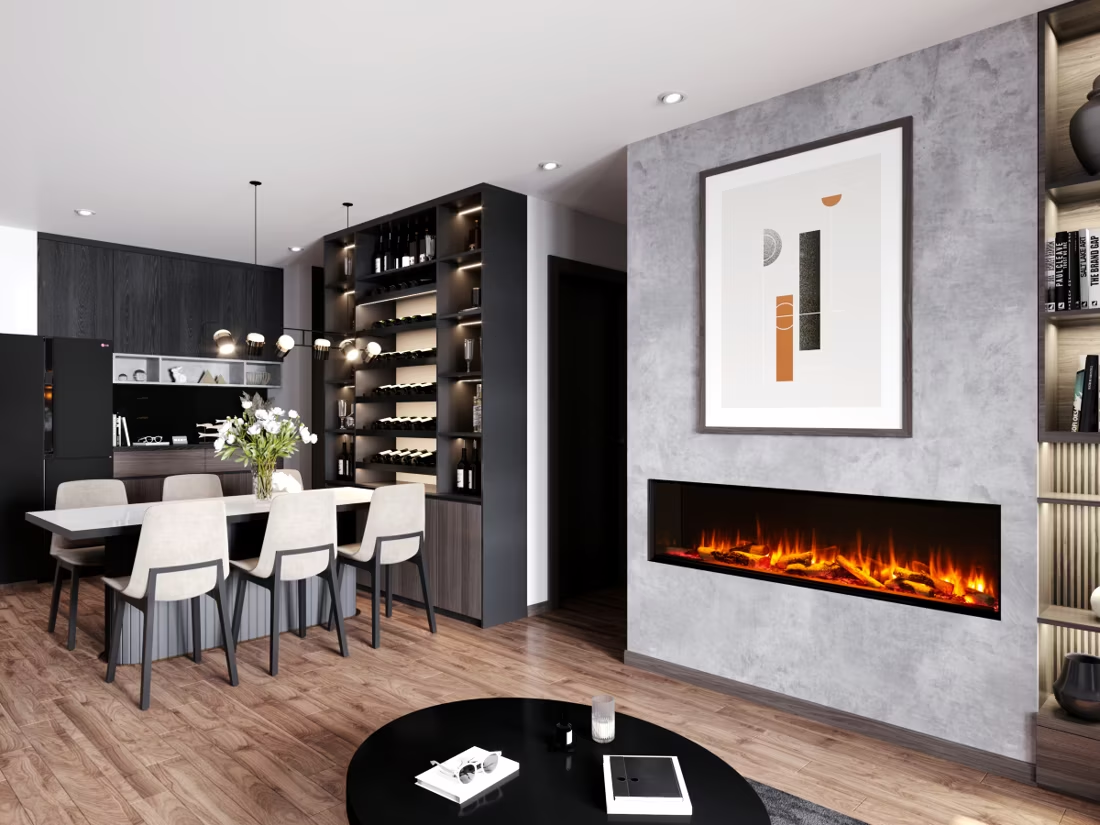
With a long, demanding winter heating season and winter lows averaging 16°F across the Republican River valley, McCook-area homes need real heating strategy—not just ambiance. An electric fireplace won't replace your furnace, but it's an easy, no-venting way to add warmth to a sunroom, finished basement, or addition. We'll match you with a local dealer who installs it right.
Every Project Starts From One of These Five Situations
A practical add-on to Nebraska's low-cost public power.
Red Willow County sits in Nebraska's climate zone 5A, with a long, cold heating season and winter lows that average 16°F—a real but not extreme cold, less punishing than Bismarck or Fargo to the north but still enough to demand a real heating plan from October through April. Most homes here, from McCook proper out to the ranch and farm properties along the Republican River, rely on propane or wood as primary or backup heat, since natural gas service doesn't reach every corner of the county. Electric fireplaces fit in as a supplemental option rather than the main event.
Nebraska is unique in being an all-public-power state, and Red Willow County is served by Southwest Public Power District in the rural areas and the City of McCook's municipal utility in town—both with electricity rates that run below the national average. That makes an electric fireplace or heater a more economical add-on here than in many other states, even though it won't carry a whole house through a 16°F night on its own. It's a good fit for a finished basement, a home office addition, or a room that the propane furnace or wood stove doesn't reach well, and it installs in an afternoon with no chimney, no venting, and no permit hassle for a plug-in unit.
Three steps. No salesperson until you're ready.
Tell us about your project
Your zip code, your situation, and the fuel you're leaning toward—or let the answers point you to one.
See what's actually available
The brands dealers within 100 miles genuinely carry—real options, never a catalog mirage.
Get your dealer & Project Guide
A trusted local dealer, plus the free Project Guide & Parts List that names every component of the job.
Frequently Asked Questions
How much does an electric fireplace installation cost in Red Willow County?
A freestanding, plug-in electric fireplace or insert runs about $150 to $1,000 for the unit itself, with no real installation cost beyond plugging it into an existing outlet. A built-in wall unit or a linear electric fireplace that requires a dedicated 120V or 240V circuit typically runs $1,200 to $3,000 installed, once you factor in the electrician's time to run new wiring—common in older McCook homes and farmhouses where the existing panel wasn't built for a high-draw appliance. Local dealers can tell you within minutes which category your project falls into.
Can an electric fireplace heat my whole house in Red Willow County's winters?
Not on its own. Most electric fireplaces top out around 1,500 watts, roughly 5,000 BTU of heat output—enough to comfortably warm a single room, but not enough to carry a home through a 16°F January night in a county with a long, demanding winter heating season. In this county, electric fireplaces work best as zone heat: warming the room you're actually sitting in while a propane furnace, wood stove, or heat pump handles the rest of the house. That's especially true for older farmhouses along the Republican River with drafty additions or unheated sunrooms.
Do I need a permit to install an electric fireplace in Red Willow County?
A simple plug-in freestanding unit typically doesn't require a permit—it's no different from plugging in a space heater. If you're installing a built-in wall unit that needs new wiring or a dedicated circuit, that electrical work should go through a licensed electrician and may require a permit from the Red Willow County Building Department or, if you're inside city limits, the City of McCook's building office. Local dealers who install built-in units generally coordinate this as part of the job.
What's the difference between an electric fireplace, insert, and stove?
An electric fireplace is typically a built-in or wall-mounted unit designed to look like a traditional fireplace, often with a mantel surround. An electric insert is sized to slide into an existing masonry fireplace opening, giving an old wood-burning fireplace a clean, no-mess heat source without touching the chimney. An electric stove is a freestanding cabinet-style unit that mimics a wood stove's look. For Red Willow County homes with an existing but unused masonry fireplace, an insert is often the simplest upgrade—no chimney sweep, no wood, no ash.
What will an electric fireplace cost to run on my electric bill?
Running a 1,500-watt electric fireplace for several hours an evening adds a modest amount to your bill—and Red Willow County residents have an advantage here. Southwest Public Power District serves the rural parts of the county and the City of McCook operates its own municipal utility in town, and Nebraska's status as an all-public-power state keeps electricity rates below the national average across the board. That doesn't make electric heat cheaper than a wood stove burning free-cut oak or hickory, but it makes supplemental electric heat a reasonable everyday cost rather than a luxury.
What's the best electric fireplace for a Red Willow County home?
Look for a unit with a real 1,500-watt heater rated for the square footage of the specific room you're heating, and make sure the heat function operates independently of the flame effect—useful in early fall or late spring here when you want the ambiance without the heat. For older farmhouses with uneven insulation, a linear or wall-mounted model with adjustable thermostat control tends to perform better than a small mantel unit. A local dealer can match wattage to your room size and existing wiring in a single visit.
Electric vs. wood—which is right for my home?
Wood remains a serious heating option in Red Willow County, where oak, hickory, and cottonwood are common along the Republican River bottomlands, and there are no air quality restrictions on burning here unlike some western states. A wood stove can serve as genuine primary or backup heat, including during power outages. An electric fireplace can't do that—it needs power to run, full stop—but it wins on convenience: no wood to split or haul, no chimney to sweep, and instant on-off control for a room you use daily. Many local homes run both: wood as backup and primary heat, electric for easy supplemental warmth in a specific room.
Electric vs. propane—which makes more sense here?
Because natural gas service doesn't reach every part of Red Willow County, propane is the common alternative to wood for whole-house heat, and many rural homes already have a propane tank and furnace in place. Propane fireplaces put out more heat than electric units and can often run without electricity depending on the ignition system, which matters given occasional winter ice storms in southwest Nebraska. Electric fireplaces cost less upfront, need no fuel deliveries, and install faster, but they're strictly a supplemental option, not a propane furnace replacement.
Will my electric fireplace work if the power goes out?
No—this is the one real tradeoff with electric heat in Red Willow County. Rural power lines here occasionally go down during winter ice or high-wind events, and an electric fireplace, like any electric appliance, goes dark with the rest of the house. If you want heat that survives an outage, a wood stove burning local oak or hickory, or a propane heater with a non-electric ignition, is the better backup. Most homeowners here treat electric fireplaces as a daily-convenience heat source and keep a wood stove or propane furnace as their outage-proof backup.
Does an electric fireplace need a vent or chimney?
No—that's its superpower. An electric fireplace needs a wall and an outlet, period. No vent pipe, no gas line, no clearances to design around, which is why it works in bedrooms, offices, apartments, and walls where venting a gas or wood unit would be impractical or impossible. Installation is typically the simplest and least expensive of any fireplace type.
Can I put a TV above my fireplace?
Yes—with an asterisk. Fireplaces are hot and TVs don't like heat. Either put a mantel between them to deflect rising warmth, or choose a fireplace with heat-management technology that creates a cool zone on the wall above—the wall stays around 125 degrees, barely warm, while the room still gets full heat. If you like clean lines and don't want a mantel, heat management is the answer.
How much should I budget for a fireplace?
For an average home—covering the fireplace, the vent pipe, and basic installation—a budget between $3,900 and $5,500 gives you a lot of options across wood, gas, and pellet. By the time you add finish work, gas line, and electrical, the average complete installation lands between $5,000 and $12,000 all-in. In a remodel or new build, a good rule is to put about 2.5% of the total project cost toward the fireplace.
Can a fireplace actually lower my heating bill?
Yes—by creating a comfort zone. A furnace heats every square foot of the house just to warm the one room you're in; a gas fireplace on low burns roughly a sixth of the gas a typical furnace does. Set the furnace around 55–60 degrees as a baseline, then heat the rooms your family actually uses. Families who heat this way commonly save $20–$60 a month.
Find your electric fireplace in Red Willow County.
Tell us about your room and your home's setup, and we'll match you with a local Red Willow County dealer along with a free Project Guide & Parts List—the right unit, the wiring requirements, and what it takes to get it installed correctly.
Find Your Fireplace →