
Bring reliable electric heat to your Cedar County home.
No venting, no gas line, no chimney—just plug-in or hardwired warmth for farmhouses and additions from Hartington to Laurel, Coleridge, Randolph, and Wynot. Find the right unit and connect with a trusted local dealer.
Every Project Starts From One of These Five Situations
Simple, targeted heat without the venting
Cedar County sits along the Missouri River in far northeast Nebraska, home to about 5,000 people spread across Hartington (the county seat), Laurel, Randolph, Coleridge, Wynot, and the surrounding farmland. Winters here run cold and long—climate zone 5A, with a long, demanding heating season and average winter lows around 10°F, a season closer in severity to Madison, Wisconsin than to most of the rest of Nebraska. That's a real heating load, and it's why most Cedar County homes lean on propane furnaces or wood stoves for whole-house heat.
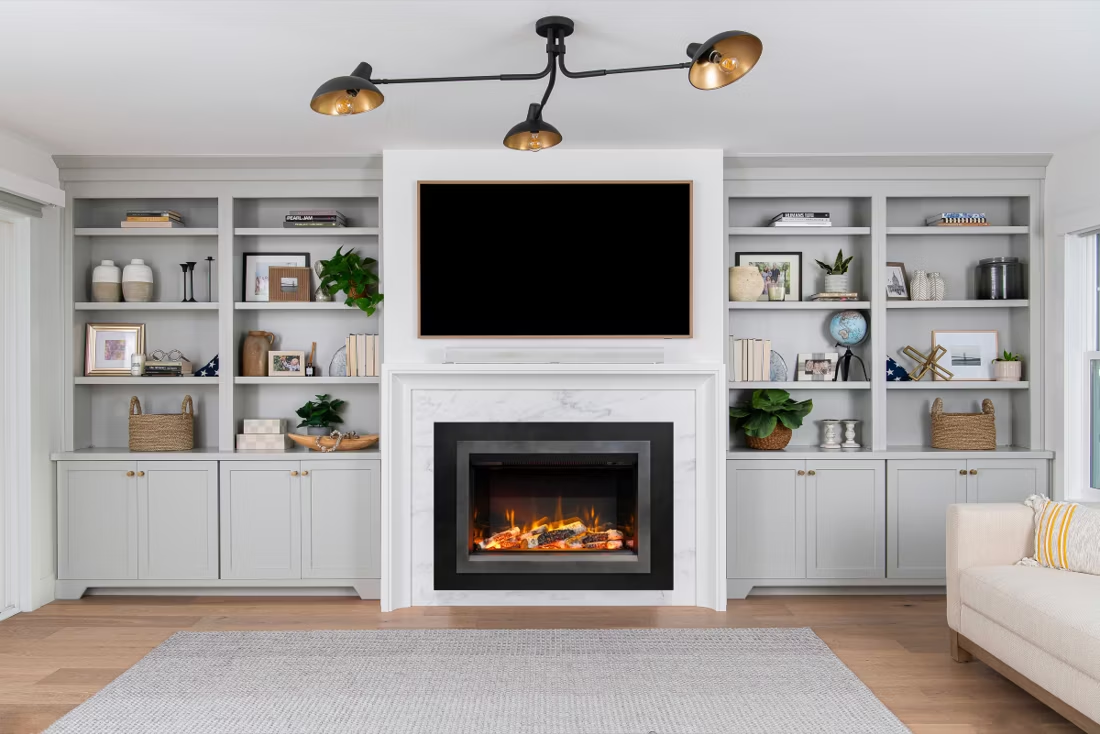
Electric fireplaces fit a different, still valuable role in that picture: zone heat for a finished basement, a farmhouse addition, a bedroom that the furnace never quite reaches, or simply a fireplace look in a home with no chimney and no interest in running gas line. Because there's no venting or combustion involved, installation is dramatically simpler than wood or gas—often just a matter of placement and, for larger built-ins, a dedicated circuit run by a licensed electrician. For rural Cedar County homes served by Cedar-Knox Public Power District, that simplicity matters: no permit runaround for flue clearances, no annual chimney sweep, just heat where you actually spend time.
Three steps. No salesperson until you're ready.
Tell us about your project
Your zip code, your situation, and the fuel you're leaning toward—or let the answers point you to one.
See what's actually available
The brands dealers within 100 miles genuinely carry—real options, never a catalog mirage.
Get your dealer & Project Guide
A trusted local dealer, plus the free Project Guide & Parts List that names every component of the job.
Frequently Asked Questions
How much does an electric fireplace installation cost in Cedar County?
Plug-in electric fireplace inserts and freestanding stoves are the most affordable option, often installed for a few hundred dollars in parts with no electrician needed since they run on a standard household outlet. Built-in wall units or mantel-surround electric fireplaces that require a dedicated 120V or 240V circuit run higher—typically $800 to $2,500 installed once you factor in the unit, custom framing or a surround, and an electrician's time. Costs stay lower here than for wood or gas projects specifically because there's no chimney, venting, or gas line to install—the labor is mostly electrical, not structural.
Can an electric fireplace be my primary heat source in Cedar County?
Not realistically, and I'd rather tell you that up front than let you find out the hard way. At 10°F average winter lows and a long, demanding heating season, Cedar County's heating load is significant, and electric resistance heat is expensive and limited in output compared to a propane furnace or a wood stove burning local oak or hickory. Most electric fireplace installations here work best as zone heat—warming a specific room, an addition, or a finished basement—while a furnace or wood stove carries the main heating load for the house. Think supplemental comfort and ambiance, not whole-home heat.
Will my electric fireplace still work during a rural power outage?
No—and this is worth planning around in Cedar County, where ice storms and high winds can knock out rural power lines for hours or longer. Electric fireplaces require grid power to run; if Cedar-Knox Public Power District service goes down, the unit goes dark along with everything else in the house. That's the main tradeoff against wood heat, which keeps working with no electricity at all. Many Cedar County homeowners pair an electric fireplace for everyday convenience with a wood stove or propane heater as backup for winter outages—worth discussing with a local dealer if resilience matters to you.
What's the difference between an electric insert, a built-in unit, and a freestanding stove?
A plug-in electric insert drops into an existing fireplace opening—masonry or zero-clearance—and is the simplest retrofit for a Cedar County farmhouse with an old, unused fireplace. A built-in wall unit is framed into new construction or a remodel, giving a flush, modern look but usually requiring a dedicated circuit. A freestanding electric stove sits on the floor like a wood stove, works anywhere near an outlet, and is popular for additions or rooms with no existing fireplace. For most rural homes here converting an old wood-burning fireplace that's fallen out of use, the insert is the easiest and cheapest path.
Do I need a permit for an electric fireplace in Cedar County?
Usually not for the fireplace itself—since there's no venting, chimney, or gas line involved, most jurisdictions don't require a building permit for a plug-in unit or a simple insert swap. If your installation calls for a new dedicated circuit or panel work, that electrical work typically needs to be pulled by a licensed electrician and may require a permit through the Cedar County zoning office in Hartington. A reputable local dealer or electrician will know exactly what's required and handle the paperwork rather than leaving it on you.
What's the best electric fireplace for a Cedar County farmhouse addition?
For a bonus room, finished basement, or addition that the furnace doesn't reach well, a mid-size built-in electric fireplace (1,500-watt units cover roughly 400 square feet) paired with a dedicated circuit gives consistent, even zone heat plus real flame-effect ambiance. For a simpler retrofit into an existing but unused masonry fireplace—common in older Hartington and Laurel homes—a plug-in insert with a realistic log or crystal display is usually the better fit and skips the electrician entirely. A local dealer can walk your specific room and recommend wattage based on square footage and how well-insulated the space is.
How much maintenance does an electric fireplace need?
Very little compared to wood or gas. There's no chimney to sweep, no venting to inspect, and no gas line to service. Routine care is mostly dusting the interior and the heater fan intake a couple of times a year and occasionally replacing an LED light strip or heater element after years of use—most units are rated for tens of thousands of hours. That low-maintenance profile is one of the main reasons Cedar County homeowners choose electric for secondary rooms where they don't want to think about upkeep.
Where can I find a local dealer near Cedar County?
With about 5,000 residents spread across Hartington, Laurel, Randolph, Coleridge, and Wynot, Cedar County itself has limited retail hearth showrooms, so most homeowners here work with dealers based in nearby Yankton, SD, or Norfolk, NE, who service the whole area. That regional reach is exactly why matching with the right dealer matters more than in a bigger market—you want someone who already knows rural electrical service conditions and will actually make the drive for installation and any follow-up service.
Electric vs. propane or wood—which fits my Cedar County home?
Propane furnaces and wood stoves burning local oak, hickory, or cottonwood carry the real heating load through Cedar County's long, cold winters and keep working when the power lines go down—a real consideration on rural Cedar-Knox Public Power District lines during ice storms. Electric fireplaces can't compete with that as primary heat, but they win on simplicity: no venting, no fuel storage, no chimney sweeping, and instant on-off convenience for a room you use daily. Most local homes that add electric do it alongside an existing furnace or wood stove—electric for the den or addition, the other fuel carrying the house through January.
Can I put a TV above my fireplace?
Yes—with an asterisk. Fireplaces are hot and TVs don't like heat. Either put a mantel between them to deflect rising warmth, or choose a fireplace with heat-management technology that creates a cool zone on the wall above—the wall stays around 125 degrees, barely warm, while the room still gets full heat. If you like clean lines and don't want a mantel, heat management is the answer.
Do electric fireplaces actually produce heat?
Yes—most put out around 4,800–5,000 BTUs from a standard outlet, which comfortably warms a bedroom, office, or den as a comfort-zone heater. What they won't do is carry a whole house the way wood, gas, or pellet can. Think of electric as ambiance-first with honest supplemental heat: flames on with no heat in July, flames plus warmth in January.
How much should I budget for a fireplace?
For an average home—covering the fireplace, the vent pipe, and basic installation—a budget between $3,900 and $5,500 gives you a lot of options across wood, gas, and pellet. By the time you add finish work, gas line, and electrical, the average complete installation lands between $5,000 and $12,000 all-in. In a remodel or new build, a good rule is to put about 2.5% of the total project cost toward the fireplace.
What is an in-home preview and do I need one?
It's a visit where a hearth professional measures your space, confirms the model you picked actually works in your home, and walks the specs—framing, gas line, venting, finish work—before anything is ordered. Some details you just can't know until you see the house. Never make a down payment without one; it's the single most-skipped step that burns buyers.
Find your electric fireplace in Cedar County.
Tell us a bit about your home and we'll match you with the right electric fireplace or insert, plus a free Project Guide & Parts List with your recommended local dealer.
Find Your Fireplace →