
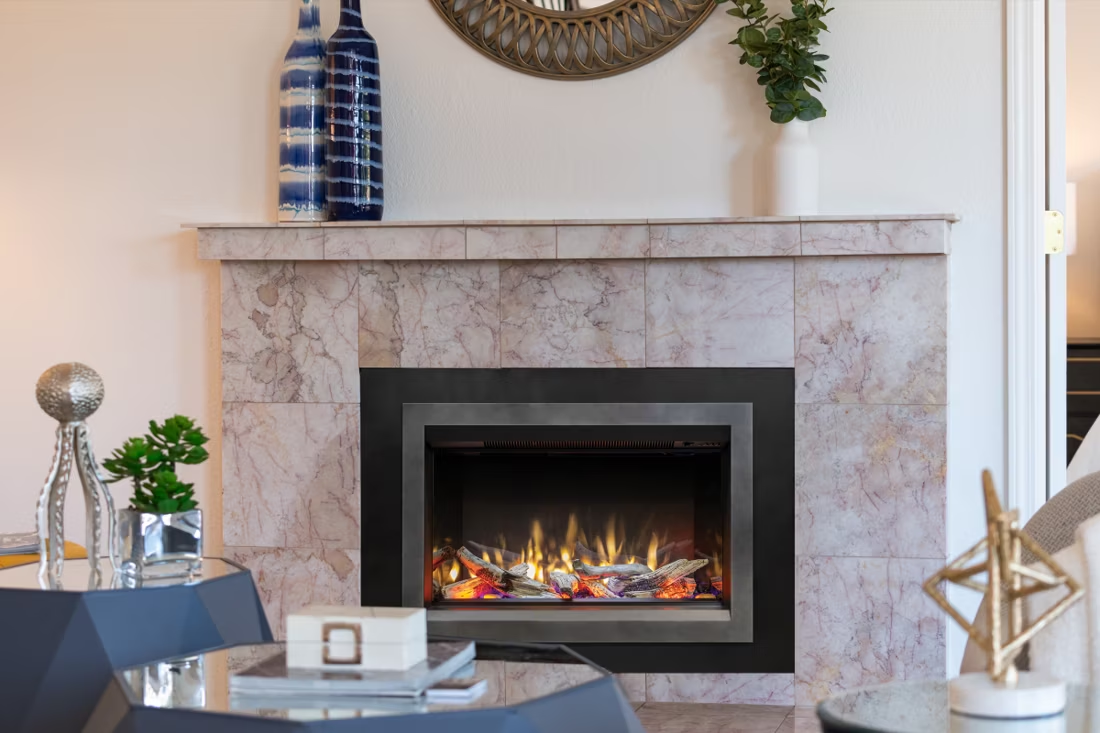
Add zone heat and ambiance to your Roosevelt County home—no chimney required.
With roughly 7,800 heating degree days a year and Arctic fronts rolling straight down the Hi-Line, Roosevelt County homes need serious heat. An electric fireplace won't replace your furnace, but it adds real supplemental warmth to a bedroom, den, or manufactured home with zero venting and no gas line. Find the right unit and connect with a trusted local dealer.
Every Project Starts From One of These Five Situations
Real warmth, zero venting, built for the Hi-Line's electrical grid.
Roosevelt County sits along US Highway 2—the Hi-Line—on the Fort Peck Indian Reservation, home to Wolf Point, Poplar, Culbertson, and Frazer. Winters here average a low around 6°F with close to 7,800 heating degree days, a colder annual load than Fargo, ND, and there's little topography between here and the Canadian border to slow down an Arctic front. A lot of the housing stock across the county is manufactured or modular, and many of those homes simply aren't good candidates for a new wood-stove chimney or a gas line run—the framing and clearances don't line up the same way they would in a stick-built house.
That's where electric fireplaces earn their place here, not as a replacement for the propane furnace or electric baseboard doing the primary heavy lifting, but as supplemental zone heat for the room you actually live in, plus real ambiance on the coldest nights. Missouri River Electric Cooperative, headquartered in Culbertson, serves most of Roosevelt County, and a plug-in or hardwired electric unit draws off that same grid without a permit headache, a flue, or combustion byproducts—which matters in a county that also deals with wildfire smoke settling in during summer. I'll be straightforward: in a 7,800-HDD climate, electric alone won't carry your whole home through January. But for the right room, it's the simplest, safest install on the list.
Three steps. No salesperson until you're ready.
Tell us about your project
Your zip code, your situation, and the fuel you're leaning toward—or let the answers point you to one.
See what's actually available
The brands dealers within 100 miles genuinely carry—real options, never a catalog mirage.
Get your dealer & Project Guide
A trusted local dealer, plus the free Project Guide & Parts List that names every component of the job.
Frequently Asked Questions
How much does an electric fireplace installation cost in Roosevelt County?
Costs vary widely by unit type. A plug-in freestanding or wall-mount electric fireplace runs a few hundred dollars for the unit and typically needs nothing more than an existing outlet—no installer required. A built-in electric insert or a linear wall unit that needs a dedicated 240V circuit, framing, or a mantel surround is a bigger project, and that's where you'll want a local electrician or hearth dealer involved, especially in an older Wolf Point or Poplar home where the electrical panel may need a capacity check first. Rural distances in Roosevelt County can add a modest trip charge if your installer is coming from Williston, ND or Glasgow rather than in town.
Will an electric fireplace keep my home warm during a Hi-Line cold front or power outage?
An electric fireplace will comfortably heat a single room during a cold front, but it runs entirely on grid power, so it offers zero backup heat during an outage—and outages do happen here when winter storms take down lines along the Hi-Line. If you're relying on Missouri River Electric Cooperative service and want heat that survives a multi-day outage, a wood stove or propane appliance is the better backup layer. Many Roosevelt County homes pair an electric fireplace for daily convenience with a wood stove or propane heater as the fallback for when the power's out and it's 6°F outside.
What's the difference between an electric fireplace and a space heater?
Both plug into a standard outlet and generate heat with resistance elements, but they're built for different jobs. A space heater is a portable, purely functional appliance. An electric fireplace is designed to look and feel like a real fireplace—a flame-effect display, a mantel or surround, and in many cases a heating element that can be run independently of the flame visual, so you get ambiance in the summer wildfire-smoke months without the heat. For a Roosevelt County living room or bedroom where you want both warmth and the look of a fire, an electric fireplace is the better long-term fixture; a space heater is the better grab-and-go option for a garage or workshop.
Can I put an electric insert into an old masonry fireplace?
Yes—if you've got an older home in Wolf Point or Culbertson with an existing masonry fireplace that's no longer used or was never finished off with a working flue, an electric insert slides into that opening and gives you heat and flame effect without touching the chimney at all. It's a common, low-cost way to bring a dead fireplace back to life, since you skip the sweep, the liner, and the venting inspection entirely—you're just running power to the opening.
What's the best electric fireplace for a manufactured or modular home in Roosevelt County?
Look for a unit with a real ceramic or infrared heating element rated for the room size you're heating, not just a flame-effect display—some lower-end models are essentially decorative and add almost no usable heat. In manufactured housing, which is common across Poplar, Frazer, and Brockton, pay attention to the home's existing electrical capacity before choosing a hardwired built-in; a licensed electrician can confirm whether your panel supports a dedicated circuit. Freestanding or wall-mount plug-in units are often the more practical choice in manufactured homes since they avoid any framing or wiring modification altogether.
Where can I find a dealer who sells and installs electric fireplaces near me?
Roosevelt County's population is small and spread across a handful of towns, so dedicated hearth retailers are limited locally—many Wolf Point and Poplar homeowners end up working with dealers based in Williston, ND, about 40 miles east, or with regional suppliers serving the broader Hi-Line and Fort Peck area. A trusted local or regional dealer can size the right unit for your room, confirm your electrical setup, and handle a built-in install correctly rather than leaving you to guess with a big-box unit that isn't matched to your space.
Electric vs. wood—which makes more sense for my Roosevelt County home?
Wood heat, burned from lodgepole pine, ponderosa pine, Douglas fir, or aspen sourced locally, provides real primary or backup heat that keeps working when the power goes out—a meaningful advantage in a county where Arctic storms occasionally take down electric service. It also asks more of you: chimney clearances, annual sweeps, and a supply of split, seasoned wood. Electric asks nothing of you beyond an outlet or a circuit, but it stops working the moment the power does, and in a 7,800-HDD climate it's realistically a supplemental or ambiance choice rather than your main defense against a Hi-Line cold front. Many households here run both—wood or propane as the backbone, electric in a bedroom or den for daily convenience.
Electric vs. pellet stove—which is right for me?
Pellet stoves burn compressed wood pellets—regional brands like Bear Mountain, Lignetics, and Forest Energy are commonly stocked in this part of Montana—and can produce real, sustained heat output comparable to a wood stove, but they still need electricity to run the auger and blower, so they share electric's vulnerability during an outage. An electric fireplace is simpler to install, cheaper up front, and better suited as supplemental zone heat rather than a home's primary heat source. If you want a cleaner-burning appliance that can meaningfully offset propane or electric baseboard costs through a Roosevelt County winter, pellet is the stronger heating tool. If you just want warmth and ambiance in one room with the least amount of installation hassle, electric wins.
How much does an electric fireplace cost to run through a Roosevelt County winter?
Most electric fireplace heating elements draw around 1,500 watts on the high setting, and your actual cost depends on your Missouri River Electric Cooperative rate and how many hours a day you run it. Given how often single-digit and sub-zero temperatures show up here, a unit run several hours a day through the coldest months adds a noticeable line to a winter electric bill, though it's still typically cheaper to operate than heating that same room with electric baseboard alone. Running it as supplemental heat in one room—rather than trying to heat a whole manufactured home with it—keeps the operating cost reasonable.
Can I put a TV above my fireplace?
Yes—with an asterisk. Fireplaces are hot and TVs don't like heat. Either put a mantel between them to deflect rising warmth, or choose a fireplace with heat-management technology that creates a cool zone on the wall above—the wall stays around 125 degrees, barely warm, while the room still gets full heat. If you like clean lines and don't want a mantel, heat management is the answer.
Does an electric fireplace need a vent or chimney?
No—that's its superpower. An electric fireplace needs a wall and an outlet, period. No vent pipe, no gas line, no clearances to design around, which is why it works in bedrooms, offices, apartments, and walls where venting a gas or wood unit would be impractical or impossible. Installation is typically the simplest and least expensive of any fireplace type.
Does a fireplace add value to my home?
On average, a fireplace adds back to the home about the same amount you spent installing it. Add the monthly savings from heating the rooms you actually use instead of the whole house—often hundreds of dollars a year—and the value case is strong before you even count what a fire does for how your family uses the room.
How much should I budget for a fireplace?
For an average home—covering the fireplace, the vent pipe, and basic installation—a budget between $3,900 and $5,500 gives you a lot of options across wood, gas, and pellet. By the time you add finish work, gas line, and electrical, the average complete installation lands between $5,000 and $12,000 all-in. In a remodel or new build, a good rule is to put about 2.5% of the total project cost toward the fireplace.
Find your electric fireplace in Roosevelt County.
Tell us about your home and how you want to use the room, and we'll put together a free Project Guide & Parts List—the right unit, the electrical requirements, and a recommended local dealer for your Roosevelt County installation.
Find Your Fireplace →