
Reliable gas heat for St. Peters winters, no wood pile required.
St. Charles County winters call for consistent, low-maintenance heat. Find the right gas fireplace or insert for your St. Peters home and connect with a trusted local dealer.
Every Project Starts From One of These Five Situations
The default choice in St. Charles County's newer subdivisions.
St. Peters sits in St. Charles County about 25 miles west of downtown St. Louis, in climate zone 4A with roughly 4,862 heating degree days a year and winter lows averaging 21°F. That's a real Midwest winter, but a moderate one compared to a place like Minneapolis, which racks up closer to 7,700 heating degree days. Most St. Peters homes were built from the 1970s through the 2000s by production builders like McBride & Son and Ryland, and the vast majority came standard with a natural gas furnace and, often, a builder-grade wood-burning fireplace that rarely gets used.
That's a big part of why gas dominates here. Spire Missouri provides natural gas service throughout most of St. Peters, and electric service splits between Union Electric (Ameren Missouri) and Cuivre River Electric Cooperative depending on which side of the city you're on. Ice storms are a regular winter event in eastern Missouri and can knock out power for days—a gas fireplace with a battery-backup ignition system keeps a room warm and lit even when the furnace can't run. For homes with an existing but unused wood fireplace, converting to gas is one of the most common upgrades local hearth dealers see in this market.
Three steps. No salesperson until you're ready.
Tell us about your project
Your zip code, your situation, and the fuel you're leaning toward—or let the answers point you to one.
See what's actually available
The brands dealers within 100 miles genuinely carry—real options, never a catalog mirage.
Get your dealer & Project Guide
A trusted local dealer, plus the free Project Guide & Parts List that names every component of the job.
Frequently Asked Questions
How much does a gas fireplace installation cost in St. Peters?
Most gas fireplace and insert installations in the St. Peters area run between roughly $3,500 and $9,000, depending on the unit, whether you're converting an existing masonry fireplace or building new, and how much gas line work is involved. Converting a builder-grade wood-burning fireplace to a direct-vent gas insert—a very common project in this area's 1980s-and-newer subdivisions—tends to land on the lower-to-middle end when a gas line already runs near the fireplace. New construction or additions requiring a fresh gas line from the meter push toward the higher end. A local dealer will give you a firm number after seeing the fireplace and running the gas line path.
Can I convert my existing wood fireplace to gas?
Yes, and it's the single most requested project among St. Peters homeowners. A large share of the city's housing stock came with a standard masonry or prefab wood-burning fireplace that homeowners rarely light, and a direct-vent gas insert converts that space into real, everyday heat using the existing chimney as the vent path with a stainless liner. Because true wood-burning is uncommon in these subdivisions—there's no local firewood-cutting culture the way there is in the Ozarks, and many HOAs discourage stacked woodpiles—most owners find gas conversion a far more practical fit for how the fireplace actually gets used.
Do I need natural gas to install a gas fireplace, or can I use propane?
Either works, but natural gas is the standard in St. Peters. Spire Missouri serves most of the city, and if your home already has a gas furnace, water heater, or range, tapping into that line for a fireplace is usually a simple extension. Homes in the more rural fringes of St. Charles County outside the Spire service footprint sometimes rely on propane instead, which requires either an existing tank or a new tank installation. Most gas fireplace models can be configured for either fuel—your installer sets the orifice and regulator to match.
Will my gas fireplace work during a power outage?
Most will, and that matters in this part of Missouri—ice storms have knocked out power to tens of thousands of Union Electric and Cuivre River Electric Cooperative customers in past winters, sometimes for days. Gas fireplaces with intermittent pilot ignition (IPI) run on a small battery backup that kicks in automatically when line power drops, so the fireplace lights and heats normally off batteries. Valor units go a step further: their pilot assembly generates its own electricity through the thermocouple, so there's no battery to remember at all. If outage resilience matters to you, ask your local dealer which ignition system a given model uses before you buy.
What's the difference between a gas fireplace, gas insert, and gas stove?
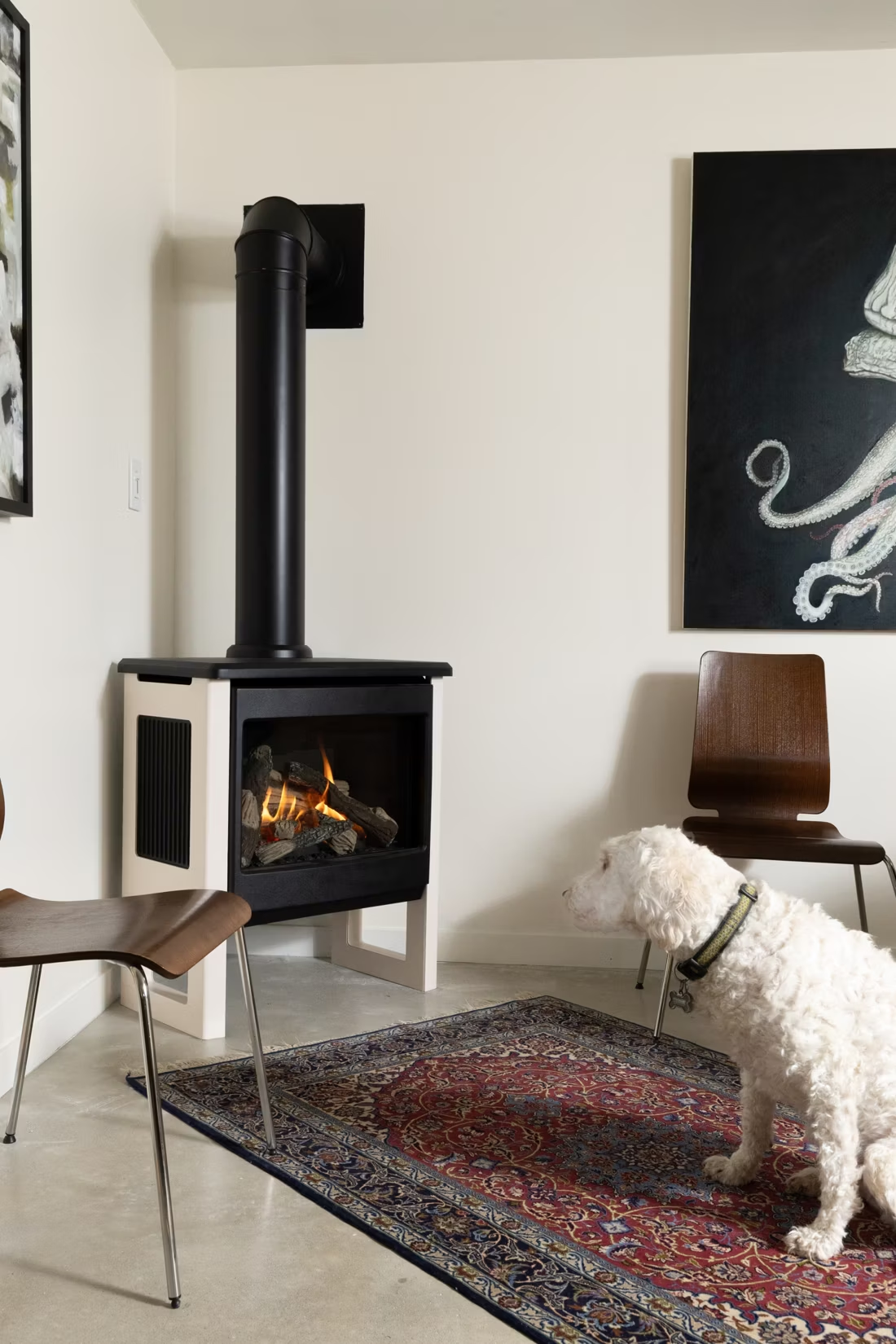
A gas fireplace is a fully built-in unit framed into a wall—the right call for new construction or a remodel with no existing fireplace. A gas insert slides into an existing masonry or prefab wood-burning firebox and uses the chimney as its vent, which is exactly the project most St. Peters homeowners are doing when they upgrade an unused builder fireplace. A gas stove is a freestanding cast-iron or steel unit that sits on the floor like a wood stove but burns gas, useful in rooms with no chimney at all. For the typical St. Peters home with an existing but idle fireplace, an insert is almost always the simplest and most cost-effective route.
Do I need a permit to install a gas fireplace in St. Peters?
Yes—the City of St. Peters Building Division requires a permit for new gas fireplace installations, and any new or modified gas line must be run by a licensed gas-fitter and inspected. Most established hearth dealers in the St. Louis metro handle this paperwork as part of the installation, coordinating the gas line, venting, and inspection so you're not managing separate trades yourself. If you live outside city limits in unincorporated St. Charles County, permitting runs through the county building department instead.
What's the difference between vented and vent-free gas fireplaces?
Vented (direct-vent) gas fireplaces pull combustion air from outside and exhaust it back outside through sealed venting—they're the cleanest, safest option and what most local dealers recommend for primary living spaces. Vent-free gas fireplaces burn directly into the room with no external venting; they're legal in Missouri but come with strict room-size and ventilation requirements, and they release some water vapor and combustion byproducts indoors. For most St. Peters homes, a direct-vent insert or fireplace is the more common and more universally recommended choice, especially in bedrooms or smaller, well-sealed rooms where a vent-free unit's rules get restrictive.
How often should my gas fireplace be serviced?
Plan on an annual inspection, ideally before the first cold snap in late fall. A certified technician checks the burner, pilot assembly, venting, and gas connections, and cleans the glass and interior—a much quicker job than chimney sweeping for a wood-burning unit, but just as important for safe operation. In the St. Louis metro area, annual gas fireplace service typically runs $125 to $225. Local hearth dealers and HVAC companies that service gas appliances both handle this work.
Gas vs. wood—which makes sense in St. Peters?
For most homes here, gas is the practical answer. St. Peters is dense suburban St. Charles County, not rural Ozark timberland—there's no local Forest Service cutting permit system, firewood delivery is limited compared to more rural parts of Missouri, and many neighborhoods discourage stacked woodpiles. Gas delivers instant, consistent heat with no ash or creosote and pairs naturally with the furnace most homes already have. Wood-burning fireplaces do exist in older St. Peters homes, but they're largely decorative or occasional-use rather than a real heating strategy, which is exactly why converting them to gas inserts is such a common project locally.
What's the difference between an insert and a zero-clearance fireplace?
An insert is a fireplace that slides into a pre-existing wood-burning fireplace—if you don't have one, there's nothing to insert it into. A zero-clearance fireplace is built into a framed wall, which makes it the answer for remodels and new construction. Simple test: existing masonry fireplace means insert; blank or framed wall means zero-clearance.
Why is my open fireplace making my house colder?
Open fireplaces suck—literally. As the fire burns, it consumes air your furnace already paid to heat and pulls it out through the chimney, so the house is actually colder after the fire goes out than before you lit it. An insert fixes this: it seals the chimney, puts fixed glass across the front, and turns that hole in your house into a real heat source.
How much should I budget for a fireplace?
For an average home—covering the fireplace, the vent pipe, and basic installation—a budget between $3,900 and $5,500 gives you a lot of options across wood, gas, and pellet. By the time you add finish work, gas line, and electrical, the average complete installation lands between $5,000 and $12,000 all-in. In a remodel or new build, a good rule is to put about 2.5% of the total project cost toward the fireplace.
Should the dealer who sells my fireplace also install it?
Ideally, yes. A fireplace project involves vent pipe, gas line, electrical, and often tile or stone. Hire three or four separate trades and you own the liability and the game of telephone between them. One company selling and installing means one accountable party, start to finish—ask about factory training, on-time completion records, and what happens if an inspection fails.
Nearby Dealers
Hearth shops serving St. Peters and the surrounding area.
Find your gas fireplace in St. Peters.
Tell us a bit about your home and we'll match you with a trusted local dealer and a free Project Guide & Parts List—the exact parts, vent kit, and installer recommendation for your St. Peters gas fireplace project.
Find Your Fireplace →