
Warm up your St. John home without the chimney.
No venting, no gas line, no masonry work—just plug-in or hardwired warmth for St. John's older brick homes and condos. Find the right unit and connect with a trusted local dealer.
Every Project Starts From One of These Five Situations
Simple heat for St. Louis County's older housing stock.
St. John is a small, tightly built municipality tucked into St. Louis County near Lambert International Airport, with a housing stock dominated by brick bungalows and mid-century ranches on modest lots. Winters here average a low of 24°F, with a solid five-month heating season—real cold, but nowhere near the extremes of places like Duluth or Fargo. Many of these homes were never built with a chimney or a gas line, and with 63114's dense street grid and shared walls in some blocks, adding venting or running new gas piping isn't always practical.
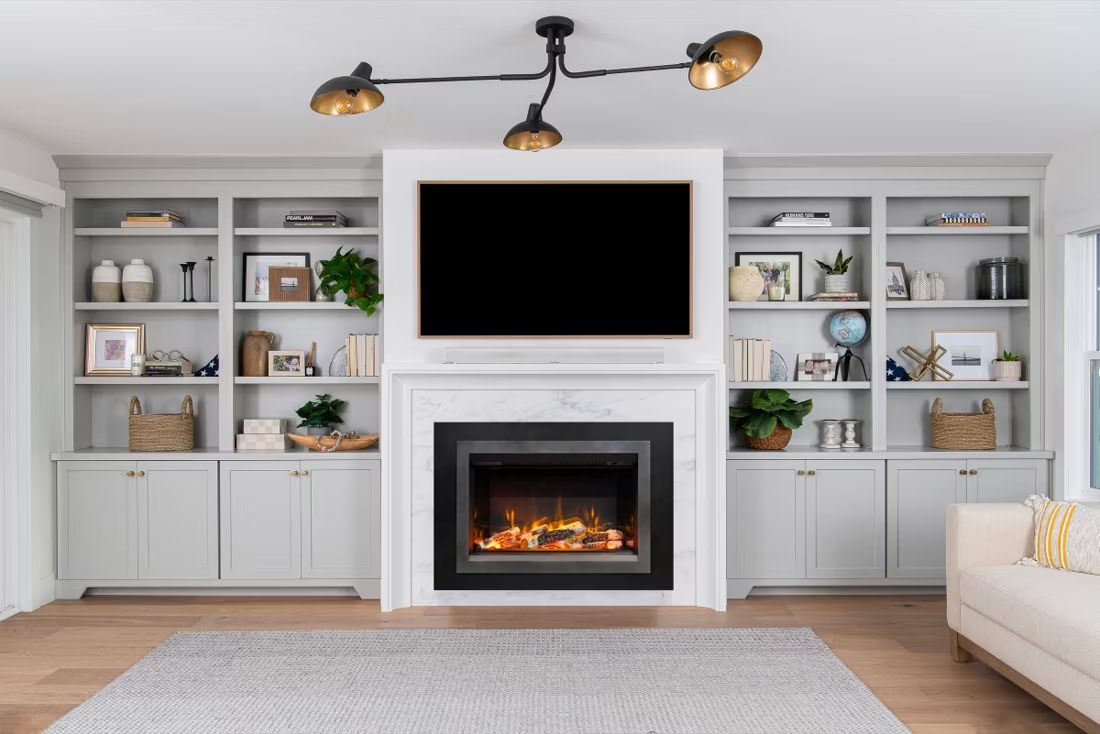
That's exactly where electric fireplaces fit. Union Electric Co (Ameren Missouri) serves St. John at roughly $0.1256 per kWh, and a plug-in or built-in electric insert can supplement a room's heat for a few dollars a month without touching the home's structure. Whether it's a rental unit that can't have permanent modifications, a condo without an existing hearth, or a homeowner converting a drafty, unused masonry fireplace, electric gives St. John residents real ambiance and zone heat with none of the venting headaches.
Three steps. No salesperson until you're ready.
Tell us about your project
Your zip code, your situation, and the fuel you're leaning toward—or let the answers point you to one.
See what's actually available
The brands dealers within 100 miles genuinely carry—real options, never a catalog mirage.
Get your dealer & Project Guide
A trusted local dealer, plus the free Project Guide & Parts List that names every component of the job.
Frequently Asked Questions
How much does an electric fireplace installation cost in St. John?
Costs vary widely by unit type. A plug-in electric insert or freestanding stove that drops into an existing opening can run $300 to $1,200 installed, since it just needs a standard outlet. A built-in wall-mount unit or a linear electric fireplace set into new framing—common in St. John's ranch-style remodels—typically runs $1,500 to $4,000 once an electrician adds a dedicated 120V or 240V circuit and any surrounding cabinetry or tile work is factored in. Local dealers will give you a firm number after seeing your space.
Do I need a permit to install an electric fireplace in St. John?
Most plug-in electric fireplaces don't require a permit since there's no new wiring, venting, or gas work involved—you're just using an existing outlet. If you're having a built-in unit hardwired with a new circuit, the City of St. John's Building Department typically requires an electrical permit, and the work should be pulled by a licensed electrician. It's a much lighter process than a gas or wood installation, but it's worth confirming with the city before work starts, especially if the fireplace is going into a wall that wasn't previously wired.
What's the difference between an electric fireplace, insert, and stove?
An electric fireplace is typically a built-in or wall-mounted unit designed to look like a framed hearth, often with a mantel surround. An electric insert is sized to slide into an existing masonry fireplace opening, which is a popular option for St. John's older brick homes that have an unused wood-burning fireplace but no interest in cutting or hauling wood. An electric stove is a freestanding cabinet-style unit that mimics a wood or pellet stove's look. All three plug into standard household power and produce heat through the same resistance-coil or infrared technology—the difference is mostly aesthetic and how it fits your space.
How much does it cost to run an electric fireplace in St. John?
At Union Electric Co's residential rate of about $0.1256 per kWh, a typical 1,500-watt electric fireplace costs roughly 19 cents per hour to run on heat mode. Used for 4 to 6 hours a night as supplemental heat in a living room, that works out to roughly $25 to $35 a month during the coldest stretch of the year. Most units let you run the flame effect without the heater engaged, which uses only a few watts and costs pennies a month—useful if you want ambiance in October before you need actual heat.
Can an electric fireplace be my home's primary heat source?
No—electric fireplaces are built for supplemental, zone heating, not whole-home heating. With St. John's roughly five-month heating season and winter lows dropping into the mid-20s, a central furnace or heat pump still needs to carry the load for the house as a whole. What an electric unit does well is take the edge off a specific room—a den, a finished basement, a sunroom—so you can turn the thermostat down elsewhere and heat only the space you're using.
What should I look for in an electric fireplace for a St. Louis winter?
Look for a unit with a true 1,500-watt heating element rather than a lower-wattage model sold mainly for the flame effect—brands like Dimplex, Touchstone, and Napoleon make models with real heat output and adjustable thermostats. For St. John's older homes with plaster walls or limited outlet placement, a freestanding insert or stove that only needs a standard 15-amp circuit avoids electrical upgrades. If you're converting an existing masonry fireplace, measure the opening carefully—insert-style units are sized to specific firebox dimensions, and a local dealer can confirm fit before you buy.
Electric vs. gas fireplace—which is right for my St. John home?
Gas fireplaces produce more heat and give you a real flame, but they require either a natural gas line or propane tank, direct-vent piping, and a higher installation cost—often $3,000 to $8,000 in this area once gas line work and venting are included. Electric skips all of that: no venting, no gas permit, and a fraction of the install cost, which matters in a lot of St. John's smaller homes where running new gas piping through finished walls isn't practical. The tradeoff is heat output—electric units top out around 5,000 BTU-equivalent, while gas units can produce 20,000+ BTU. For a home that already has gas service and wants a strong secondary heat source, gas often wins. For a condo, rental, or a room where running gas isn't feasible, electric is usually the more practical answer.
Are electric fireplaces a good option for renters or condo owners in St. John?
Yes—this is one of the most common reasons homeowners in a dense inner suburb like St. John go electric. A plug-in insert or freestanding stove requires no permanent modification to the unit, no permit, and no landlord approval for structural changes, since it's essentially a large appliance that plugs into the wall. If you move, it moves with you. For condo buildings with restrictions on chimneys or open flame, an electric unit is often the only fireplace option allowed by the HOA in the first place.
How long does an electric fireplace installation take?
A plug-in insert or freestanding stove can be set up in under an hour—it's furniture-level installation, not construction. A built-in wall unit with new framing, a dedicated circuit, and surround finishing typically takes a local installer one to two days, depending on whether trim carpentry or tile work is involved. Compared to a gas conversion, which can take a week or more once permits and gas line inspections are factored in, electric is by far the fastest path to a working fireplace in St. John.
Can I put a TV above my fireplace?
Yes—with an asterisk. Fireplaces are hot and TVs don't like heat. Either put a mantel between them to deflect rising warmth, or choose a fireplace with heat-management technology that creates a cool zone on the wall above—the wall stays around 125 degrees, barely warm, while the room still gets full heat. If you like clean lines and don't want a mantel, heat management is the answer.
Does an electric fireplace need a vent or chimney?
No—that's its superpower. An electric fireplace needs a wall and an outlet, period. No vent pipe, no gas line, no clearances to design around, which is why it works in bedrooms, offices, apartments, and walls where venting a gas or wood unit would be impractical or impossible. Installation is typically the simplest and least expensive of any fireplace type.
How much should I budget for a fireplace?
For an average home—covering the fireplace, the vent pipe, and basic installation—a budget between $3,900 and $5,500 gives you a lot of options across wood, gas, and pellet. By the time you add finish work, gas line, and electrical, the average complete installation lands between $5,000 and $12,000 all-in. In a remodel or new build, a good rule is to put about 2.5% of the total project cost toward the fireplace.
What is an in-home preview and do I need one?
It's a visit where a hearth professional measures your space, confirms the model you picked actually works in your home, and walks the specs—framing, gas line, venting, finish work—before anything is ordered. Some details you just can't know until you see the house. Never make a down payment without one; it's the single most-skipped step that burns buyers.
Nearby Dealers
Hearth shops serving St. John and the surrounding area. Every listing shows whether it is a WhyFire partner, a dealer we have verified as authorized for the brands we recommend, or a local business carrying hearth products. No manufacturer pays for placement. How we verify dealers →
Gas Appliance Service LLC
Savvy Surroundings
Forshaws
Villa Lighting Supply
Fireside Hearth & Grill Center
Fireplace And Grill Center
English Sweep
Summer Classics By Forshaw
Brighthouse Living
Arnold Stove & Fireplace Center
C Bennett Building Supply
Hearthside Grill & Fireplace
Electric Service in St. John
An electric fireplace's heater draws about 1,500 watts—pennies per hour at local rates.
Union Electric Co - (Mo)
Find your electric fireplace in St. John.
Tell us a bit about your home and we'll put together a free Project Guide & Parts List—the right electric fireplace or insert for your space, plus a trusted local dealer near St. John who can install it.
Find Your Fireplace →