
Find the Right Fireplace for Every St. Louis County Home.
Fireplace resources for every municipality in St. Louis County—from Clayton to Chesterfield to Florissant. Connect with a trusted local hearth retailer who knows the permit process in your specific suburb.
Every Project Starts From One of These Five Situations
Gas-forward heating across St. Louis County, Missouri.
St. Louis County sits in climate zone 4A with an average winter low around 25°F and roughly 4,292 heating degree days a year—a real winter, but a mild one next to places like Duluth, Minnesota or Fargo, North Dakota, where HDD totals run double. Nearly every one of the county's almost 90 municipalities is served by natural gas through Spire Energy, and most homes were built with forced-air gas furnaces as the primary heat source. That infrastructure is why gas fireplaces, gas inserts, and gas log sets are the default hearth choice here—a retailer can tie into an existing gas line rather than build a heating system from scratch.
Wood-burning fireplaces do exist across the county, largely as decorative masonry features in older housing stock in inner-ring suburbs like Webster Groves, Kirkwood, and University City—oak, hickory, walnut, and maple are the native hardwoods, but they're rarely burned as a primary heat source anymore. Pellet stoves are uncommon for the same reason: with gas this available, there's little demand for a wood-alternative fuel. This hub covers what's actually installable in St. Louis County—mostly gas and electric, with honest notes on where wood and pellet still make sense for restoring an existing chimney or adding ambiance.
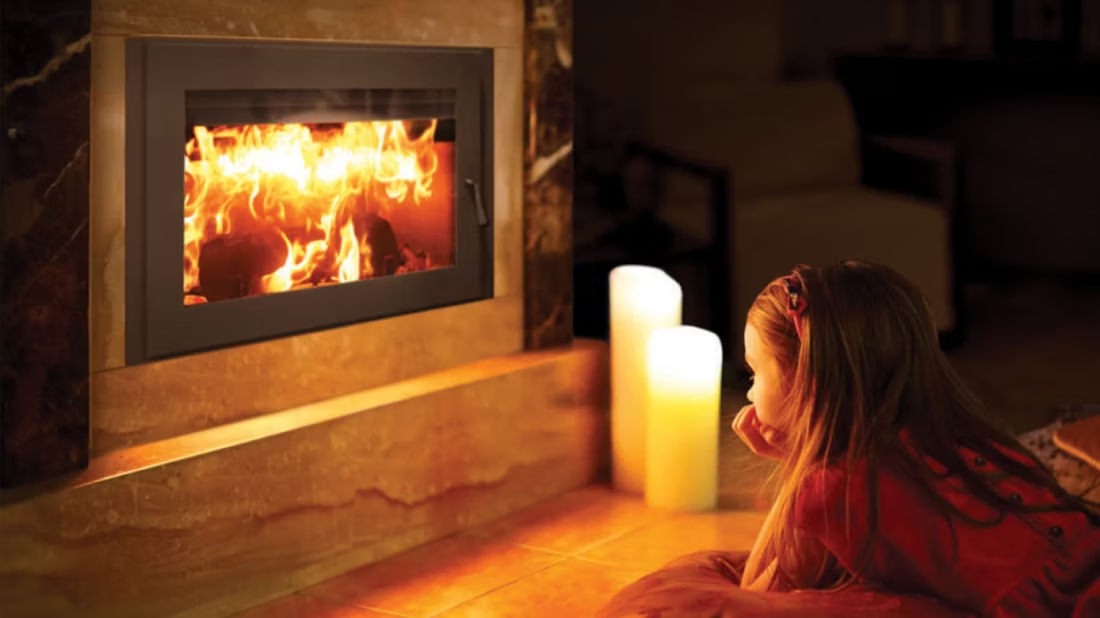
Four fuels. One honest answer for St. Louis County.
Three steps. No salesperson until you're ready.
Tell us about your project
Your zip code, your situation, and the fuel you're leaning toward—or let the answers point you to one.
See what's actually available
The brands dealers within 100 miles genuinely carry—real options, never a catalog mirage.
Get your dealer & Project Guide
A trusted local dealer, plus the free Project Guide & Parts List that names every component of the job.
Frequently Asked Questions
Which fuel works best in St. Louis County?
For most homes, gas. Spire Energy's extensive service territory across the county's nearly 90 municipalities means most homes already have a gas line, and a direct-vent gas fireplace or insert ties into that existing infrastructure with minimal construction. Electric fireplaces are a strong second choice—no venting required, which makes them popular for condos, finished basements, and newer builds in areas like Chesterfield where zero-clearance installs are common. Wood fireplaces mostly exist as decorative features in older homes with existing masonry chimneys (common in Webster Groves and Kirkwood), rather than as new installs. Pellet stoves are rare here—the county's mild winters (25°F average low, 4,292 HDD) and near-universal gas access remove most of the reasons homeowners elsewhere choose pellet as a wood alternative.
Do I need a permit to install a fireplace in St. Louis County?
In most cases, yes, but the process depends entirely on which of the county's nearly 90 municipalities you're in. Clayton, Chesterfield, Ballwin, and Kirkwood each maintain their own building department with their own permit fees and inspection schedules; if you're in an unincorporated area, permits go through the St. Louis County Department of Public Works instead. Gas fireplace and insert installations typically require both a building permit and a licensed gas-fitter for the line connection. Electric fireplaces usually don't require a permit unless it's a built-in installation with new wiring or a dedicated circuit. Most local hearth retailers handle the permit paperwork for whichever municipality you're in as part of the installation quote.
Are there air quality restrictions on wood burning in St. Louis County?
No county-wide restrictions of the kind you'd see in wildfire-prone or inversion-prone western counties—St. Louis County isn't a non-attainment area and doesn't run seasonal burn curtailment programs. That said, because the county is densely subdivided into close-set neighborhoods, some individual municipalities have nuisance ordinances covering smoke drifting onto neighboring properties, particularly in older, tightly-packed suburbs. If you're restoring an existing wood fireplace, check your specific municipality's code rather than assuming county-wide rules apply.
Why aren't wood and pellet stoves more common in St. Louis County?
It comes down to infrastructure and climate. St. Louis County's winters are real but moderate—a 25°F average low and 4,292 heating degree days, roughly half what you'd see in Duluth, Minnesota—so wood or pellet as a primary heat source isn't the necessity it is farther north. Combine that with Spire Energy's near-universal gas coverage and dense municipal zoning across the county's nearly 90 cities, and there's little practical case for installing a new wood stove or pellet stove. Where wood does show up is in older homes with an original masonry fireplace—homeowners in Webster Groves or University City sometimes add a wood or gas insert to an existing chimney rather than build new venting from scratch.
Can one local hearth retailer handle all four fuel types?
Most St. Louis County retailers focus on gas and electric, since that's where the vast majority of demand sits. A smaller subset also carry wood inserts for retrofitting an existing masonry chimney, and pellet products are typically available only through specialty dealers or the regional suppliers who serve the handful of pellet stove owners in the county. If you're restoring an older fireplace and aren't sure whether gas, electric, or wood makes sense for your specific chimney, look for a retailer who explicitly lists insert experience—that's usually the differentiator, not a full four-fuel showroom.
What's the typical cost range for fireplace installation across fuel types in St. Louis County?
Gas fireplace, insert, or stove: roughly $3,500–$9,000 depending on whether an existing gas line is in place or new line work is needed. Electric fireplace: $200–$3,000 for the unit itself, plus $400–$1,200 in labor for anything beyond a plug-and-play wall unit. Wood insert retrofit into an existing masonry chimney: roughly $3,000–$6,000, mostly labor and liner work rather than new construction. Pellet stove: $3,500–$6,500 for the smaller number of installs each year. Exact pricing depends on which of the county's nearly 90 municipalities you're in and their specific permit fees—see the county + fuel pages above for retailer-specific detail.
Does a fireplace add value to my home?
On average, a fireplace adds back to the home about the same amount you spent installing it. Add the monthly savings from heating the rooms you actually use instead of the whole house—often hundreds of dollars a year—and the value case is strong before you even count what a fire does for how your family uses the room.
Wood, gas, pellet, or electric—how do I choose?
Match the fuel to your life, not the other way around. Wood: lowest fuel cost and total power-outage independence, but you're hauling and stacking. Gas: press a button, set a thermostat, no maintenance to speak of. Pellet: wood economics with automatic feeding, in exchange for weekly cleaning and a need for electricity. Electric: plugs in anywhere with honest supplemental heat. Nobody regrets the fuel that fits how they actually live.
Can a fireplace actually lower my heating bill?
Yes—by creating a comfort zone. A furnace heats every square foot of the house just to warm the one room you're in; a gas fireplace on low burns roughly a sixth of the gas a typical furnace does. Set the furnace around 55–60 degrees as a baseline, then heat the rooms your family actually uses. Families who heat this way commonly save $20–$60 a month.
What is an in-home preview and do I need one?
It's a visit where a hearth professional measures your space, confirms the model you picked actually works in your home, and walks the specs—framing, gas line, venting, finish work—before anything is ordered. Some details you just can't know until you see the house. Never make a down payment without one; it's the single most-skipped step that burns buyers.
Stove and Fireplace Dealers in St. Louis County
Listings include WhyFire partner dealers, dealers we have verified as authorized for the brands we recommend, and established local businesses that carry hearth products. Every listing shows which one it is. The ones marked Preferred run on WhyFire's software, so they can show you real pricing and book your appointment right here. No manufacturer pays for placement. How we verify dealers →
Savvy Surroundings
Forshaws
Gas Appliance Service LLC
Villa Lighting Supply
Fireplace And Grill Center
Fireside Hearth & Grill Center
English Sweep
Summer Classics By Forshaw
Arnold Stove & Fireplace Center
Brighthouse Living
Hearthside Grill & Fireplace
C Bennett Building Supply
Get matched with a St. Louis County hearth dealer.
Pick your fuel below and we'll match you with a trusted local dealer serving your municipality, plus a free Project Guide & Parts List—the exact parts, vent kit, and gas line specs for your project in St. Louis County.
Find Your Fireplace →