
Keep Your Family Warm and Safe—No Matter What
Winters here average 9°F lows and add up to a long, hard heating season, but West St. Paul is a built-out, gas-piped inner-ring suburb—so wood stoves show up in specific homes, not most of them. We'll help you figure out if yours is one.
Every Project Starts From One of These Five Situations
Cold winters, but gas already reaches almost every block.
West St. Paul sits on the bluffs above the Mississippi River in Dakota County, a fully developed inner-ring suburb of Cape Cods, ramblers, and split-levels mostly built between 1945 and 1965. The climate is genuinely cold—winters here run about as long and harsh as Fargo, ND, not a mild Midwestern winter—but unlike rural or forested parts of Minnesota, this city has no adjoining national forest, no cutting-permit office, and almost no lots large enough for a woodpile and a stovepipe chimney to feel like the obvious choice.
Natural gas service from Northern States Power (Xcel Energy) and the City of St. Paul's utility reaches nearly every home here, which is the main reason wood heat never became standard the way it has in places like Duluth or the Iron Range. That said, wood isn't nonexistent: homeowners restoring an original masonry fireplace in an older bungalow, or households who want heat that keeps working when the power (and the furnace blower) doesn't, still look at a wood stove or insert. Local oak, maple, birch, and aspen are the species you'll find at metro firewood suppliers, and any install here works within the Minnesota State Building Code rather than a wildland fire-district rulebook.
Three steps. No salesperson until you're ready.
Tell us about your project
Your zip code, your situation, and the fuel you're leaning toward—or let the answers point you to one.
See what's actually available
The brands dealers within 100 miles genuinely carry—real options, never a catalog mirage.
Get your dealer & Project Guide
A trusted local dealer, plus the free Project Guide & Parts List that names every component of the job.
Frequently Asked Questions
Are wood stoves even legal to install in West St. Paul?
Yes. There's no local ordinance banning wood-burning appliances, and air quality here is flagged as a non-issue—West St. Paul isn't in a non-attainment zone and doesn't deal with the winter inversion problems that trigger burn bans in mountain valleys out west. Installations go through the City of West St. Paul's building permit process under the Minnesota State Building Code, same as any other solid-fuel appliance in the Twin Cities metro. The bigger constraint isn't legality, it's practicality: narrow lots and shared property lines mean clearance-to-combustible rules and chimney placement take more planning than they would on a rural acreage.
What does a wood stove installation typically cost in West St. Paul?
There isn't a large local install base to pull firm averages from, but Twin Cities metro installers commonly quote $3,500 to $8,000 for a wood stove or insert, depending on whether you're feeding an existing masonry chimney with a stainless liner or building new Class A pipe through a roof that was never designed for one. Older West St. Paul bungalows with an original fireplace tend to land on the lower end as insert conversions; homes with no existing chimney run higher because the venting has to be built from scratch.
Why don't more homes in West St. Paul have wood stoves if winters are this cold?
Mostly infrastructure and lot size. Northern States Power's gas network covers nearly the whole city, so builders here have piped gas to nearly every home since the postwar boom that built most of West St. Paul's housing stock. Add in tight lot lines, shared driveways, and small backyards with nowhere to season a cord of oak, and gas simply became the path of least resistance. Wood heat never disappeared, but it stayed a niche choice for specific homes rather than a default.
What firewood species are actually available around West St. Paul?
Oak, maple, birch, and aspen are what you'll find from Twin Cities metro firewood suppliers and what most local boulevard and yard trees produce. Oak and hard maple are the ones to ask for if you want long, hot burns and don't mind a longer seasoning time (a full year, sometimes more). Birch lights fast and burns hot but quick, which makes it a good kindling or shoulder-season wood. Aspen is common but lower-density—fine for milder days, less ideal for a January cold snap when overnight lows sit near 9°F.
Where do West St. Paul residents get firewood if there's no local cutting permit office?
Because West St. Paul has no adjoining national forest—the nearest public land with cutting permits is up near the Chippewa or Superior National Forest, hours north—almost nobody here self-cuts firewood. Instead, residents buy delivered cords from Twin Cities-area firewood dealers, typically running $220 to $300 per cord depending on species and whether it's kiln-dried or seasoned. If you're planning to actually heat with wood through a Minnesota winter, budget on 3 to 5 cords for the season depending on your stove size and how much of your heat load it's carrying.
Does West St. Paul have wood-burning restrictions or air quality burn bans?
No—air quality concerns are listed as none for this area, which is a real point in wood heat's favor here. Unlike high-desert or mountain-valley towns that deal with winter temperature inversions trapping smoke, the Twin Cities metro's open, flat terrain doesn't create the same stagnant-air problem. You won't run into curtailment periods or red/yellow burn-ban days the way homeowners do in parts of the Mountain West or Pacific Northwest.
Wood stove or pellet stove—does either make more sense here?
Both are genuinely uncommon in West St. Paul for the same underlying reason: dense lot sizes and near-universal gas service. Pellet bags from brands like Lignetics and Somerset Pellet Fuel are easy enough to find at Twin Cities farm-and-fleet retailers, and a pellet stove is arguably the lower-hassle option since it doesn't require seasoned cordwood or a masonry chimney. But pellet stoves need electricity to run the auger and blower, so they go dark in a power outage—which matters if your reason for wanting wood heat in the first place is backup warmth during a Minnesota ice storm. If that's the priority, a wood stove wins on resilience even though it's the less convenient day-to-day appliance.
Who actually installs wood stoves in West St. Paul, and why?
The typical candidate is a homeowner in one of West St. Paul's original postwar Cape Cods or ramblers who has an existing masonry fireplace that's never been more than decorative, and wants to convert it into a real heat source with a wood insert. The other common case is a household that's been through a multi-day winter power outage and wants a heat source that doesn't depend on the electric grid or a gas furnace's blower motor—a wood stove will keep a room livable at 9°F outside even with the power off, which neither a gas furnace nor a pellet stove can promise.
Wood vs. gas—which actually makes sense for a West St. Paul home?
For nearly all West St. Paul homes, gas wins on convenience: it's instant, it's clean, and Northern States Power's infrastructure already reaches your house, so there's no gas line to run in most cases. Wood wins in one specific scenario—you want a heat source that works when the grid doesn't, or you have an existing fireplace you'd rather restore than remove. Given how cold the winters actually get here, some homeowners end up with both: gas for daily comfort, a wood insert or stove as the backup plan for the next ice storm.
What's the difference between an insert and a zero-clearance fireplace?
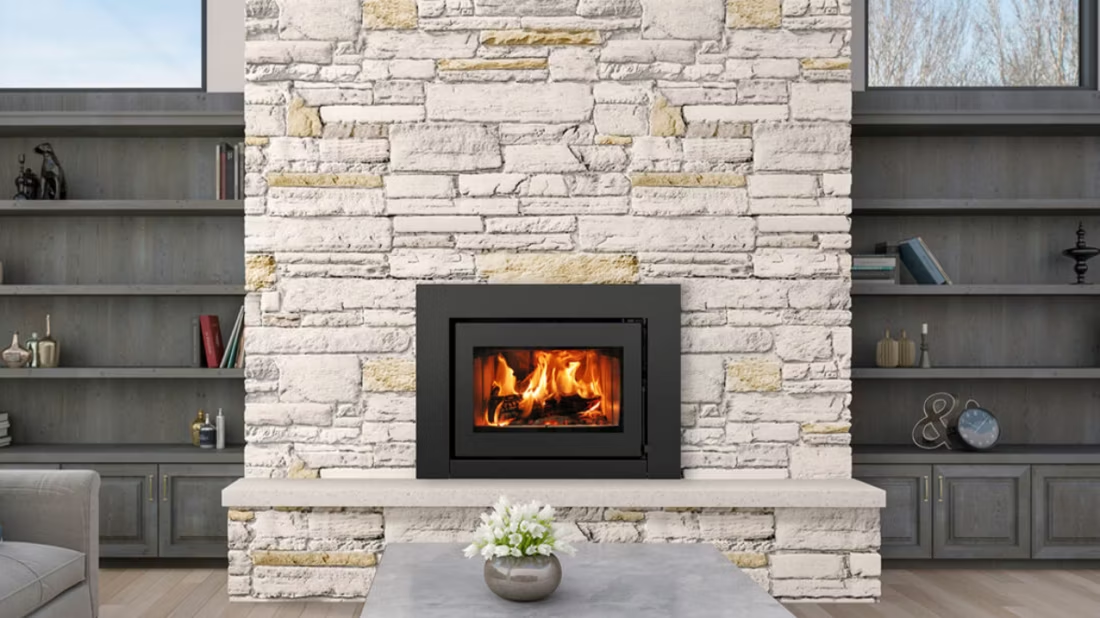
An insert is a fireplace that slides into a pre-existing wood-burning fireplace—if you don't have one, there's nothing to insert it into. A zero-clearance fireplace is built into a framed wall, which makes it the answer for remodels and new construction. Simple test: existing masonry fireplace means insert; blank or framed wall means zero-clearance.
Why is a fireplace insert so efficient?
An insert does two things: it seals the chimney completely, so you stop losing air you already paid to heat, and it radiates warmth into the room through the firebox and glass. Most add a heat-exchange fan that pulls cool room air underneath, wraps it around the hot firebox, and pushes it back out warm. Your home is more efficient before you've even lit the first fire.
Can a fireplace actually lower my heating bill?
Yes—by creating a comfort zone. A furnace heats every square foot of the house just to warm the one room you're in; a gas fireplace on low burns roughly a sixth of the gas a typical furnace does. Set the furnace around 55–60 degrees as a baseline, then heat the rooms your family actually uses. Families who heat this way commonly save $20–$60 a month.
Can I install a fireplace myself?
If you're putting a fire in your house on purpose, it's best to work with an expert. Unless you're genuinely experienced in framing, gas line, vent pipe, and the national code on clearances to combustibles, have a professional do it—and ideally the same company that sells you the fireplace, so warranty, service, and liability all live under one roof.
Nearby Dealers
Hearth shops serving West St. Paul and the surrounding area. Every listing shows whether it is a WhyFire partner, a dealer we have verified as authorized for the brands we recommend, or a local business carrying hearth products. No manufacturer pays for placement. How we verify dealers →
Fireside Hearth & Home - Eagan
The Chimney Pro’s Mn
Fireside Hearth & Home - Roseville
Minnesota Gas Grills & Fireplaces
Pure Design Environments
Ferguson Enterprises
Condor Fireplace & Stone
Comfort By Design
Fireside Hearth & Home - Eden Prairie
Fireside Hearth & Home - Minnetonka
Custom Fireplace & Chimney Care
Fireside Hearth & Home - Maple Grove
Scotts Heating And Ac
Glowing Hearth & Home - Coon Rapids
Find your wood fireplace option in West St. Paul.
Tell us about your home and whether you're restoring an existing fireplace or starting from scratch. We'll give you an honest read on whether wood fits, and match you with a trusted local dealer plus a free Project Guide & Parts List—including the vent kit—for your specific installation.
Find Your Fireplace →