
Gas Heat Built for St. Paul's Long, Cold Winters.
With a winter heating load that rivals Fargo, ND and winter lows that regularly sit near 9°F, St. Paul homes need heat that turns on instantly and keeps up. Find the right gas fireplace or insert and connect with a trusted local dealer.
Every Project Starts From One of These Five Situations
Warmth that keeps up with a true Zone 6A winter.
St. Paul sits in climate zone 6A at 820 feet along the Mississippi River bluffs, with a winter heating load that rivals Fargo, ND, and winters where the average low hovers around 9°F—with stretches well below zero most Januaries. In a metro this cold, a fireplace isn't just for ambiance during the holidays; it's a genuine heat source that a lot of homeowners lean on during subzero snaps and the occasional ice-storm power outage.
Natural gas service reaches most of St. Paul through CenterPoint Energy's Twin Cities distribution network, which makes direct-vent gas fireplaces and inserts a practical, widely available option across the city—from the 1900s-era homes around Cathedral Hill and Summit Avenue to newer construction in Highland Park and the East Side. A properly sized direct-vent unit delivers real, on-demand heat at the flip of a switch, and select models keep working even when the power goes out.
Three steps. No salesperson until you're ready.
Tell us about your project
Your zip code, your situation, and the fuel you're leaning toward—or let the answers point you to one.
See what's actually available
The brands dealers within 100 miles genuinely carry—real options, never a catalog mirage.
Get your dealer & Project Guide
A trusted local dealer, plus the free Project Guide & Parts List that names every component of the job.
Frequently Asked Questions
How much does a gas fireplace installation cost in St. Paul?
A direct-vent gas fireplace or insert installation in the St. Paul area typically runs $4,000 to $10,000, depending on the unit, the venting path through an exterior wall or roof, and whether a new gas line needs to be run from your meter. Homes already plumbed for natural gas—common in St. Paul's older neighborhoods where gas ranges and water heaters are the norm—tend to land on the lower end. New construction or additions requiring a longer gas line run and full venting package sit higher. A local dealer will give you a firm number after seeing your chimney or wall configuration in person.
Can I convert an existing wood fireplace to gas?
Yes, and it's one of the most common projects in a city like St. Paul, where so much of the housing stock—the classic Cathedral Hill Victorians, the Mac-Groveland foursquares, the brick duplexes on the East Side—was built with a wood-burning masonry fireplace as a standard feature. A gas insert slides into that existing firebox and vents through a stainless liner run up your current chimney, which keeps the mantel and surround intact while eliminating the ash, smoke, and creosote upkeep. Expect $4,500 to $9,000 for a typical conversion, with cost driven mainly by whether new gas piping has to reach the fireplace location.
Is natural gas available at my address, or do I need propane?
Most of St. Paul, including all the zip codes from downtown (55101, 55102) out through Highland Park (55116) and the East Side (55119, 55130), sits within CenterPoint Energy's natural gas service territory. If your home already has a gas furnace, range, or water heater, adding a fireplace almost always means tapping into gas you already have on-site. Propane is rarely needed inside city limits and mostly comes into play for detached structures or lots at the edge of Ramsey County that fall outside the distribution network—your installer will confirm which applies to your address.
Will my gas fireplace still work if the power goes out?
Most units with intermittent pilot ignition (IPI) include a battery backup that automatically takes over when St. Paul loses power during an ice storm or a heavy Alberta clipper—the fireplace lights on demand off the batteries, same as usual. Valor fireplaces handle this differently: their pilot assembly generates its own electricity through the thermocouple, so there's no battery to remember to replace, ever. Given how often winter storms in the Twin Cities knock out power for a few hours or a full day, this is worth asking about when you're comparing units with a local dealer.
What's the difference between a gas fireplace, gas insert, and gas stove?
A gas fireplace is a fully framed-in unit built into a wall—the right call for new construction or a remodel where there's no existing masonry. A gas insert is built to slide into an existing wood-burning firebox, which describes a huge share of homes in St. Paul's older neighborhoods. A gas stove is freestanding, sits directly on the floor, and works well in a room that never had a fireplace at all—a converted porch or a basement family room, for instance. For most St. Paul homeowners upgrading an existing masonry fireplace, an insert is the straightforward choice.
Do I need a permit to install a gas fireplace in St. Paul?
Yes—the City of St. Paul Department of Safety and Inspections (DSI) requires both a mechanical permit and a gas piping permit for new gas fireplace or insert installations, and the work has to be signed off by a licensed gas-fitter. In practice, the hearth retailer or contractor you hire pulls these permits and schedules the inspection as part of the job, so you're not coordinating separate trades yourself. This is one of the reasons it pays to go through an established local dealer rather than a handyman install.
Should I get a vented or vent-free gas fireplace for a St. Paul home?
Direct-vent units—sealed combustion that draws air from outside and exhausts back outside—are by far the more common and more strongly recommended choice for St. Paul homes. Vent-free (unvented) fireplaces are legal in Minnesota within room-size and ventilation limits, but they release combustion byproducts into the living space, which matters more in a tightly sealed, well-insulated house built for a heavy winter heating load like St. Paul's. Direct-vent units avoid that trade-off entirely and still deliver strong heat output on a subzero night, which is why most local dealers steer homeowners toward them.
How often does a gas fireplace need to be serviced?
Plan on an annual inspection, ideally in early fall before the unit sees regular winter use. A technician checks the burner, pilot assembly, venting, and gas connections, and cleans the glass—a straightforward visit that typically runs $150 to $250 in the Twin Cities. It's a much lighter lift than wood-stove chimney sweeping, but skipping it is how small issues like a dirty flame sensor or a failing thermocouple turn into a fireplace that won't light on the coldest night of the year.
Gas vs. electric fireplace—which makes more sense for my St. Paul home?
Gas delivers real, substantial heat output—enough to take the chill off a room during a January cold snap—and runs on natural gas that's already reaching most St. Paul homes through CenterPoint Energy. Electric fireplaces plug into a standard outlet, need no venting or gas line at all, and are the simpler retrofit, but at Xcel Energy's residential rate of about 16.98 cents per kWh, they're better suited to ambiance and light supplemental warmth than to seriously heating a room through a Minnesota winter. For a St. Paul living room that needs to actually perform on the coldest nights, gas is usually the better fit; electric fits smaller spaces, condos, or rentals where venting isn't an option.
Can I put a TV above my fireplace?
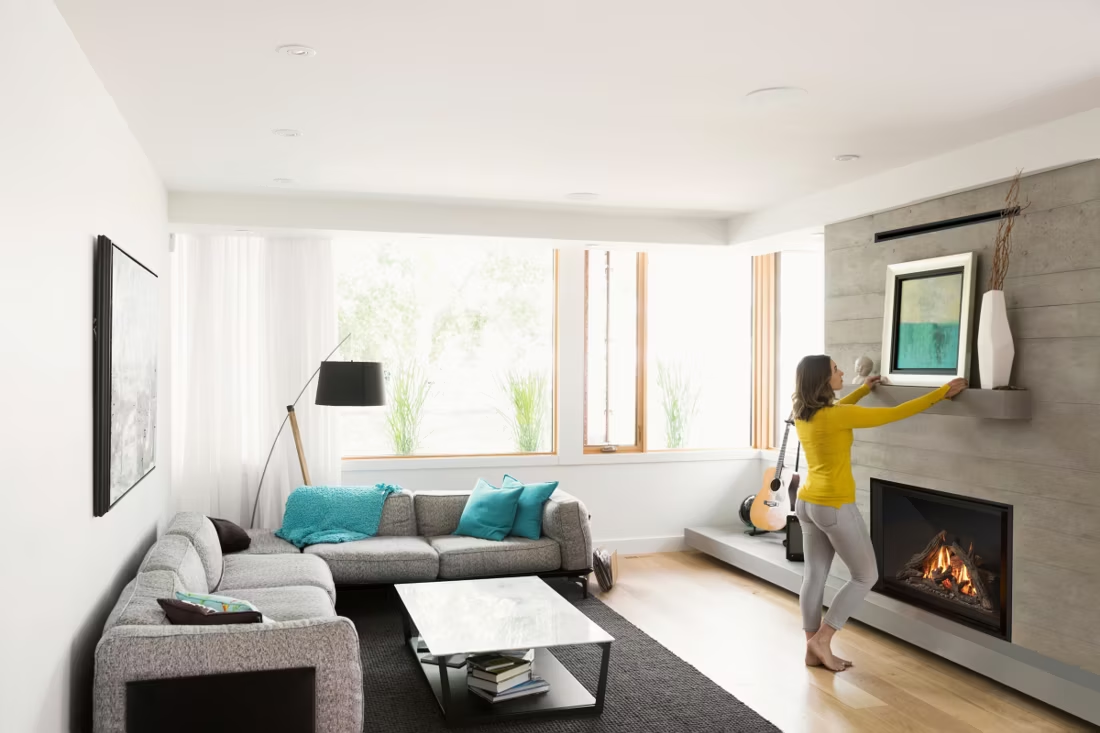
Yes—with an asterisk. Fireplaces are hot and TVs don't like heat. Either put a mantel between them to deflect rising warmth, or choose a fireplace with heat-management technology that creates a cool zone on the wall above—the wall stays around 125 degrees, barely warm, while the room still gets full heat. If you like clean lines and don't want a mantel, heat management is the answer.
What's the difference between an insert and a zero-clearance fireplace?
An insert is a fireplace that slides into a pre-existing wood-burning fireplace—if you don't have one, there's nothing to insert it into. A zero-clearance fireplace is built into a framed wall, which makes it the answer for remodels and new construction. Simple test: existing masonry fireplace means insert; blank or framed wall means zero-clearance.
Does a fireplace add value to my home?
On average, a fireplace adds back to the home about the same amount you spent installing it. Add the monthly savings from heating the rooms you actually use instead of the whole house—often hundreds of dollars a year—and the value case is strong before you even count what a fire does for how your family uses the room.
Can a fireplace actually lower my heating bill?
Yes—by creating a comfort zone. A furnace heats every square foot of the house just to warm the one room you're in; a gas fireplace on low burns roughly a sixth of the gas a typical furnace does. Set the furnace around 55–60 degrees as a baseline, then heat the rooms your family actually uses. Families who heat this way commonly save $20–$60 a month.
Nearby Dealers
Hearth shops serving St. Paul and the surrounding area. Every listing shows whether it is a WhyFire partner, a dealer we have verified as authorized for the brands we recommend, or a local business carrying hearth products. No manufacturer pays for placement. How we verify dealers →
The Chimney Pro’s Mn
Fireside Hearth & Home - Roseville
Fireside Hearth & Home - Eagan
Minnesota Gas Grills & Fireplaces
Condor Fireplace & Stone
Ferguson Enterprises
Pure Design Environments
Custom Fireplace & Chimney Care
Fireside Hearth & Home - Minnetonka
Fireside Hearth & Home - Eden Prairie
Fireside Hearth & Home - Maple Grove
Comfort By Design
Glowing Hearth & Home - Coon Rapids
Fireplace Gallery, Inc.
Scotts Heating And Ac
Find your gas fireplace in St. Paul.
Tell us about your home and your existing fireplace or chimney, and we'll match you with a trusted local St. Paul dealer plus a free Project Guide & Parts List—the exact parts, vent kit included, for your project.
Find Your Fireplace →