
Warm, Reliable Heat for Faribault's Long Winters.
Faribault racks up a long, cold winter heating season and lows that regularly hit single digits. A gas fireplace delivers instant, dependable warmth without a woodpile. Find the right unit and connect with a trusted local dealer.
Every Project Starts From One of These Five Situations
Steady heat built for a genuinely cold climate.
Faribault sits in Rice County about 45 miles south of the Twin Cities, at a modest 976 feet of elevation but squarely in climate zone 6A, with average winter lows near 5°F and a long, cold winter heating season comparable to Fargo, ND. Unlike parts of the country where firewood cutting is part of the culture, active wood-burning is uncommon here; most of the older homes downtown that still have a masonry fireplace use it rarely, if at all, and few local suppliers sell firewood commercially. Gas has become the practical, mainstream choice for both new construction on the edges of town and older homes near downtown looking to upgrade an unused fireplace.
Most of Faribault proper has natural gas service, and outside city limits in rural Rice County, propane is the standard alternative for homes not reached by a gas main. Either way, a direct-vent gas fireplace or insert gives you heat at the flip of a switch, consistent output through the coldest stretches of a Minnesota winter, and—on models with battery-backed ignition—a fireplace that still lights during an ice-storm power outage on either Xcel Energy's (Northern States Power Company) grid or Steele-Waseca Cooperative Electric's rural lines.
Three steps. No salesperson until you're ready.
Tell us about your project
Your zip code, your situation, and the fuel you're leaning toward—or let the answers point you to one.
See what's actually available
The brands dealers within 100 miles genuinely carry—real options, never a catalog mirage.
Get your dealer & Project Guide
A trusted local dealer, plus the free Project Guide & Parts List that names every component of the job.
Frequently Asked Questions
How much does a gas fireplace installation cost in Faribault?
Most gas fireplace and insert projects in Faribault run roughly $4,000 to $10,000. A direct-vent insert dropped into an existing masonry fireplace with a nearby gas line sits toward the lower end, typically $4,000 to $6,500. A full built-in gas fireplace for new construction or a remodel—with framing, new venting through an exterior wall, and a gas line run from the meter—lands closer to $7,000 to $11,000. Homes on propane rather than natural gas sometimes add a bit more if a new tank or regulator setup is needed.
Can I convert an older Faribault fireplace from wood to gas?
Yes, and it's one of the more common projects local hearth dealers handle here. Faribault has plenty of older homes with a masonry fireplace that was built for wood but rarely used for it—wood-burning just isn't a big part of daily life in this part of Rice County the way it is farther north or out west. Converting to a gas insert uses your existing chimney (typically with a stainless liner) as the vent path, keeps the look of the original opening, and turns a decorative, drafty fireplace into a real heat source. Expect $4,000 to $8,000 depending on the insert and whether new gas piping is required.
Do I need natural gas, or can I run a fireplace on propane?
Either works, and your address decides which makes sense. Homes within Faribault's city limits are generally on the natural gas main, so if you already have gas service for a furnace or water heater, adding a fireplace is straightforward. Out in the townships surrounding Faribault, where natural gas mains don't reach, propane is the standard fuel—supplied from an above-ground or buried tank on the property. Nearly every gas fireplace and insert sold locally can be configured for either fuel; your installer sets the correct orifice and regulator for whichever you have.
Will a gas fireplace still work if the power goes out?
Most will. Units with intermittent pilot ignition (IPI) run on a small battery backup that keeps the fireplace lighting on demand even when Xcel Energy's grid (Northern States Power Company) or Steele-Waseca Cooperative Electric's rural lines go down in a winter storm—which does happen in Rice County during heavy ice or high wind events. Valor fireplaces take a different approach: their pilot generates its own electricity through a thermocouple, so there's no battery to remember at all. Given how far a Faribault winter power outage can stretch temperatures indoors, this is worth asking your local dealer about directly.
What's the difference between a gas fireplace, insert, and stove?
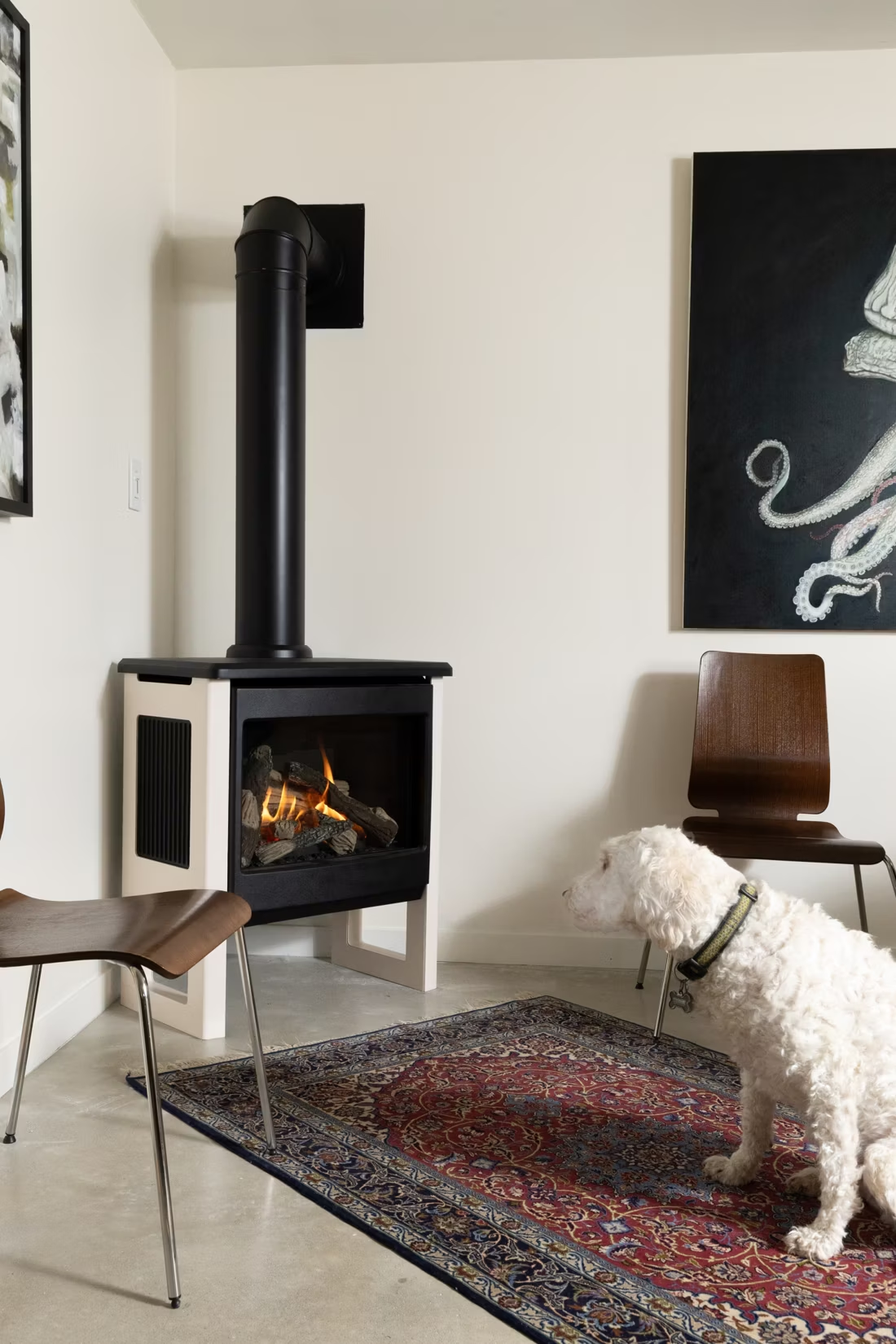
A gas fireplace is a built-in unit framed into a wall—the right call for new construction or a remodel without an existing hearth. A gas insert slides into an existing masonry fireplace opening and uses the chimney as its vent path, which fits a lot of Faribault's older housing stock near downtown. A gas stove is freestanding, sitting on a hearth pad much like a wood stove would, and works well in a room without any existing fireplace. For most homeowners here converting an unused wood fireplace, an insert is the simplest and most cost-effective route.
Do I need a permit to install a gas fireplace in Faribault?
Yes—a building permit is required through the City of Faribault (or Rice County if you're outside city limits), and any new or extended gas line needs to be run by a licensed gas fitter under the Minnesota Fuel Gas Code. A reputable local hearth dealer typically pulls the permit and schedules the inspection as part of the installation, so you're not coordinating separate trades yourself.
Should I choose a vented or vent-free gas fireplace in Faribault?
Direct-vent (sealed combustion) units are the standard recommendation here, and for good reason: they draw combustion air from outside and exhaust it back outside through a sealed pipe, which matters in a well-insulated, tightly-built Minnesota home where indoor air exchange is already limited. Vent-free gas units are legal in Minnesota under specific room-sizing and oxygen-sensor rules, but most local dealers steer cold-climate customers toward direct-vent models for both air quality and heat performance through a long heating season like Faribault's.
What size gas fireplace do I need for a Faribault home?
With such a long, cold winter, Faribault homes generally need more BTU output than the same square footage would require in a milder climate. As a starting point, a 20,000–30,000 BTU direct-vent fireplace handles supplemental heat for an open living area, while units in the 30,000–40,000 BTU range are common where the fireplace is expected to carry a larger, poorly-insulated, or older space through single-digit nights. A local dealer will size the unit to your square footage, ceiling height, and insulation level during an in-home visit rather than relying on a generic chart.
Gas vs. wood—why do most Faribault homeowners choose gas?
Wood heat isn't really part of the picture here the way it is in more forested or rural parts of the Upper Midwest—even though oak, maple, birch, and aspen are the common species around Rice County, few homes rely on cordwood for daily heat and firewood delivery isn't a mainstream local business. Gas wins out for most Faribault homeowners because it starts instantly, needs no wood storage or ash cleanup, and holds a steady output through a long, genuinely cold season. A handful of rural properties still keep a wood stove as backup heat for extended outages, but for in-town homes and most new construction, gas is the default choice local dealers install.
What's the difference between an insert and a zero-clearance fireplace?
An insert is a fireplace that slides into a pre-existing wood-burning fireplace—if you don't have one, there's nothing to insert it into. A zero-clearance fireplace is built into a framed wall, which makes it the answer for remodels and new construction. Simple test: existing masonry fireplace means insert; blank or framed wall means zero-clearance.
Why is a fireplace insert so efficient?
An insert does two things: it seals the chimney completely, so you stop losing air you already paid to heat, and it radiates warmth into the room through the firebox and glass. Most add a heat-exchange fan that pulls cool room air underneath, wraps it around the hot firebox, and pushes it back out warm. Your home is more efficient before you've even lit the first fire.
How much should I budget for a fireplace?
For an average home—covering the fireplace, the vent pipe, and basic installation—a budget between $3,900 and $5,500 gives you a lot of options across wood, gas, and pellet. By the time you add finish work, gas line, and electrical, the average complete installation lands between $5,000 and $12,000 all-in. In a remodel or new build, a good rule is to put about 2.5% of the total project cost toward the fireplace.
What is an in-home preview and do I need one?
It's a visit where a hearth professional measures your space, confirms the model you picked actually works in your home, and walks the specs—framing, gas line, venting, finish work—before anything is ordered. Some details you just can't know until you see the house. Never make a down payment without one; it's the single most-skipped step that burns buyers.
Nearby Dealers
Hearth shops serving Faribault and the surrounding area.
Find your gas fireplace in Faribault.
Tell us a bit about your home and we'll match you with a trusted local dealer and send over a free Project Guide & Parts List—the exact parts, including the vent kit, and the dealer we recommend for your gas fireplace project in Faribault.
Find Your Fireplace →