
Add electric warmth to your Faribault County home.
Reliable, plug-in heat and ambiance for the long Faribault County winter—from Blue Earth to Wells, Winnebago, and the farm townships in between. Find the right electric fireplace or stove and connect with a trusted local dealer.
Every Project Starts From One of These Five Situations
Heat that works without a chimney, a gas line, or a woodpile.
Faribault County sits in the flat farm country of south-central Minnesota, hard against the Iowa border, with the county seat in Blue Earth and small communities like Wells, Winnebago, Kiester, Bricelyn, and Elmore scattered across the townships. At 7,257 heating degree days and an average winter low of 8°F, the county's climate approaches what places like Fargo, ND see most winters—long stretches below freezing, several weeks that dip into single digits or below zero, and a heating season that runs from October well into April.
For a lot of Faribault County homeowners, electric fireplaces aren't the primary furnace—they're the zone heat in a finished basement, the ambiance in a living room addition, or the backup warmth in a farmhouse bedroom the ductwork never quite reaches. Because there's no chimney, no gas line, and in most cases no combustion permit involved, an electric unit is often the fastest and least invasive hearth project in the county. Most rural homes here are served by electric cooperatives such as Federated Rural Electric Association, with Xcel Energy covering some in-town service near Blue Earth—either way, a licensed electrician can confirm your panel and circuit can handle a new built-in unit before installation.
Three steps. No salesperson until you're ready.
Tell us about your project
Your zip code, your situation, and the fuel you're leaning toward—or let the answers point you to one.
See what's actually available
The brands dealers within 100 miles genuinely carry—real options, never a catalog mirage.
Get your dealer & Project Guide
A trusted local dealer, plus the free Project Guide & Parts List that names every component of the job.
Frequently Asked Questions
How much does an electric fireplace installation cost in Faribault County?
Cost depends almost entirely on the type of unit. A plug-in electric insert or freestanding stove that runs on a standard 15-amp household outlet typically runs $300 to $1,200 installed, since there's no venting, no gas line, and often no permit required. A built-in, wall-mounted linear electric fireplace—the kind recessed into a wall or dropped into an existing wood-burning firebox—usually runs $1,500 to $4,000 once you factor in framing, a dedicated 20-amp circuit, and an electrician's time to run it. A local dealer can tell you quickly which category your project falls into during a home visit.
What size electric fireplace do I need for my home?
Most electric fireplace heaters are rated to genuinely warm 400 to 1,000 square feet, which makes them a strong fit for a single room—a living room, a finished basement, a farmhouse addition—rather than a whole-house solution. In a county where winter lows average 8°F and heating degree days top 7,200, don't expect a 1,500-watt unit to replace your furnace on the coldest January nights; it's built to supplement central heat or handle a room that's hard to reach with existing ductwork. Local dealers size these based on room volume, window count, and insulation, not just square footage.
Where can I find installers for electric fireplaces near me?
Look for a licensed electrician for any built-in or hardwired unit, and a hearth dealer who specifically stocks linear and insert-style electric models for the finish work. Providers based around Blue Earth and Wells cover most of Faribault County; expect a modest trip charge for homes out toward Kiester, Bricelyn, or Delavan given how spread out the townships are in a county this rural. For plug-in units, most dealers will deliver and set the unit in place without needing an electrician at all.
What's the difference between an electric fireplace, insert, and stove?
An electric fireplace is typically a built-in or wall-mounted unit designed to look like a framed fireplace, often recessed into drywall or mounted flush on a wall. An electric insert is sized to slide into an existing masonry or wood-burning firebox, giving an old fireplace opening new life without any venting work. An electric stove is a freestanding cabinet-style unit that mimics a wood stove's look and can sit against nearly any wall with a nearby outlet. For Faribault County homes with an existing but unused fireplace opening, an insert is usually the simplest upgrade; for a new room or addition, a built-in or freestanding stove gives more placement flexibility.
Do I need a permit to install an electric fireplace in Faribault County?
Faribault County Planning & Zoning, based in Blue Earth, generally doesn't require a building permit for a plug-in electric fireplace since there's no combustion, venting, or structural change involved. A built-in unit that requires new wiring, a dedicated circuit, or a wall opening may need an electrical permit, and any framing changes should go through the county for a standard permit review. Ask your electrician or dealer to confirm—most handle the paperwork as part of the installation.
What's the best electric fireplace for Faribault County's climate?
For genuine supplemental heat during Faribault County's coldest stretches, look for units with a 1,500-watt (roughly 5,100 BTU) heater rather than a decorative-only model—the difference matters when you're trying to take the chill off a farmhouse bedroom at 8 degrees or colder. Linear built-in units from manufacturers like Dimplex and Amantii tend to pair a strong heater with a more realistic flame, which is worth the upgrade over a bargain plug-in unit that's flame-only. A local dealer can walk you through wattage and BTU output for your specific room and household electrical setup.
How much does it cost to run an electric fireplace?
Running an electric fireplace costs less than most homeowners expect. A 1,500-watt heater run on high costs roughly 15 to 25 cents per hour at typical Faribault County electric rates from cooperatives like Federated Rural Electric Association—meaning an evening of use runs closer to a dollar than the propane costs many rural county homes are used to budgeting for. Running the flame effect alone, with the heater switched off, costs only a few cents an hour, which is why a lot of homeowners use theirs for ambiance in the shoulder seasons and heat only when it's genuinely cold.
Electric vs. wood or pellet—which is right for my home?
Faribault County has a long tradition of wood heat—oak, maple, birch, and aspen are all common locally—and pellet stoves stocked with fuel from regional suppliers like Lignetics or Somerset Pellet Fuel remain a serious primary-heat option in a county this cold. Electric doesn't compete on raw BTU output or on backup heat during an outage—an electric fireplace goes dark the moment the co-op line goes down, which matters on the farm during an ice storm. Where electric wins is simplicity: no wood to split and stack, no ash, no chimney to sweep, and a lower upfront cost for anyone who wants supplemental warmth or the look of a fire in a room where a wood or pellet appliance isn't practical.
Electric vs. gas—which is right for my home?
Gas fireplaces cost more to install but deliver real, consistent heat even during a power outage if you choose a unit with battery-backup or self-powered ignition—useful in a county where winter storms can take out rural electric lines for hours. Electric fireplaces cost less upfront, install almost anywhere without venting or a gas line, and work well for renters, additions, or rooms where running new gas line isn't worth the cost. For most Faribault County homeowners, the deciding factor is whether the unit needs to function as real backup heat during an outage (gas) or simply provide ambiance and zone warmth with the simplest possible install (electric).
Can I put a TV above my fireplace?
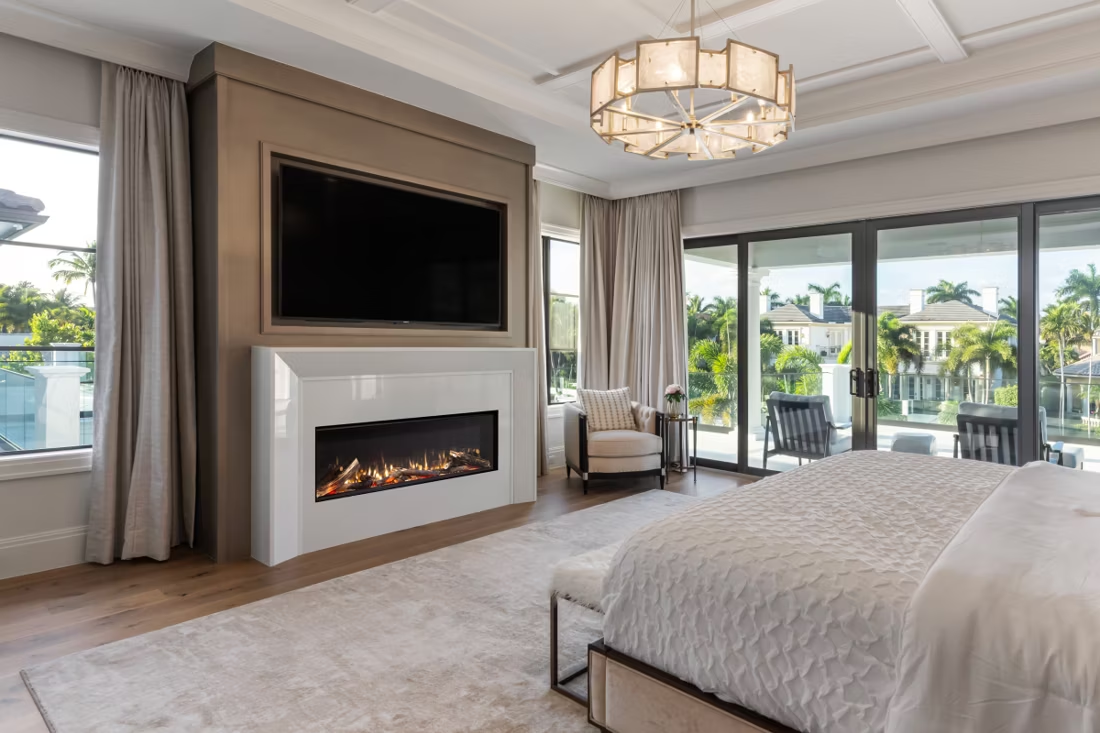
Yes—with an asterisk. Fireplaces are hot and TVs don't like heat. Either put a mantel between them to deflect rising warmth, or choose a fireplace with heat-management technology that creates a cool zone on the wall above—the wall stays around 125 degrees, barely warm, while the room still gets full heat. If you like clean lines and don't want a mantel, heat management is the answer.
Do electric fireplaces actually produce heat?
Yes—most put out around 4,800–5,000 BTUs from a standard outlet, which comfortably warms a bedroom, office, or den as a comfort-zone heater. What they won't do is carry a whole house the way wood, gas, or pellet can. Think of electric as ambiance-first with honest supplemental heat: flames on with no heat in July, flames plus warmth in January.
How much should I budget for a fireplace?
For an average home—covering the fireplace, the vent pipe, and basic installation—a budget between $3,900 and $5,500 gives you a lot of options across wood, gas, and pellet. By the time you add finish work, gas line, and electrical, the average complete installation lands between $5,000 and $12,000 all-in. In a remodel or new build, a good rule is to put about 2.5% of the total project cost toward the fireplace.
Does a fireplace add value to my home?
On average, a fireplace adds back to the home about the same amount you spent installing it. Add the monthly savings from heating the rooms you actually use instead of the whole house—often hundreds of dollars a year—and the value case is strong before you even count what a fire does for how your family uses the room.
Find your electric fireplace in Faribault County.
Tell us about your home and we'll match you with the right electric fireplace or stove—plus a free Project Guide & Parts List with your recommended local dealer.
Find Your Fireplace →