
Instant heat for the Thumb's long, cold winters.
With long, cold winters and lows averaging 15°F across Tuscola County, an electric fireplace adds real zone heat and ambiance to a bonus room, mobile home, or addition—no chimney, no gas line, no smoke. Find the right unit and connect with a trusted local dealer.
Every Project Starts From One of These Five Situations
Zone heat that plugs in and works.
Tuscola County sits in Michigan's Thumb—flat farmland, sugar beet and dairy country, with towns like Caro, Vassar, Cass City, and Millington spread across roughly 15,900 residents in a county with more soybean fields than stoplights. Winters here are long: Climate Zone 5A, average lows around 15°F, and a long, cold heating season comparable to parts of Wisconsin and Minnesota. Plenty of county homes still burn oak, maple, birch, and ash as primary or supplemental heat, and there are no local air quality restrictions on wood burning here—but not every room, mobile home, or rental has a chimney or the budget for one.
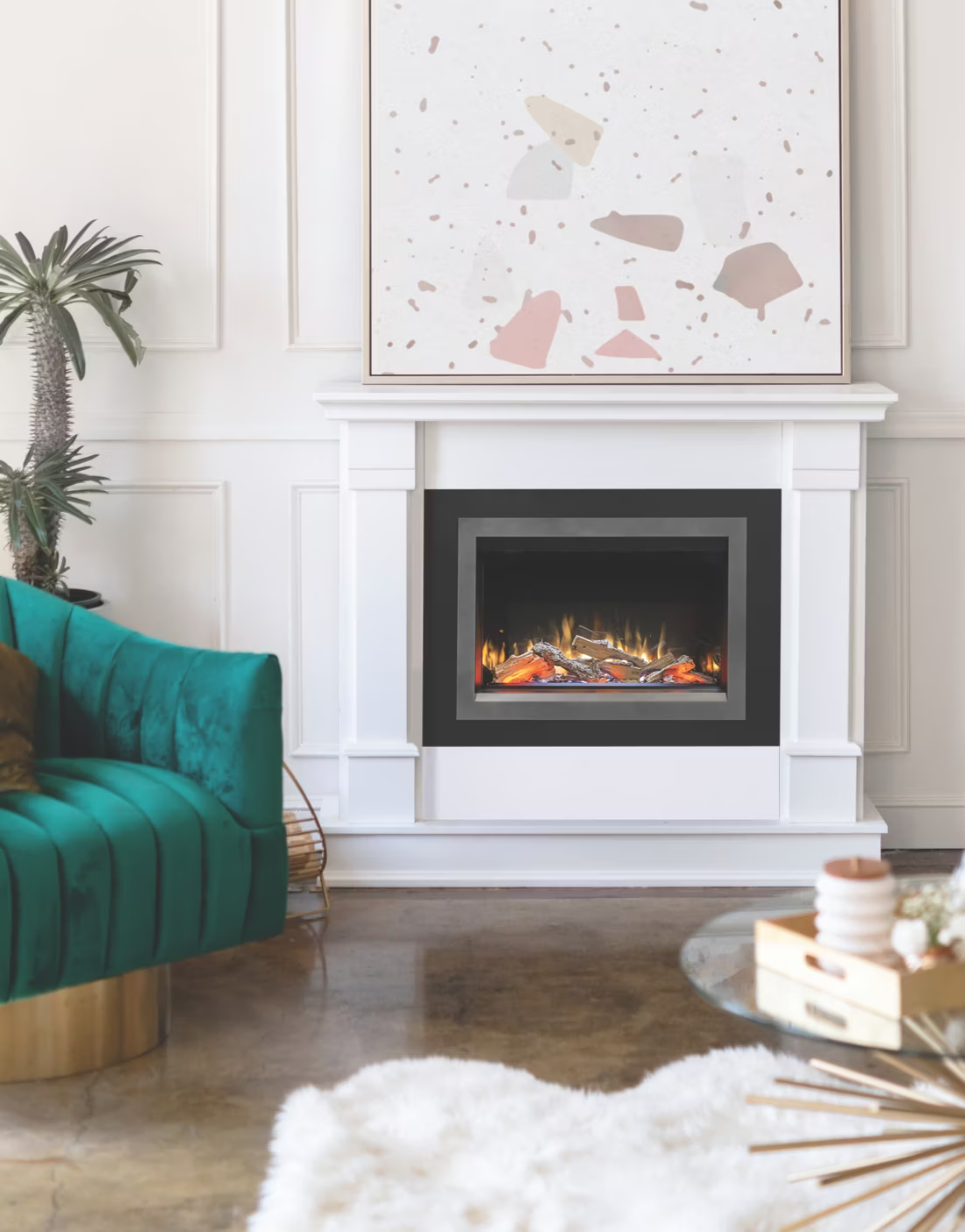
That's where electric fireplaces fit. A plug-in freestanding or wall-mount unit needs nothing more than a standard outlet, while a built-in electric insert or mantel unit typically runs on a dedicated 240-volt circuit installed by a licensed electrician—no venting, no gas line permit, no combustion byproducts to worry about. The tradeoff worth knowing: electric units go dark the moment the power does, and the Thumb sees its share of ice storms and downed lines each winter through both Thumb Electric Cooperative and Consumers Energy territory. Most local homeowners treat electric as supplemental zone heat or a backup-heat-free ambiance feature, not a storm-outage lifeline—pairing it with a wood stove or a generator if outage backup matters to your household.
Three steps. No salesperson until you're ready.
Tell us about your project
Your zip code, your situation, and the fuel you're leaning toward—or let the answers point you to one.
See what's actually available
The brands dealers within 100 miles genuinely carry—real options, never a catalog mirage.
Get your dealer & Project Guide
A trusted local dealer, plus the free Project Guide & Parts List that names every component of the job.
Frequently Asked Questions
How much does an electric fireplace installation cost in Tuscola County?
A plug-in freestanding or wall-mount electric fireplace typically runs $150 to $600 for the unit itself, with no installation beyond hanging it and plugging it into a standard outlet. A built-in electric insert or mantel package that requires a dedicated 240-volt circuit—the more common choice for a living room or addition—usually runs $1,500 to $3,500 once you include the unit, a licensed electrician's panel and wiring work, and any surround or mantel carpentry. Rural properties on the outer edges of the county (toward Fairgrove or Mayville) may see a small trip charge added by electricians or installers based on drive time.
Do I need a permit to install an electric fireplace in Tuscola County?
A simple plug-in unit needs no permit at all—it's no different than adding a lamp. If your installer is running a new dedicated 240-volt circuit for a built-in electric fireplace or insert, that electrical work does require a permit through the Tuscola County Building Department, and it should be pulled and inspected by a licensed electrician. This is far simpler than the permitting involved with a wood stove or gas line, which is one reason electric is a popular choice for additions, finished basements, and mobile homes across the county where a chimney isn't practical.
Will my electric fireplace work during a power outage?
No—electric fireplaces require power to run and will not operate during an outage, which is worth planning around in Tuscola County. Ice storms and high winds off Lake Huron and Saginaw Bay periodically knock out power to Thumb Electric Cooperative and Consumers Energy customers for hours or occasionally days. If backup heat during outages is a priority for your household, most local dealers will point you toward pairing an electric fireplace for daily ambiance and zone heat with a wood stove, or investing in a standby generator, rather than relying on electric as your only heat source.
Electric vs. wood vs. gas—which is right for my Tuscola County home?
Wood remains common across the county given the local abundance of oak, maple, birch, and ash and Tuscola County's lack of any air quality burn restrictions—it's the choice for real backup heat during outages. Gas fireplaces offer instant, consistent heat but require either a natural gas line (limited to in-town service areas like Caro and Vassar) or a propane tank. Electric fireplaces skip the fuel supply question entirely, install almost anywhere with an outlet or a dedicated circuit, and cost the least upfront—but they add nothing during a power outage and cost more per BTU to run than wood or gas over a full heating season. For a spare bedroom, sunroom, or rental unit, electric is usually the practical answer; for a primary heat source in an older farmhouse, wood or gas still wins.
What's the difference between an electric insert, a wall-mount unit, and an electric log set?
An electric insert is built to slide into an existing masonry fireplace opening, giving a wood-burning fireplace real supplemental heat without touching the chimney—a popular retrofit for older farmhouses around Caro and Cass City that have a fireplace but rarely light a fire in it. A wall-mount unit is a slim, framed-in or surface-mounted panel, common in additions, finished basements, and newer builds. An electric log set is simply decorative logs with a heater built in, meant to sit inside an existing firebox for ambiance. For homes that want real, felt heat in a room, an insert or wall-mount unit with a proper heater (not just a light-and-flame log set) is the better investment.
Can an electric fireplace actually heat a room in Tuscola County's winters?
Most electric fireplace heaters are rated around 5,000 BTU (roughly 1,500 watts), which comfortably heats a single well-insulated room of 400 to 600 square feet as supplemental heat—not a whole home. Given the county's long, cold winters and lows near 15°F, an electric unit works best as zone heat for a specific space (a bonus room, sunroom, or finished basement) alongside your home's central furnace, rather than as the sole heat source for the house. If you're trying to heat a larger open area, ask a local dealer about larger insert models or discuss whether a wood or gas unit is a better fit for that space.
Does an electric fireplace need a dedicated circuit and a licensed electrician?
Small plug-in units (typically under 1,500 watts) can usually run on a standard household outlet without any electrical work. Built-in electric fireplaces and larger inserts often draw enough current that manufacturers recommend or require a dedicated 15- or 20-amp circuit, which means a licensed electrician needs to run new wire from your panel. This is especially worth checking in older Tuscola County farmhouses with dated electrical panels that may need capacity upgrades before adding a dedicated circuit—a local dealer or electrician can check your panel during a quote.
Where do electric fireplaces make the most sense in Tuscola County—mobile homes, additions, apartments?
Electric fireplaces are a common fit in exactly the places where a wood or gas installation isn't practical: mobile and manufactured homes (common throughout rural parts of the county), rental properties and apartments in Caro or Vassar where tenants can't modify chimneys or gas lines, finished basements without existing venting, and additions or sunrooms built without a masonry fireplace in the plans. Because there's no combustion, no venting, and no chimney involved, they're often the only realistic fireplace option in these situations—and installation is far faster than a wood or gas project.
How much does it cost to run an electric fireplace, and who's my utility?
Most of Tuscola County is served by Thumb Electric Cooperative or Consumers Energy, depending on location. Running a typical 1,500-watt electric fireplace on high heat for several hours an evening costs somewhere in the range of $0.20 to $0.35 per hour at current Michigan residential rates—modest compared to running a whole-home furnace, but worth factoring into your decision if you plan to use it daily through a long Thumb winter. Many owners run the heater setting only when the room is occupied and leave the flame effect on alone (which draws very little power) the rest of the time.
Does an electric fireplace need a vent or chimney?
No—that's its superpower. An electric fireplace needs a wall and an outlet, period. No vent pipe, no gas line, no clearances to design around, which is why it works in bedrooms, offices, apartments, and walls where venting a gas or wood unit would be impractical or impossible. Installation is typically the simplest and least expensive of any fireplace type.
Can I put a TV above my fireplace?
Yes—with an asterisk. Fireplaces are hot and TVs don't like heat. Either put a mantel between them to deflect rising warmth, or choose a fireplace with heat-management technology that creates a cool zone on the wall above—the wall stays around 125 degrees, barely warm, while the room still gets full heat. If you like clean lines and don't want a mantel, heat management is the answer.
How much should I budget for a fireplace?
For an average home—covering the fireplace, the vent pipe, and basic installation—a budget between $3,900 and $5,500 gives you a lot of options across wood, gas, and pellet. By the time you add finish work, gas line, and electrical, the average complete installation lands between $5,000 and $12,000 all-in. In a remodel or new build, a good rule is to put about 2.5% of the total project cost toward the fireplace.
Can a fireplace actually lower my heating bill?
Yes—by creating a comfort zone. A furnace heats every square foot of the house just to warm the one room you're in; a gas fireplace on low burns roughly a sixth of the gas a typical furnace does. Set the furnace around 55–60 degrees as a baseline, then heat the rooms your family actually uses. Families who heat this way commonly save $20–$60 a month.
Stove and Fireplace Dealers in Tuscola County
Find your electric fireplace in Tuscola County.
Tell us a bit about your home and we'll match you with the right electric fireplace or insert—plus a free Project Guide & Parts List and a trusted local dealer to install it.
Find Your Fireplace →