
Warm, Reliable Heat for Dearborn's Long Winters.
Clean, instant gas heat for Dearborn homes near the Rouge—from a cozy insert in a 1940s brick bungalow to a full remodel fireplace. Find the right unit and get matched with a trusted local dealer.
Every Project Starts From One of These Five Situations
Instant warmth for Wayne County winters.
Dearborn sits in climate zone 5A, where winters average an 18°F low and the region faces a winter heating load in the same range as Madison, Wisconsin. Between Ford's Rouge complex, the University of Michigan-Dearborn, and the dense grid of East and West Dearborn neighborhoods, most of the city's housing stock dates from the 1920s through the 1950s: brick bungalows, cape cods, and colonials, many built with a masonry fireplace as a focal point rather than a primary heat source.
Because Dearborn is fully built out and served by an established natural gas distribution network, running a gas line to a fireplace or insert is usually straightforward—a much simpler job than in newer exurban subdivisions still waiting on utility buildout. That infrastructure, combined with Michigan's real cold snaps and the appeal of heat that works the instant you flip a switch, is why gas fireplaces and inserts are the default upgrade for homeowners retrofitting an old masonry firebox or finishing a basement rec room near the Southend or Springwells corridor.
Three steps. No salesperson until you're ready.
Tell us about your project
Your zip code, your situation, and the fuel you're leaning toward—or let the answers point you to one.
See what's actually available
The brands dealers within 100 miles genuinely carry—real options, never a catalog mirage.
Get your dealer & Project Guide
A trusted local dealer, plus the free Project Guide & Parts List that names every component of the job.
Frequently Asked Questions
How much does a gas fireplace installation cost in Dearborn?
Costs vary with the unit, the venting path, and whether new gas line work is needed, but homeowners in the Detroit metro area typically budget $3,500 to $10,000 for a gas fireplace or insert installation. A direct-vent insert dropped into an existing masonry fireplace in one of Dearborn's older brick homes—where a gas line is often already nearby for a furnace or water heater—tends to land on the lower end. A new built-in unit for a basement remodel or an addition, requiring fresh gas line and venting runs through brick or block, sits higher. A local dealer will give you a firm number after seeing your fireplace or framing in person.
Can I convert my existing wood-burning fireplace to gas?
Yes, and it's one of the most common jobs local hearth dealers handle in Dearborn's older neighborhoods. Many of the city's 1920s-to-1950s brick homes have a masonry fireplace that was rarely used even for wood—a gas insert with a stainless liner run up the existing flue turns that cold, drafty firebox into real supplemental heat. Expect the job to run in the same $3,500-$8,500 range as a typical insert install, with the final number depending on chimney condition and whether a new gas line needs to be tapped in from an existing appliance run.
Is natural gas or propane the right choice for my Dearborn home?
For nearly every home inside Dearborn's city limits, natural gas is the practical answer—the city sits within an established gas distribution territory, and most homes already have gas service for the furnace and water heater. Propane is really only a consideration for a handful of properties on the edge of service areas or for portable and outdoor gas appliances. If your home already has a gas meter, adding a fireplace line is usually a matter of tapping into existing service rather than starting from scratch.
Will a gas fireplace still work if the power goes out?
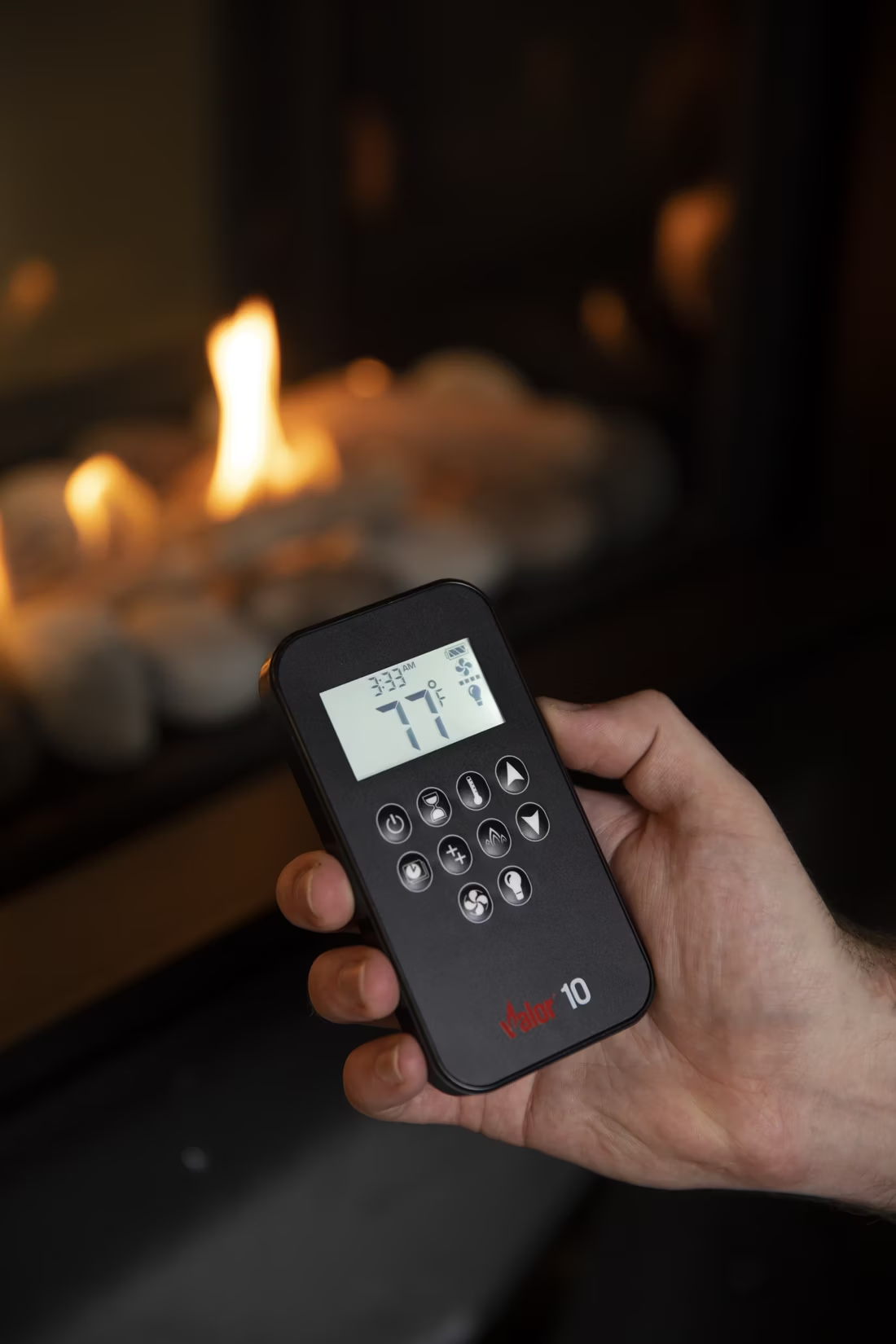
Most will. Units with standing pilot or IPI (intermittent pilot ignition) run on millivolt systems and battery backup, so they'll light and heat the room even when DTE Electric or Wyandotte Municipal Services has an outage on the line. Valor's lineup goes a step further—its pilot generates its own electricity through a thermocouple, so there's no battery to remember or replace. For a city that sees its share of ice storms and summer line outages, that self-powering detail matters more than it sounds like it should. Ask your dealer about the ignition system on any model you're considering.
Gas fireplace, insert, or gas stove—what's the difference?
A gas fireplace is a fully built-in unit, framed into a wall—the right call for a basement remodel or new construction where there's no existing masonry opening. A gas insert is sized to slide into an existing masonry firebox, which describes a large share of Dearborn's older brick homes. A gas stove is a freestanding cabinet unit that sits on the floor and vents out a nearby wall or through the roof—a good option for a room without any existing fireplace, like a converted garage or sunroom. For most Dearborn homeowners with an existing but underused fireplace, an insert is the straightforward upgrade.
Do I need a permit to install a gas fireplace in Dearborn?
Yes—new gas fireplace and insert installations require a building permit and a licensed gas-fitter to run or tap the gas line, both coordinated through the City of Dearborn's Building Department. Most established hearth dealers handle this paperwork as part of the installation quote, pulling the permit and scheduling the inspection so you're not the one tracking down a licensed plumber separately. That coordination is one of the real advantages of working with a dealer who installs gas appliances regularly rather than a general contractor doing it occasionally.
Should I get a vented or vent-free gas fireplace?
Vented (direct-vent) units draw combustion air from outside and exhaust it back outside through sealed pipe—they're the standard, code-friendly choice everywhere in Michigan and deliver real heat output. Vent-free units burn without any outside venting and are permitted in Michigan under specific room-size and ventilation rules, but they release some moisture and combustion byproducts into the room, which is a real consideration in a tightly sealed, well-insulated older Dearborn home. For most installations—especially inserts going into an existing chimney that's already there to use—direct-vent is the easier and more universally recommended path.
How often does a gas fireplace need to be serviced?
Plan on an annual inspection, ideally before the heating season starts. A technician checks the burner, pilot assembly, venting, and gas connections, and cleans the glass and interior—a quick visit compared to wood chimney sweeping but still important, since a dirty or misaligned burner can produce soot on the glass or an uneven flame. Local gas appliance service providers in the Dearborn/Wayne County area typically charge $150 to $250 for this annual visit.
Gas vs. wood—why don't more Dearborn homes burn wood?
Wood-burning stoves and fireplaces are uncommon in Dearborn—it's a fully built-out, close-in Detroit suburb where most lots are small, firewood storage and sourcing are impractical, and many of the older masonry fireplaces here were built for looks rather than heat output. Species like oak, maple, and ash are available from suppliers farther out in Wayne and Washtenaw counties, but hauling and stacking cordwood isn't realistic for most in-city homeowners. Gas solves that: no wood handling, no chimney creosote to manage, and heat at the flip of a switch—which is why gas is the default fireplace fuel across nearly all of Dearborn's neighborhoods.
Why is my open fireplace making my house colder?
Open fireplaces suck—literally. As the fire burns, it consumes air your furnace already paid to heat and pulls it out through the chimney, so the house is actually colder after the fire goes out than before you lit it. An insert fixes this: it seals the chimney, puts fixed glass across the front, and turns that hole in your house into a real heat source.
What's the difference between radiant and convective fireplace heat?
Most fireplaces are a thin metal box—they heat fine, but you rely on the fan to move the warmth into the room. Radiant models use a thick cast-ceramic firebox, about an inch and a quarter thick, that soaks up the fire's heat and radiates roughly 25–30% more warmth into the room with no fan running. If you watch TV in the same room or want heat in a power outage, radiant is worth asking about.
How much should I budget for a fireplace?
For an average home—covering the fireplace, the vent pipe, and basic installation—a budget between $3,900 and $5,500 gives you a lot of options across wood, gas, and pellet. By the time you add finish work, gas line, and electrical, the average complete installation lands between $5,000 and $12,000 all-in. In a remodel or new build, a good rule is to put about 2.5% of the total project cost toward the fireplace.
Can a fireplace actually lower my heating bill?
Yes—by creating a comfort zone. A furnace heats every square foot of the house just to warm the one room you're in; a gas fireplace on low burns roughly a sixth of the gas a typical furnace does. Set the furnace around 55–60 degrees as a baseline, then heat the rooms your family actually uses. Families who heat this way commonly save $20–$60 a month.
Nearby Dealers
Hearth shops serving Dearborn and the surrounding area. Every listing shows whether it is a WhyFire partner, a dealer we have verified as authorized for the brands we recommend, or a local business carrying hearth products. No manufacturer pays for placement. How we verify dealers →
Allstate By Watsons
Allstate Billiards, Patio, Fireplace
Glenn's Fireplace & Spa
Premier Furniture
AirMaster
Fireside Hearth & Home - Canton
Fireside Hearth & Home - Royal Oak
This Is It Shop's House Of Fire
Syles
Marquis Fireplace Ltd.
Scott’s Fireplace
Grate Fireplace Shop
Creative Design Build Associates
Bourlier & Sons Inc
American Grill And Patio
Fireside Hearth & Home - Utica
Find your gas fireplace in Dearborn.
Tell us about your home and we'll put together a free Project Guide & Parts List—the right gas fireplace or insert, the exact vent kit, and a trusted local Dearborn-area dealer to install it.
Find Your Fireplace →