
Instant heat for Norfolk County homes, no wood pile required.
From Quincy triple-deckers to Wellesley colonials, gas fireplaces and inserts deliver clean, on-demand warmth without the cordwood, ash, or backyard storage that most Norfolk County lots simply don't have room for. Find the right unit and connect with a trusted local dealer.
Every Project Starts From One of These Five Situations
Built for tight lots and real New England winters.
Norfolk County sits in climate zone 5A, with an average winter low of 18°F and a heating season that runs from October into April across towns like Quincy, Brookline, Dedham, Milton, and Weymouth. That's meaningfully milder than interior New England (Burlington, VT sees a noticeably longer and colder winter heating season most years), but it's still cold enough that supplemental heat matters, especially in the older capes and colonials that make up much of the county's housing stock.
Unlike more rural parts of the state, wood stoves are essentially a non-factor here—small lot sizes, attached and semi-attached housing in towns like Quincy and Brookline, and local bylaws around clearances and wood storage make wood heat impractical for most Norfolk County homeowners, even though the length of the local heating season would otherwise support it. Gas fills that gap instead. Eversource Energy and National Grid provide natural gas service to most of the county's town centers, and where mains don't reach—parts of Norfolk, Wrentham, and Plainville, for instance—propane fills in. Either way, a gas fireplace or insert gives you real zone heat at the flip of a switch, a way to convert an old, drafty masonry fireplace into something that actually contributes to your heating bill, and a look that suits everything from a Quincy triple-decker to a Wellesley Colonial Revival.
Three steps. No salesperson until you're ready.
Tell us about your project
Your zip code, your situation, and the fuel you're leaning toward—or let the answers point you to one.
See what's actually available
The brands dealers within 100 miles genuinely carry—real options, never a catalog mirage.
Get your dealer & Project Guide
A trusted local dealer, plus the free Project Guide & Parts List that names every component of the job.
Frequently Asked Questions
How much does a gas fireplace installation cost in Norfolk County?
Most gas fireplace and insert installations in Norfolk County run in the $5,000 to $11,000 range, with the biggest cost drivers being the venting path and whether new gas line work is needed. A direct-vent insert dropped into an existing masonry fireplace where a gas line is already nearby tends to land toward the lower end. A new built-in fireplace for a renovation—with framing, a fresh gas run from the meter, and full direct-vent piping through an exterior wall—sits higher. Homes on propane rather than natural gas sometimes need tank installation or an upgrade, which adds to the total. A local retailer will give you a firm number after seeing the space in person.
Can I convert my existing wood fireplace to gas?
Yes, and it's one of the most common projects local hearth dealers handle in Norfolk County's older housing stock—plenty of the capes and colonials in Dedham, Milton, and Needham still have the original masonry fireplace, often unused for years. A gas insert typically drops into that opening, running a stainless liner up the existing chimney for venting. Costs usually fall between $4,500 and $9,500 depending on the insert and whether the home already has a nearby gas line. Because open masonry fireplaces are notoriously inefficient—most of the heat goes straight up the flue—this conversion is usually a real upgrade in comfort, not just aesthetics.
Do I need natural gas to install a gas fireplace, or can I use propane?
Either works, and which one you use mostly comes down to where you live in the county. Eversource Energy and National Grid run natural gas mains through most of Norfolk County's denser towns—Quincy, Brookline, Weymouth, Dedham—so if you already have gas appliances, adding a fireplace is usually straightforward. In lower-density areas where mains don't extend, including pockets of Norfolk, Wrentham, and Plainville, propane is the standard fallback, typically with a buried or above-ground tank installed by a local supplier. Most fireplace models can be configured for either fuel; your installer sets the correct orifice and regulator for whichever you have.
Will my gas fireplace work during a power outage?
Most modern gas fireplaces will, which matters here given how often nor'easters take out power across the county for a day or more. Units with IPI (intermittent pilot ignition) run on a battery backup—typically AA batteries built into the unit—that kicks in the moment power drops, so the fireplace still lights on demand. Just remember to swap those batteries periodically; they're easy to forget until a storm hits. Valor fireplaces handle this differently: their pilot assembly generates its own electricity through the thermocouple, so there's no battery to maintain at all. Worth asking your local dealer which ignition system a given model uses if outage performance matters to you.
What's the difference between a gas fireplace, gas insert, and gas stove?
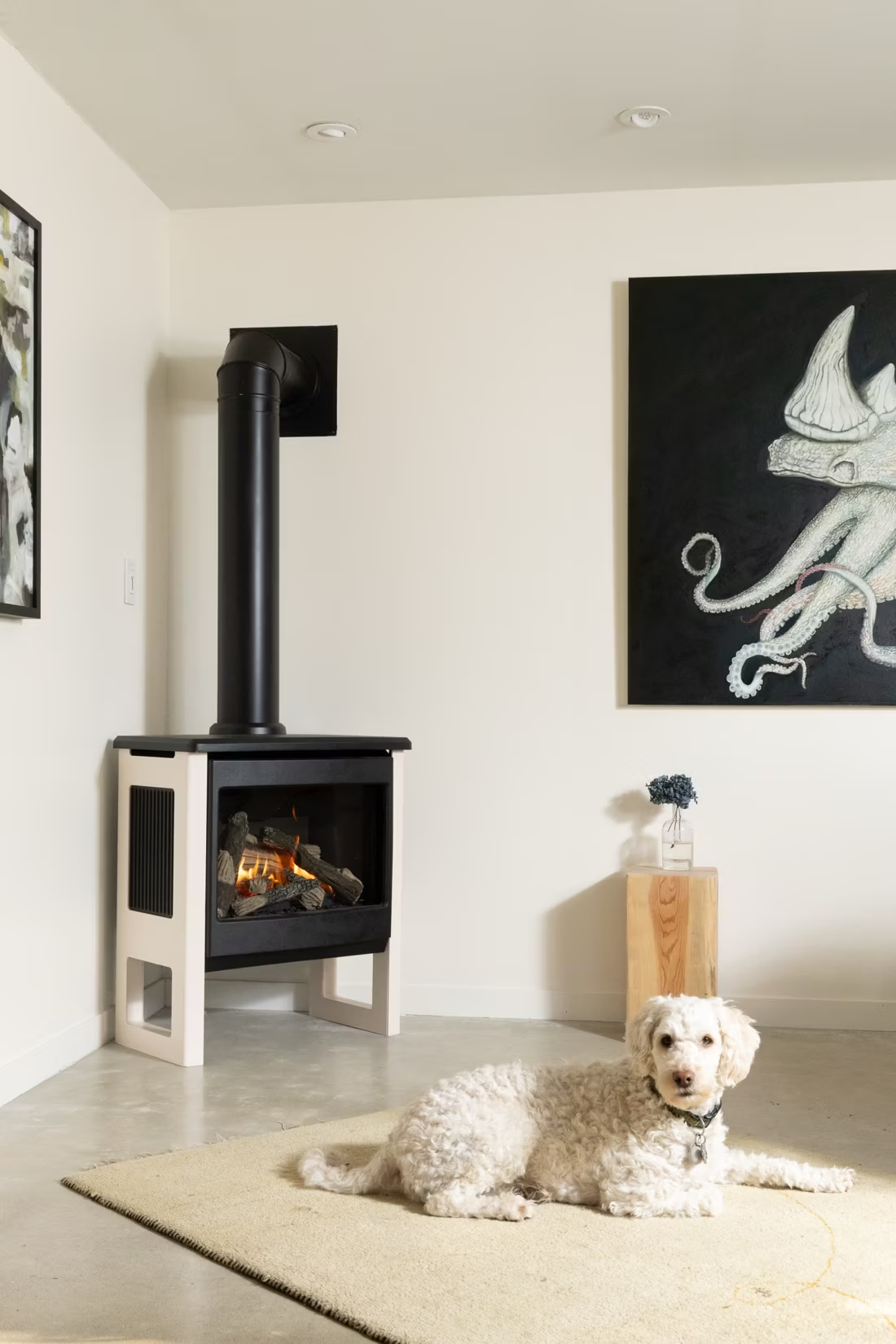
A gas fireplace is a fully built-in unit, framed into a wall—the right call for new construction or a full remodel. A gas insert is sized to slide into an existing masonry fireplace opening, using the existing chimney (with a liner) to vent, which is why it's the go-to for Norfolk County's older colonials and capes with an unused hearth. A gas stove is freestanding, sitting on the floor like a wood stove but running on gas—a good option when there's no existing fireplace and you want a focal point without framing work. For most homeowners here with an old masonry fireplace already in place, an insert is the simplest and most cost-effective path.
Do I need a permit to install a gas fireplace in Norfolk County?
Yes. Massachusetts requires both a building permit and a gas permit for new gas fireplace or insert installations, and because Norfolk County government doesn't administer building codes, permitting runs through each individual town—Quincy, Brookline, Dedham, Weymouth, and the rest each issue their own. The gas line portion has to be pulled and inspected by a licensed gas fitter under the Massachusetts Fuel Gas Code, which is one reason working with an established hearth dealer helps—they coordinate the gas work, venting, and inspections together instead of leaving you to manage separate trades and separate town offices.
What's the difference between vented and vent-free gas fireplaces?
Vented (direct-vent) gas fireplaces pull combustion air from outside and exhaust it back outside through sealed piping—they're the standard, code-friendly choice everywhere, including throughout Norfolk County. Vent-free units burn gas directly into the room with no outside venting; they're technically legal in Massachusetts under strict room-sizing and oxygen-depletion-sensor rules, but many local building departments and insurers are cautious about them, particularly in smaller, tightly sealed rooms common in older Norfolk County homes. Given the county's housing stock—a lot of well-insulated, not-especially-large rooms in older construction—direct-vent units are what most local dealers install and recommend by default.
How often should my gas fireplace be serviced?
Plan on an annual inspection, ideally in early fall before the heating season starts. A technician checks the burner, pilot assembly, gas connections, and venting, and cleans the glass and interior—most local service providers charge $150 to $250 for this. One Norfolk County-specific thing to watch: direct-vent terminations on the exterior wall can get partially blocked by snow drifts or ice buildup after a heavy nor'easter, which restricts airflow and can trip a safety shutoff. A quick check after major storms, in addition to the annual service, keeps that from becoming a mid-winter problem.
Gas vs. wood—which is right for my home?
For most Norfolk County homes, this isn't really a close call. Wood stoves need clearances, a wood supply, and somewhere to store cordwood—all in short supply on the tighter lots common in Quincy, Brookline, and similar towns, which is why wood heat has largely disappeared from the county even though the climate would otherwise support it. A small number of homeowners on larger, more rural parcels in towns like Medfield, Sharon, or Wrentham still run a wood stove for backup heat, but it's the exception rather than the norm. Gas, by contrast, fits the housing stock here: instant on-off operation, no ash or smoke, and an easy retrofit into an existing masonry fireplace. If backup heat during outages is the concern, a gas unit with battery-backup or self-generating ignition covers that just as well as wood does for most households.
Can I put a TV above my fireplace?
Yes—with an asterisk. Fireplaces are hot and TVs don't like heat. Either put a mantel between them to deflect rising warmth, or choose a fireplace with heat-management technology that creates a cool zone on the wall above—the wall stays around 125 degrees, barely warm, while the room still gets full heat. If you like clean lines and don't want a mantel, heat management is the answer.
Why is a fireplace insert so efficient?
An insert does two things: it seals the chimney completely, so you stop losing air you already paid to heat, and it radiates warmth into the room through the firebox and glass. Most add a heat-exchange fan that pulls cool room air underneath, wraps it around the hot firebox, and pushes it back out warm. Your home is more efficient before you've even lit the first fire.
How much should I budget for a fireplace?
For an average home—covering the fireplace, the vent pipe, and basic installation—a budget between $3,900 and $5,500 gives you a lot of options across wood, gas, and pellet. By the time you add finish work, gas line, and electrical, the average complete installation lands between $5,000 and $12,000 all-in. In a remodel or new build, a good rule is to put about 2.5% of the total project cost toward the fireplace.
Can a fireplace actually lower my heating bill?
Yes—by creating a comfort zone. A furnace heats every square foot of the house just to warm the one room you're in; a gas fireplace on low burns roughly a sixth of the gas a typical furnace does. Set the furnace around 55–60 degrees as a baseline, then heat the rooms your family actually uses. Families who heat this way commonly save $20–$60 a month.
Stove and Fireplace Dealers in Norfolk County
Hearthside - Holliston
The Fireplace Connection
Find your gas fireplace in Norfolk County.
Tell us a bit about your home and we'll match you with a trusted local Norfolk County dealer and send over a free Project Guide & Parts List—the exact fireplace or insert, venting, and parts recommended for your space, with your matched dealer ready to install it.
Find Your Fireplace →