
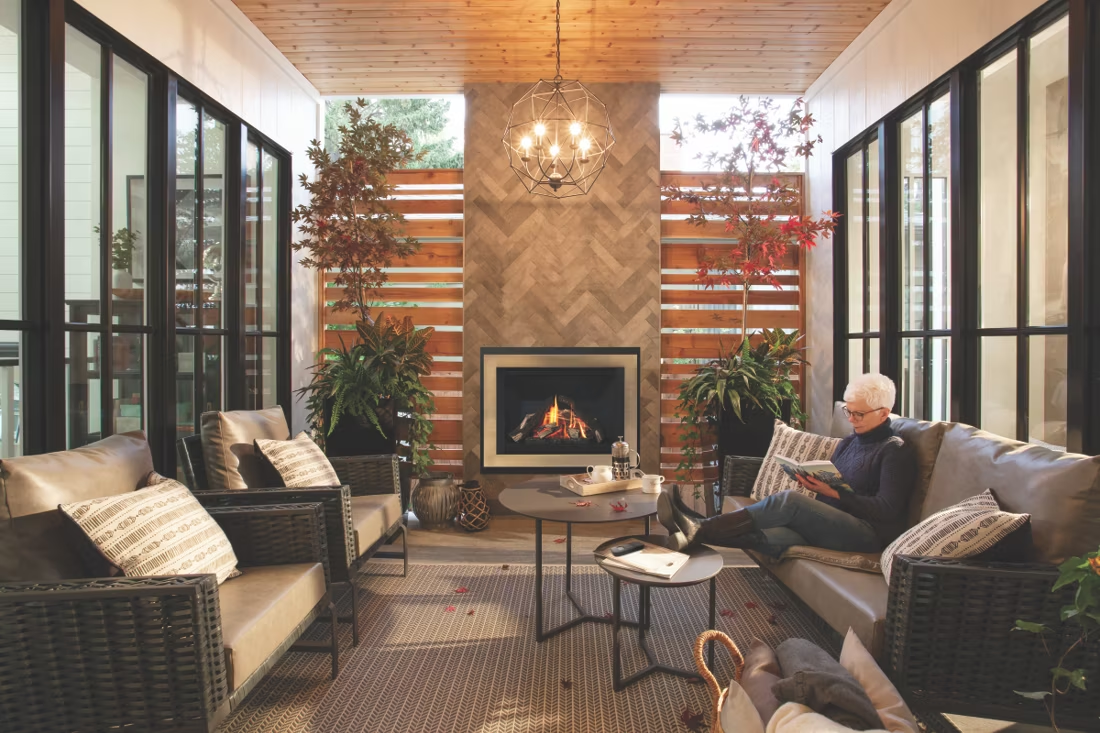
Real flame heat without a chimney in sight.
Direct-vent gas fireplaces are built for exactly the kind of high-rise, waterfront construction that defines National Harbor. Find the right unit and connect with a trusted local dealer.
Every Project Starts From One of These Five Situations
Built for condos, not cabins.
National Harbor is a planned waterfront community on the Potomac River in Prince George's County, built almost entirely in the last two decades—high-rise condos, townhomes, and resort properties like the Gaylord National anchor the skyline. At climate zone 4A with a moderately cool winter season and lows averaging 27°F, this is a moderate mid-Atlantic climate—nowhere near the deep-freeze territory of a place like Buffalo, NY, but still cold enough on winter evenings along the water that residents want real, dependable heat, not just a decorative flicker.
That combination of vertical, dense construction and moderate winters is exactly why gas dominates here. A direct-vent gas fireplace doesn't need a masonry chimney or roof penetration—it vents straight through an exterior wall, which is the only practical venting path in a high-rise condo tower or resort unit. Wood stoves and pellet stoves, by contrast, are essentially off the table: there's no practical way to store cordwood or pellet bags in a condo unit, no chimney infrastructure in most buildings, and HOA and fire-code rules in National Harbor's association-managed towers generally don't accommodate solid-fuel appliances. For homeowners without an accessible gas line, or in interior units where running a new line isn't feasible, an electric fireplace through Pepco (Potomac Electric Power Co.) at roughly $0.1874 per kWh is the common fallback.
Three steps. No salesperson until you're ready.
Tell us about your project
Your zip code, your situation, and the fuel you're leaning toward—or let the answers point you to one.
See what's actually available
The brands dealers within 100 miles genuinely carry—real options, never a catalog mirage.
Get your dealer & Project Guide
A trusted local dealer, plus the free Project Guide & Parts List that names every component of the job.
Frequently Asked Questions
How much does a gas fireplace installation cost in National Harbor?
Because most National Harbor installs happen inside condo and townhome construction rather than retrofitting an old masonry fireplace, pricing tends to track two variables: whether a gas line already exists at the unit, and how much wall or venting work the building's construction requires. A direct-vent gas fireplace installed where a gas stub is already run typically lands in the $3,500–$6,500 range. Units in interior rooms without exterior wall access, or where new gas line work and HOA-required venting review are needed, can run $7,000–$10,000 or more. A local installer familiar with National Harbor's condo associations can give you a firm number after reviewing your unit's layout.
Can I install a wood-burning fireplace in my National Harbor condo instead?
In almost all cases, no. Oak, hickory, and maple are the common regional firewood species around Prince George's County, but wood-burning appliances require a masonry or Class A chimney, code clearances, and space to store cordwood—none of which exist in National Harbor's high-rise and townhome construction. Most buildings here were built after 2005 with gas and electric infrastructure in mind, not solid-fuel venting, and condo association fire codes typically prohibit wood-burning units outright. If you're set on a real wood fire, that's realistically a project for a single-family home outside the immediate National Harbor footprint.
Do I need natural gas service, or can I use propane?
Most National Harbor residential and resort buildings were constructed with natural gas infrastructure already in place, so if your unit has a gas water heater, range, or dryer, a fireplace hookup is usually a straightforward tie-in for a licensed installer. Propane is uncommon in this setting—there's no practical place to site a tank in a condo tower or shared-wall townhome—so it's rarely the path homeowners here take. If your specific building or unit isn't currently plumbed for gas, your installer and building management will need to confirm whether a new line can be run before any install proceeds.
Will my gas fireplace work if the power goes out?
Yes, if it's equipped for it. Direct-vent gas fireplaces with IPI (intermittent pilot ignition) run on a battery backup that kicks in automatically when power drops, so the unit still lights on demand. That's worth prioritizing in National Harbor, where riverside storms off the Potomac occasionally knock out power for a stretch. Some manufacturers, like Valor, go a step further and generate their own electricity through the pilot's thermocouple, so there's no battery to remember to replace. Ask your local dealer which ignition system a specific model uses before you buy.
Gas fireplace vs. gas insert—which applies to my unit?
A gas insert is designed to slide into an existing masonry fireplace opening—which most National Harbor units simply don't have, since they were built without wood-burning fireplaces to begin with. What you're almost always installing here is a true direct-vent gas fireplace, built into a framed wall cavity during construction or added later with new framing and venting run through an exterior wall. The one exception is some of the older single-family and townhome stock near the waterfront with a masonry firebox already in place—those homes can use a gas insert the same way a retrofit project would anywhere else.
What permits or HOA approvals do I need for a gas fireplace in National Harbor?
Any new gas fireplace install requires a building permit and gas line permit through the Prince George's County Department of Permitting, Inspections and Enforcement (DPIE). On top of that, because most of National Harbor's residential buildings are managed by a community association, you'll also need architectural or construction approval from your specific condo or townhome association before any wall penetration or exterior venting work begins—that step trips people up more often than the county permit does. A local installer who's worked in National Harbor before will know which associations require what documentation.
What size gas fireplace do I actually need here?
With a moderate winter climate overall and lows averaging 27°F, National Harbor's climate doesn't demand a high-BTU workhorse the way a place like Duluth, MN would. Most condo and townhome installs here are sized for supplemental zone heat and ambiance in a single living area—typically a 20,000–30,000 BTU direct-vent unit—rather than a whole-home heat source. Larger open-plan units or ground-floor spaces near the waterfront with higher ceilings may call for something on the upper end of that range. A local dealer can size it against your specific floor plan.
How often does a gas fireplace need to be serviced?
Plan on an annual inspection, ideally in early fall before the units get regular use through the cooler months. A certified technician checks the burner, pilot assembly, venting termination, and glass seal, and cleans the interior—a quick visit that typically runs $150–$250. In a condo or high-rise setting like National Harbor, it's also worth confirming your building's exterior vent termination is clear of debris or nearby construction, since new development continues to go up around the waterfront.
Gas vs. electric fireplace—which makes more sense for my unit?
Gas gives you real flame, genuine radiant heat, and battery-backup operation during outages, but it requires an accessible gas line and exterior-wall venting—not always possible in an interior condo unit. Electric fireplaces need neither: they plug into a standard outlet, install in an afternoon, and work in any room regardless of gas access, running on Pepco service at roughly $0.1874 per kWh. The tradeoff is heat output and ambiance—electric units simulate a flame rather than produce one, and they cost more per hour to run as a heat source. For interior units or where gas line work isn't feasible, electric is often the practical choice; for anyone with exterior wall access, gas remains the more popular pick in National Harbor.
What's the difference between an insert and a zero-clearance fireplace?
An insert is a fireplace that slides into a pre-existing wood-burning fireplace—if you don't have one, there's nothing to insert it into. A zero-clearance fireplace is built into a framed wall, which makes it the answer for remodels and new construction. Simple test: existing masonry fireplace means insert; blank or framed wall means zero-clearance.
Is my gas fireplace wasting gas?
If it was installed more than 15 years ago, probably. Older gas fireplaces keep a standing pilot light burning all the time, and that little flame can cost a couple hundred dollars a year. Newer models use pilot-on-demand ignition—the pilot lights only when you use the fireplace and goes out when you turn it off.
Can a fireplace actually lower my heating bill?
Yes—by creating a comfort zone. A furnace heats every square foot of the house just to warm the one room you're in; a gas fireplace on low burns roughly a sixth of the gas a typical furnace does. Set the furnace around 55–60 degrees as a baseline, then heat the rooms your family actually uses. Families who heat this way commonly save $20–$60 a month.
Should the dealer who sells my fireplace also install it?
Ideally, yes. A fireplace project involves vent pipe, gas line, electrical, and often tile or stone. Hire three or four separate trades and you own the liability and the game of telephone between them. One company selling and installing means one accountable party, start to finish—ask about factory training, on-time completion records, and what happens if an inspection fails.
Nearby Dealers
Hearth shops serving National Harbor and the surrounding area. Every listing shows whether it is a WhyFire partner, a dealer we have verified as authorized for the brands we recommend, or a local business carrying hearth products. No manufacturer pays for placement. How we verify dealers →
We’ve paused dealer listings for this connection today. Enter your zip or postal code above to find dealers near you, or come back tomorrow.
Popular Gas Brands
Where each brand came from, what's inside it today, and every current model. No brand pays to be here. Not every dealer carries every brand, so enter your zip code to see what's sold near National Harbor.
Kozy Heat
Kozy Heat was founded in 1976 by Dudley Hussong in Lakefield, Minnesota, and incorporated as Hussong Manufacturing Co., Inc. in 1978.
28 gas models →Fireplace Xtrordinair
Fireplace Xtrordinair, now often called FireplaceX, is the fireplace brand of Travis Industries, Inc., of Mukilteo, Washington.
25 gas models →Town & Country
Town & Country Fireplaces is the luxury gas fireplace brand of Pacific Energy Fireplace Products Ltd., of Duncan, British Columbia.
14 gas models →Lopi
Lopi is a wood, pellet, and gas stove brand founded by Kurt Rumens in Bellevue, Washington, in 1979.
7 gas models →Forge & Flame
Forge & Flame is the stove brand Hearth & Home Technologies introduced in August 2023 to bring Vermont Castings, Harman, and Quadra-Fire under one name.
6 gas models →Vermont Castings
Vermont Castings was founded in 1975 by Duncan Syme, the designer, and his brother-in-law Murray Howell, the business partner, in Randolph, Vermont.
6 gas models →Find your gas fireplace in National Harbor.
Tell us a bit about your condo, townhome, or property and we'll help you find a trusted local dealer and a free Project Guide & Parts List—the exact parts, including the vent kit, for your National Harbor gas fireplace project.
Find Your Fireplace →