
Instant Warmth for Colesville's Suburban Winters.
Clean, on-demand heat for Colesville homes just outside the Beltway. Find the right gas fireplace or insert and connect with a trusted local dealer.
Every Project Starts From One of These Five Situations
The default choice for Montgomery County homes.
At 409 feet in elevation with a moderate amount of annual heating need, Colesville's climate is nowhere near the extremes of a place like Burlington, VT or Duluth, MN—winter lows average around 25°F, and the heating season runs a solid but manageable four to five months. Still, that's enough cold-weather stretch that most homes in this part of Montgomery County run supplemental zone heat through the winter, and gas has become the go-to fuel for it.
Many Colesville homes date to the postwar subdivisions of the 1950s and '60s and were built with a wood-burning masonry fireplace as a standard feature. Today, most of those original fireboxes get converted to gas rather than used for wood—Montgomery County's solid-fuel burning device regulations and the practical realities of storing and seasoning cordwood on a suburban half-acre lot have made wood-burning increasingly uncommon here. Gas, by contrast, requires no permit hassle around fuel storage, runs off the natural gas service most Colesville homes already have for their furnace and water heater, and delivers instant heat at the flip of a switch or remote.
Three steps. No salesperson until you're ready.
Tell us about your project
Your zip code, your situation, and the fuel you're leaning toward—or let the answers point you to one.
See what's actually available
The brands dealers within 100 miles genuinely carry—real options, never a catalog mirage.
Get your dealer & Project Guide
A trusted local dealer, plus the free Project Guide & Parts List that names every component of the job.
Frequently Asked Questions
How much does a gas fireplace installation cost in Colesville?
A typical gas fireplace installation in Colesville runs roughly $4,500 to $12,000, with the spread driven mostly by venting path and gas line distance. Converting an existing masonry fireplace with a gas insert—common in the postwar ramblers and colonials around White Oak and Colesville Manor—tends to land on the lower half of that range, especially if a gas line already runs near the firebox. A new direct-vent unit in a room addition or basement remodel, where a fresh gas line has to be run from the meter, sits higher. A local hearth dealer will give you a firm number after seeing the space.
Can I convert my existing wood fireplace to gas?
Yes, and it's one of the more common projects in this part of Montgomery County, since so many Colesville homes still have their original 1950s-60s masonry firebox. A gas insert typically slides into that existing opening, vents through a stainless liner run up the old chimney, and costs somewhere between $4,500 and $9,500 depending on the insert and whether new gas line work is needed. It's a straightforward way to get real heat out of a fireplace that, if left as wood-burning, would otherwise sit unused most winters.
Do I need natural gas, or can I use propane?
Most of Colesville sits within the Washington Gas service territory, so if your home already has gas heat, a gas water heater, or a gas range, adding a fireplace usually means tapping into that existing line. A handful of homes on the outer edges of the zip codes here, particularly those on well and septic, aren't on the gas main and use propane instead, with a tank supplied by a regional propane company. Either fuel works in most modern gas fireplace models—your installer sets the orifice and regulator for whichever you have.
Will my gas fireplace work during a power outage?
Most will. Units with IPI (intermittent pilot ignition) include a battery backup—typically a set of AA batteries inside the unit—that takes over automatically if power drops, so the fireplace still lights on demand. Pepco outages in this part of Montgomery County are usually short, but ice storms and downed trees can knock out power for a day or more in some Colesville neighborhoods, which is exactly when a battery-backed unit earns its keep. Valor fireplaces skip batteries entirely—their pilot generates its own electricity through a thermocouple, so the unit runs on gas alone with no batteries to check or replace.
What's the difference between a gas fireplace, gas insert, and gas stove?
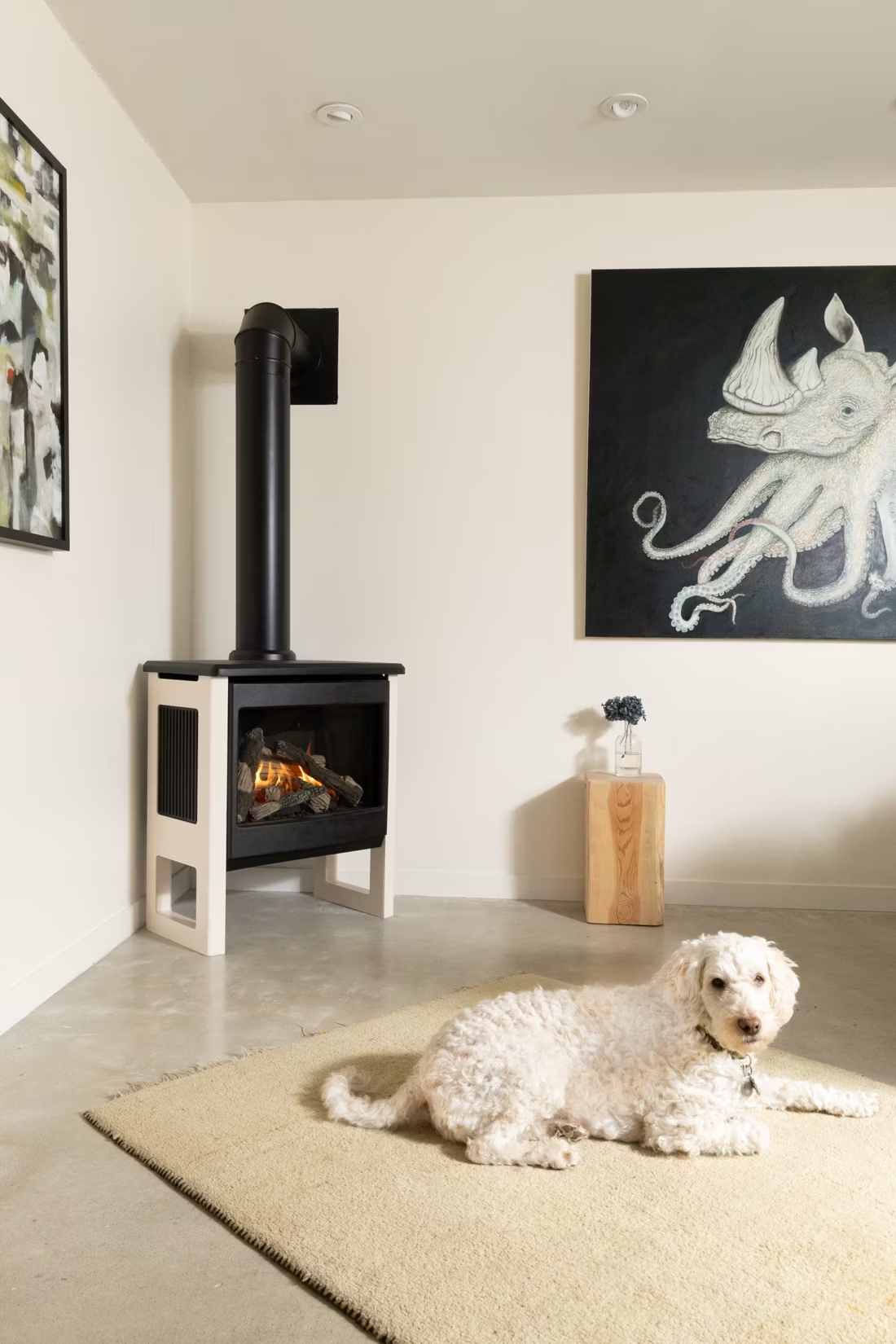
A gas fireplace is a fully built-in unit framed into a wall—the right call for new construction or a remodel that doesn't already have a firebox. A gas insert is sized to slide into an existing masonry fireplace opening, which describes most of the older homes around Colesville. A gas stove is a freestanding cast-iron or steel unit that sits on the floor and vents out through a wall or existing chimney, a good option for a room with no fireplace at all, like a finished basement. For the typical Colesville home with an original wood-burning firebox, an insert is usually the simplest and most cost-effective path.
Do I need a permit to install a gas fireplace in Colesville?
Yes. Montgomery County requires both a mechanical permit and a gas permit through the Department of Permitting Services (DPS) for new gas fireplace and insert installations, and the gas line work has to be done by a licensed gas fitter. Most established hearth dealers in the DC metro area handle the permit filing and inspection scheduling as part of the installation, so you're not left coordinating DPS, a gas fitter, and an installer separately.
What's the difference between vented and vent-free gas fireplaces?
Vented gas fireplaces—direct-vent or B-vent—pull combustion air from outside and exhaust combustion byproducts back outside through a sealed flue. Vent-free (ventless) units burn fuel directly into the room without any external venting and are legal in Maryland, but they come with strict room-size and ventilation requirements and release water vapor and trace combustion gases into the living space. For Colesville homes, which tend to be well-insulated older construction with central HVAC already handling whole-house air exchange, most local dealers steer homeowners toward a vented direct-vent unit—it delivers stronger heat output and avoids any question about indoor air quality.
How often should my gas fireplace be serviced?
Plan on an annual inspection, ideally in early fall before the heating season starts. A technician checks the burner, pilot assembly, gas connections, and venting, and cleans the glass and interior—a much quicker visit than a chimney sweep, but just as important for safe operation. Local gas appliance service providers in the Silver Spring and Montgomery County area typically charge $150 to $250 for this annual visit.
Should I even consider wood heat instead of gas in Colesville?
For most Colesville homes, no—wood-burning has become the exception here rather than the rule. Montgomery County's solid-fuel burning device rules add permitting and registration steps that most homeowners skip, and suburban lot sizes leave little room for stacking and seasoning cordwood, even though oak, hickory, and maple are all available regionally. Gas sidesteps all of that: no fuel storage, no ash, and heat on demand through the same Washington Gas line already running to your furnace. A small number of Colesville homeowners still keep a wood-burning fireplace for occasional ambiance, but as a primary or supplemental heat source, gas is the practical choice in this area.
Can I put a TV above my fireplace?
Yes—with an asterisk. Fireplaces are hot and TVs don't like heat. Either put a mantel between them to deflect rising warmth, or choose a fireplace with heat-management technology that creates a cool zone on the wall above—the wall stays around 125 degrees, barely warm, while the room still gets full heat. If you like clean lines and don't want a mantel, heat management is the answer.
Why is my open fireplace making my house colder?
Open fireplaces suck—literally. As the fire burns, it consumes air your furnace already paid to heat and pulls it out through the chimney, so the house is actually colder after the fire goes out than before you lit it. An insert fixes this: it seals the chimney, puts fixed glass across the front, and turns that hole in your house into a real heat source.
Can I install a fireplace myself?
If you're putting a fire in your house on purpose, it's best to work with an expert. Unless you're genuinely experienced in framing, gas line, vent pipe, and the national code on clearances to combustibles, have a professional do it—and ideally the same company that sells you the fireplace, so warranty, service, and liability all live under one roof.
How much should I budget for a fireplace?
For an average home—covering the fireplace, the vent pipe, and basic installation—a budget between $3,900 and $5,500 gives you a lot of options across wood, gas, and pellet. By the time you add finish work, gas line, and electrical, the average complete installation lands between $5,000 and $12,000 all-in. In a remodel or new build, a good rule is to put about 2.5% of the total project cost toward the fireplace.
Nearby Dealers
Hearth shops serving Colesville and the surrounding area. Every listing shows whether it is a WhyFire partner, a dealer we have verified as authorized for the brands we recommend, or a local business carrying hearth products. No manufacturer pays for placement. How we verify dealers →
Complete Chimneys Fireplaces & Grills
Chimney.com
Capitol Chimney Service
Cyprus Air
Costello's Hearth & Spa - Rockville
The Fireplace Shop
Chelsea's Chimney
Masters Pellet Stoves
Westlake Ace Hardware
Fireside Hearth & Home - Elkridge
Trinity Chimney Service
Belair Engineering & Service Co, Inc
The Torch Guys
Affordable Outdoor Kitchens
Costello's Hearth & Spa - Glen Burnie
Aspen Green Gasworks
Cyprus Air, Indoor Comfort
Genesis Chimney Services
Lawn & Leisure
Find your gas fireplace in Colesville.
Tell us a bit about your home and we'll put together a free Project Guide & Parts List—the exact parts, vent kit, and a trusted local Colesville-area dealer for your gas fireplace project.
Find Your Fireplace →