
Electric warmth that fits any room in Morgan County.
No chimney, no gas line, no venting—just plug in or hardwire and go. A practical option for the manufactured homes, additions, and older farmhouses scattered across Morgan County, from West Liberty out toward the Daniel Boone National Forest.
Every Project Starts From One of These Five Situations
A low-cost way to add heat and ambiance without touching your chimney.
Morgan County sits in climate zone 4A with roughly 4,891 heating degree days and an average winter low near 22°F—a real Appalachian heating season, but not an extreme one. Wood heat runs deep here: oak, hickory, maple, and cherry are cut locally, often under a Daniel Boone National Forest permit ($20 per cord, May through October season), and plenty of homes still lean on a wood stove for whole-house warmth. But not every room, and not every home, is set up for that. A lot of Morgan County's housing stock is manufactured or modular, or older single-story construction where running a new chimney is either impossible or not worth the cost.
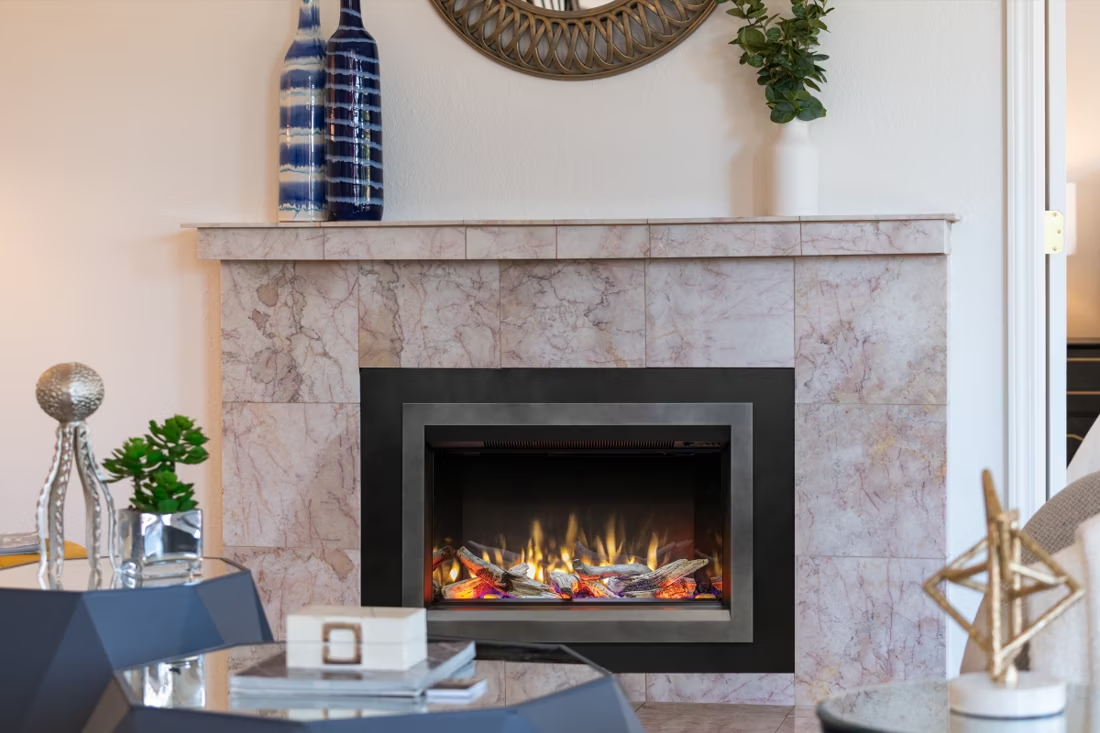
That's where electric fireplaces earn their place. There's no combustion, no venting, and typically no building permit beyond an electrical inspection if a dedicated circuit is needed—a licensed electrician and a local dealer can usually have a built-in unit running in a day. For homes served by Licking Valley RECC, an electric fireplace is an easy add-on to an existing panel, and it works well as zone heat in a bedroom, sunroom addition, or rental unit where a wood stove or propane tank doesn't make sense. The tradeoff worth knowing: electric fireplaces are grid-dependent, so during the ice storms that periodically knock out power in the eastern Kentucky hills, they go dark along with everything else. Most Morgan County homeowners who add one keep it as a supplement to wood or propane heat rather than a replacement.
Three steps. No salesperson until you're ready.
Tell us about your project
Your zip code, your situation, and the fuel you're leaning toward—or let the answers point you to one.
See what's actually available
The brands dealers within 100 miles genuinely carry—real options, never a catalog mirage.
Get your dealer & Project Guide
A trusted local dealer, plus the free Project Guide & Parts List that names every component of the job.
Frequently Asked Questions
How much does an electric fireplace installation cost in Morgan County?
Electric fireplace costs run lower than wood, gas, or pellet installs because there's no chimney, no venting, and no gas line to run. A plug-in freestanding electric stove or a simple insert that fits into an existing masonry opening typically lands in the $400 to $1,200 range installed. A built-in wall unit that requires framing, a dedicated 240-volt circuit, and finish carpentry costs more—often $1,500 to $3,000 depending on the unit and whether an electrician needs to extend service from the panel. Local dealers serving Morgan County can quote a firm number after seeing the space and your existing wiring.
Can an electric fireplace actually heat a room, or is it just for looks?
Modern electric fireplaces with a built-in heater can genuinely warm a single room—most units put out around 4,700 to 5,200 BTU, enough for a bedroom, den, or sunroom addition, especially layered on top of central heat or a wood stove elsewhere in the house. They're not designed to replace whole-home heating in a Morgan County winter with lows regularly near 22°F, but as supplemental zone heat for a specific space, they perform well and cost far less to run than baseboard electric heat in that same room.
Do I need a permit to install an electric fireplace in Morgan County?
A simple plug-in unit generally doesn't require a permit—it's treated like any other appliance you plug into an outlet. If you're installing a built-in unit that needs a new dedicated circuit run from your panel, that electrical work typically does require a permit and inspection through the county building department, and it should be done by a licensed electrician. There's no chimney inspection, no venting sign-off, and no air quality review to worry about, which is a big part of why electric installs move faster than wood or gas projects.
Will my electric fireplace still work if the power goes out?
No—electric fireplaces run entirely on grid power, so they shut down the moment your electricity does. That matters in Morgan County, where ice storms in the surrounding hills can knock out Licking Valley RECC service for a day or more during the coldest stretches of winter. If you're relying on a fireplace for actual emergency heat, a wood stove or a properly vented propane unit will keep working when the power doesn't. Most homeowners here treat electric fireplaces as everyday zone heat and ambiance, with a wood stove or propane heater as the real backup plan.
Electric vs. wood—which makes more sense for my Morgan County home?
Wood remains the traditional choice in this part of eastern Kentucky—cutting permits through the Daniel Boone National Forest run about $20 per cord in the May-to-October season, and oak, hickory, maple, and cherry are all abundant locally. Wood also keeps working when the power's out. Electric wins on installation simplicity and upfront cost: no chimney, no creosote, no annual sweep, and it can go almost anywhere in the house, including additions and manufactured homes where a chimney isn't practical. A lot of households here end up with both—a wood stove for primary or backup heat, and an electric unit in a bedroom or living area for everyday convenience.
Are electric fireplaces a good fit for manufactured and modular homes?
Yes—this is one of the strongest use cases for electric in Morgan County, where manufactured and modular homes make up a meaningful share of the housing stock. Wood stoves and masonry fireplaces are often difficult or impossible to retrofit into these homes due to clearance and structural requirements, but a plug-in or built-in electric unit avoids that problem entirely. There's no roof penetration, no floor protection pad required for fire code, and no structural modification—just an outlet or a properly sized circuit.
How much maintenance does an electric fireplace need?
Very little. There's no creosote, no ash, and no chimney to sweep, so you can skip the annual inspection that wood-burning appliances require. Most upkeep is limited to occasionally dusting the unit, replacing the heater element or LED flame bulbs after several years of use (most last 5-10 years), and keeping the vents on the unit clear of dust and pet hair. This low-maintenance profile is part of why electric fireplaces are popular as secondary heat sources in rental properties and vacation homes around the county.
Where can an electric fireplace be installed in my home?
Almost anywhere, since there's no venting requirement—bedrooms, basements, sunrooms, additions, even interior walls with no exterior access all work. This flexibility is a real advantage over wood or gas units, which need a clear path to the outside for venting. The main constraint is electrical: a plug-in unit just needs a standard outlet, while a built-in unit needs access to run a dedicated circuit, which a local electrician or dealer can assess during a walkthrough.
Electric vs. propane—which is more common for supplemental heat in Morgan County?
Propane is the more common supplemental fuel in much of rural Morgan County, since natural gas lines don't reach most of the county and propane tanks are a practical workaround. Propane heaters and fireplaces put out more heat per unit and, with the right setup, can run during a power outage—an advantage over electric. Electric fireplaces cost less to install since there's no tank, no gas line, and no venting to plan for, and they're simpler for renters or homeowners who don't want to manage propane deliveries. For pure ambiance or light zone heat in a single room, electric is usually the lower-hassle choice; for real backup heating capacity, propane still has the edge.
Can I put a TV above my fireplace?
Yes—with an asterisk. Fireplaces are hot and TVs don't like heat. Either put a mantel between them to deflect rising warmth, or choose a fireplace with heat-management technology that creates a cool zone on the wall above—the wall stays around 125 degrees, barely warm, while the room still gets full heat. If you like clean lines and don't want a mantel, heat management is the answer.
Do electric fireplaces actually produce heat?
Yes—most put out around 4,800–5,000 BTUs from a standard outlet, which comfortably warms a bedroom, office, or den as a comfort-zone heater. What they won't do is carry a whole house the way wood, gas, or pellet can. Think of electric as ambiance-first with honest supplemental heat: flames on with no heat in July, flames plus warmth in January.
How much should I budget for a fireplace?
For an average home—covering the fireplace, the vent pipe, and basic installation—a budget between $3,900 and $5,500 gives you a lot of options across wood, gas, and pellet. By the time you add finish work, gas line, and electrical, the average complete installation lands between $5,000 and $12,000 all-in. In a remodel or new build, a good rule is to put about 2.5% of the total project cost toward the fireplace.
Can a fireplace actually lower my heating bill?
Yes—by creating a comfort zone. A furnace heats every square foot of the house just to warm the one room you're in; a gas fireplace on low burns roughly a sixth of the gas a typical furnace does. Set the furnace around 55–60 degrees as a baseline, then heat the rooms your family actually uses. Families who heat this way commonly save $20–$60 a month.
Find your electric fireplace in Morgan County.
Tell us a bit about your home and we'll put together a free Project Guide & Parts List for your electric fireplace project—the right unit, the circuit requirements, and a trusted local dealer to install it.
Find Your Fireplace →