
Warm up any room in McCracken County—no chimney required.
From the historic floodwall district in downtown Paducah to newer homes along the Jackson Purchase Parkway corridor, electric fireplaces deliver real zone heat with none of the venting, gas lines, or chimney work. Find the right unit and get matched with a trusted local dealer.
Every Project Starts From One of These Five Situations
Electric fireplaces fit Paducah's historic homes and modern builds alike.
McCracken County sits at the confluence of the Ohio and Tennessee Rivers in Kentucky's Jackson Purchase region—climate zone 4A, with a winter heating load roughly in line with a place like Louisville, and winter lows that average around 25°F. That's a real heating season, but nothing like the sustained deep cold of places like Duluth, MN or Fargo, ND. Most McCracken County homes need solid heat for a December-through-February stretch, not months of subzero nights, which is exactly the kind of climate where electric fireplaces earn their keep as supplemental, room-by-room heat rather than a full furnace replacement.
Downtown Paducah's older brick homes near the floodwall murals and the National Quilt Museum district often have existing masonry fireplaces that were never built for efficient heat, and running new gas line or a full chimney liner into a 1920s house gets expensive fast. An electric insert drops into that same opening with no venting and no gas permit. Out in newer subdivisions around Lone Oak and Reidland, a built-in wall unit or freestanding electric stove adds heat to a bonus room or finished basement without touching the HVAC system. Whether your power comes from Paducah Power System inside city limits or Jackson Purchase Energy Corporation in the rural county, the appeal is the same: plug it in (or have an electrician wire a dedicated circuit) and you have heat and ambiance in an afternoon, not a multi-week gas-line project.
Three steps. No salesperson until you're ready.
Tell us about your project
Your zip code, your situation, and the fuel you're leaning toward—or let the answers point you to one.
See what's actually available
The brands dealers within 100 miles genuinely carry—real options, never a catalog mirage.
Get your dealer & Project Guide
A trusted local dealer, plus the free Project Guide & Parts List that names every component of the job.
Frequently Asked Questions
How much does an electric fireplace installation cost in McCracken County?
A plug-in freestanding electric stove or mantel unit runs $200 to $800 for the unit itself and needs no installation beyond setting it in place near an outlet. A built-in wall unit or an insert that replaces the guts of an existing masonry fireplace typically runs $1,200 to $3,500 installed, and that range climbs if a licensed electrician needs to run a new dedicated 20-amp circuit—common in older Paducah homes with older panels that are already near capacity. Recessed or linear units built into new framing during a remodel land on the higher end once trim carpentry is factored in. Local dealers will quote a firm number after seeing your wall, your panel, and the model you want.
What size electric fireplace do I need for my room?
Most electric fireplaces put out 1,500 watts (roughly 5,000 BTU) of supplemental heat, which comfortably takes the edge off a single room of 400 to 1,000 square feet depending on ceiling height and insulation. They are not designed to replace your furnace or heat pump—think of them as zone heat for a den, sunroom, or finished basement rather than whole-home heating. In older McCracken County homes with drafty single-pane windows near downtown Paducah, a unit with a strong fan-forced heater matters more than one chosen purely for flame realism. Larger great rooms usually do better with two smaller units or a linear model spread across a wider opening rather than one oversized unit in a corner.
Do I need an electrician to install an electric fireplace?
Plug-in units need nothing more than a standard 120-volt outlet, so no electrician is required. Built-in wall units, inserts, and anything hardwired instead of plugged in typically draw enough current that a dedicated circuit is recommended, and in many older McCracken County homes it's necessary—older knob-and-tube or undersized panels common in Paducah's pre-1960s housing stock often can't handle an added 1,500-watt load safely on an existing circuit. A licensed electrician should handle any hardwired install, and your local hearth dealer will typically coordinate that work as part of the installation rather than leaving you to find your own electrician.
What's the difference between an electric fireplace, insert, and stove?
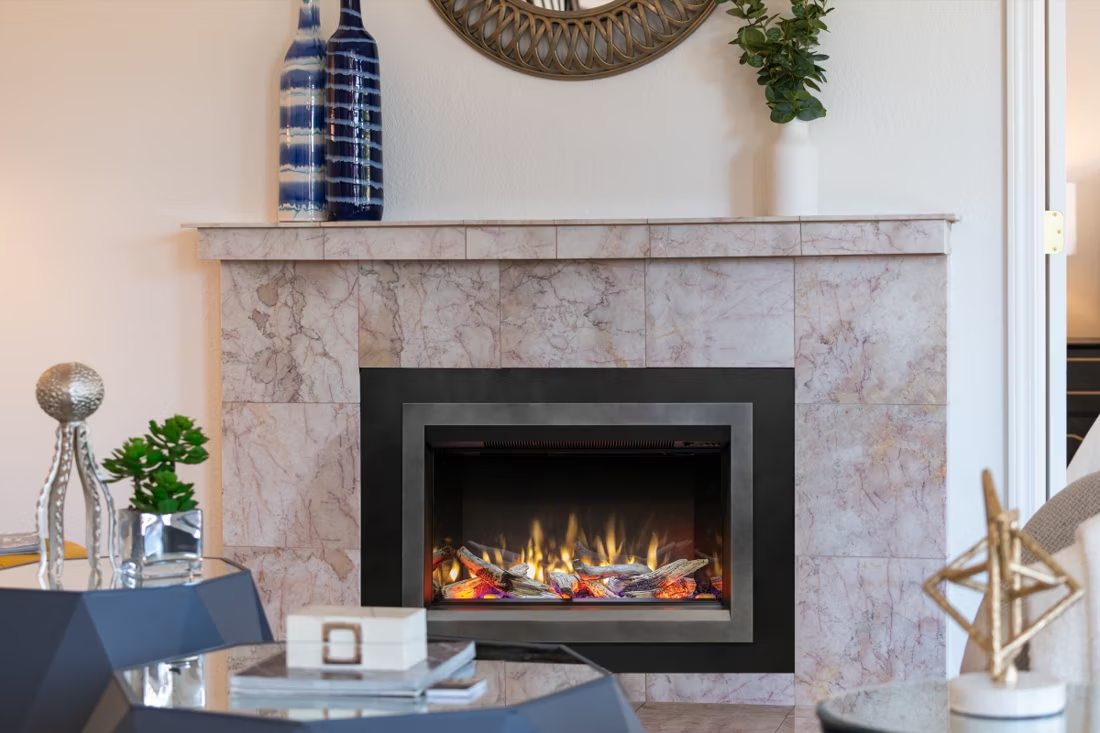
An electric fireplace is usually a built-in unit set into a wall, framed enclosure, or media console—best for new construction or a remodel. An electric insert is sized to slide into an existing masonry fireplace opening, which is the common choice for older Paducah homes with a fireplace that was never efficient to begin with. An electric stove is a freestanding cabinet-style unit that sits on the floor like a wood stove but plugs into an outlet—a good fit for renters, apartments, or anyone who wants heat and flame effect without any wall modification at all. All three heat the same way; the difference is really about the opening or space you're working with.
Do I need a permit to install an electric fireplace in McCracken County?
A plug-in freestanding unit generally needs no permit at all—it's treated like any other appliance. If your installation involves new electrical wiring, a dedicated circuit, or work inside a wall, that portion typically does require an electrical permit through the city of Paducah's building codes office if you're inside city limits, or McCracken County code enforcement if you're in the unincorporated county. Most licensed electricians and hearth dealers handle that paperwork as part of the job, so it's rarely something homeowners have to manage themselves.
What's the best electric fireplace for McCracken County's climate?
Because McCracken County's winters are moderate rather than brutal—average lows around 25°F rather than the sustained subzero stretches you'd see in Minnesota or North Dakota—most homeowners here do fine with a mid-range fan-forced electric insert or built-in from brands like Dimplex, Napoleon, or Amantii, chosen more for flame realism and finish than for heavy-duty output. For a sunroom or converted porch that gets genuinely cold, prioritize a model with a stronger heater rating and a thermostat rather than one built purely for ambiance. Downtown homes retrofitting a masonry opening should measure the firebox carefully first—insert sizing is where a local dealer's in-home visit pays off.
How much does an electric fireplace cost to run compared to my utility bill?
A typical 1,500-watt electric fireplace run on high costs roughly 15 to 20 cents per hour at current residential rates from Paducah Power System or Jackson Purchase Energy Corporation, translating to a few dollars for a full evening of use. Run it a few hours a night through a cold January stretch and you'll see a noticeable but manageable bump on your bill—nowhere near what it costs to heat the same square footage with your central system. Most owners use the heater setting only when they're actually in the room and switch to flame-only mode (which draws only a few watts) the rest of the time.
How much maintenance does an electric fireplace need?
Very little. There's no chimney to sweep, no flue to inspect, and no combustion byproducts to worry about. Maintenance is mostly dusting the interior fan and vents once or twice a year and occasionally replacing an LED module after many years of use—most units are rated for 10 to 15 years or more of daily use before the light components need attention. This low-maintenance profile is one of the bigger draws for McCracken County homeowners who want fireplace ambiance without an annual service call.
Electric vs. gas—which is right for my McCracken County home?
Gas fireplaces put out real, substantial heat and work well as a primary supplemental source in a main living area, and natural gas or propane service is common throughout McCracken County. Electric fireplaces trade some heat output for simplicity—no gas line, no venting, no combustion, and the ability to install one in almost any room, including apartments, condos, and older Paducah homes where running new gas line into a 1920s brick structure is a real expense. If you want strong heat in your primary living space, gas is usually the better fit. If you want ambiance and light supplemental warmth in a bedroom, basement, or converted sunroom with the simplest possible install, electric wins. Plenty of local homes end up with both.
Can I put a TV above my fireplace?
Yes—with an asterisk. Fireplaces are hot and TVs don't like heat. Either put a mantel between them to deflect rising warmth, or choose a fireplace with heat-management technology that creates a cool zone on the wall above—the wall stays around 125 degrees, barely warm, while the room still gets full heat. If you like clean lines and don't want a mantel, heat management is the answer.
How much does an electric fireplace cost to run?
With the heater on, a typical unit draws about 1,500 watts—at average electric rates that's roughly 20 cents an hour. Run the flame effect alone and it costs pennies; the flames are LED-driven and use about as much power as a light bulb. There's no pilot light, no fuel delivery, and essentially no maintenance.
How much should I budget for a fireplace?
For an average home—covering the fireplace, the vent pipe, and basic installation—a budget between $3,900 and $5,500 gives you a lot of options across wood, gas, and pellet. By the time you add finish work, gas line, and electrical, the average complete installation lands between $5,000 and $12,000 all-in. In a remodel or new build, a good rule is to put about 2.5% of the total project cost toward the fireplace.
Can a fireplace actually lower my heating bill?
Yes—by creating a comfort zone. A furnace heats every square foot of the house just to warm the one room you're in; a gas fireplace on low burns roughly a sixth of the gas a typical furnace does. Set the furnace around 55–60 degrees as a baseline, then heat the rooms your family actually uses. Families who heat this way commonly save $20–$60 a month.
Stove and Fireplace Dealers in McCracken County
Find your electric fireplace in McCracken County.
Tell us a bit about your home and we'll put together a free Project Guide & Parts List—the right electric fireplace or insert for your space, the exact parts involved, and a trusted local McCracken County dealer to install it.
Find Your Fireplace →