
Reliable Gas Heat for Central Indiana Winters.
Westfield's building boom has filled Hamilton County with new great rooms built around direct-vent gas fireplaces. Find the right unit for your home and connect with a trusted local dealer.
Every Project Starts From One of These Five Situations
Built for a fast-growing Hamilton County suburb.
Westfield has roughly doubled in population over the past two decades, and neighborhoods like Bridgewater, Chatham Hills, and Viking Meadows reflect that growth—most homes here are new construction with great rooms designed around a built-in gas fireplace rather than a masonry hearth. Sitting at 901 feet in climate zone 5A, Westfield sees an average winter low around 19°F and a solid six-month heating season each year—colder than Nashville, but well short of the brutal, prolonged cold of Minneapolis or Fargo. It's real Midwest winter, but not extreme cold, which is exactly the climate direct-vent gas handles well without the overkill of a heavy-duty wood setup.
Wood-burning and pellet appliances are rare in Westfield, and for practical reasons: many of the newer subdivisions carry HOA covenants that discourage open-flame wood burning, tightly sealed new-construction homes don't pair well with solid-fuel combustion, and there's no nearby public forest land or cutting-permit infrastructure the way there is in more rural or mountain regions. Gas fills that gap cleanly—instant heat at the flip of a switch or remote, no ash or creosote, and a look that matches the finished, builder-grade aesthetic of a Chatham Hills or Bridgewater great room. Electric fireplaces from Duke Energy Indiana-served homes are the other common secondary option for finished basements and bonus rooms.
Three steps. No salesperson until you're ready.
Tell us about your project
Your zip code, your situation, and the fuel you're leaning toward—or let the answers point you to one.
See what's actually available
The brands dealers within 100 miles genuinely carry—real options, never a catalog mirage.
Get your dealer & Project Guide
A trusted local dealer, plus the free Project Guide & Parts List that names every component of the job.
Frequently Asked Questions
How much does a gas fireplace installation cost in Westfield?
A typical gas fireplace installation in Westfield runs roughly $4,200 to $10,500. Many newer homes in developments like Bridgewater or Viking Meadows were already stubbed for gas during construction, so upgrading a builder-grade unit to a higher-efficiency model is usually on the lower end. Retrofitting an older home near downtown Westfield's Grand Junction area—one without an existing gas line to the fireplace location—costs more once line extension and venting are factored in. A local dealer will confirm the exact number after seeing your home's layout.
Can I convert an existing wood-burning fireplace to gas?
Yes, though it's less common here than in older Midwest cities simply because most Westfield homes were built in the last 20 years with gas already in mind. For the handful of pre-boom farmhouses and older homes scattered through Hamilton County that do have a masonry wood fireplace, a gas insert with a stainless liner run up the existing chimney is a straightforward upgrade, typically landing in the $4,500 to $9,000 range depending on whether new gas line work is required.
Is natural gas or propane more common for Westfield homes?
Natural gas mains have been extended alongside nearly every subdivision built in Westfield over the past two decades, so most homes within city limits already have gas service for the furnace and water heater, making a fireplace addition simple. Out toward the unincorporated edges of Hamilton County—near Sheridan or Arcadia—propane tanks are more typical. Gas fireplace units can generally be configured for either fuel; your installer sets the orifice and regulator accordingly.
Will my gas fireplace still work if the power goes out?
Most modern gas fireplaces will, which matters here—Hamilton County sees its share of ice storms and summer derecho-style wind events that can knock out Duke Energy Indiana service for hours at a time. Units with IPI (intermittent pilot ignition) run on a battery backup that kicks in automatically when the power drops. Valor fireplaces go a step further: their pilot's thermocouple generates its own electricity, so there's no battery to remember to replace. Ask your dealer about the ignition system on any model you're considering.
Fireplace, insert, or stove—which fits a Westfield home?
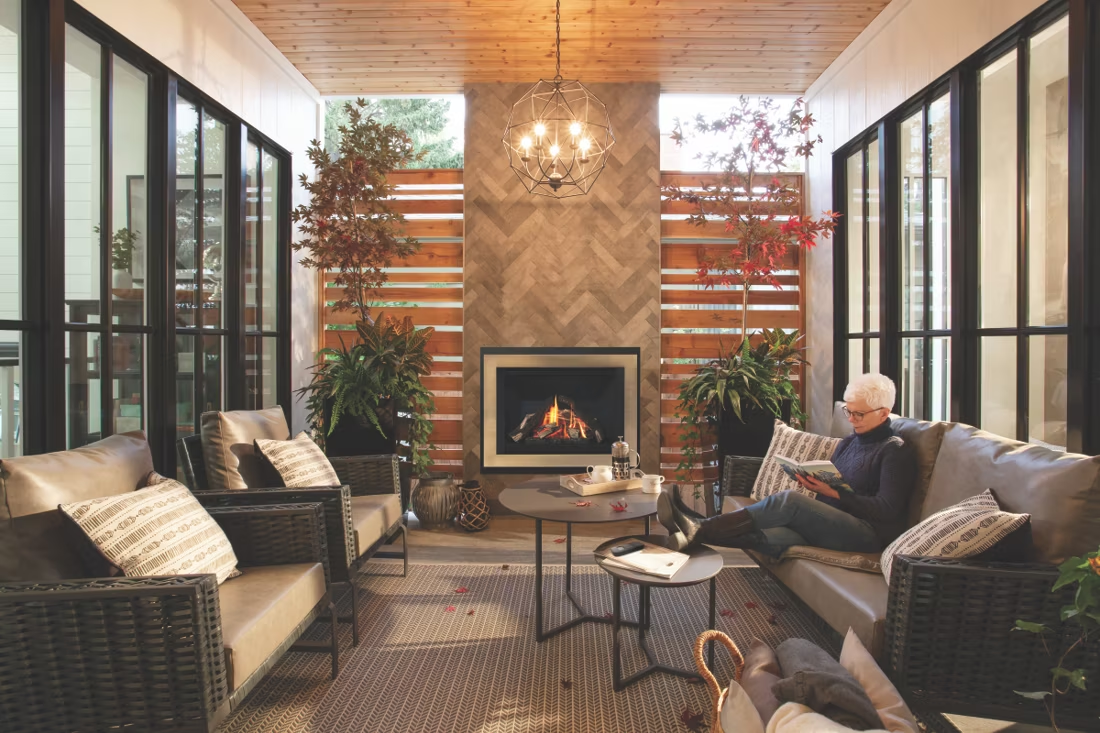
Most new-construction great rooms in Westfield are built around a framed, built-in direct-vent gas fireplace as the visual centerpiece of the room—that's the default in nearly every recent subdivision. For the smaller number of older homes with an existing masonry firebox, a gas insert makes more sense, since it reuses the chimney. A freestanding gas stove is less common here but works well in a converted garage, bonus room, or finished basement where there's no existing fireplace opening.
What permits do I need for a gas fireplace in Westfield?
New gas fireplace installations inside city limits require a building permit through the City of Westfield's Department of Community Development, plus a separate gas line permit pulled by a licensed gas fitter. Homes in unincorporated Hamilton County go through the county building department instead. Reputable local hearth dealers coordinate both permits and the final inspection as part of the installation, so you're not managing multiple trades yourself.
Should I get a vented or vent-free gas fireplace?
Vent-free units are legal in Indiana within room-size and ventilation guidelines, but for the tightly sealed, energy-efficient construction typical of newer Westfield homes, direct-vent (fully vented) units are the stronger recommendation—they draw combustion air from outside and exhaust it back out, which keeps indoor air quality unaffected regardless of how airtight the house is. Direct-vent is also what most local dealers install by default in new-construction great rooms.
How often does a gas fireplace need to be serviced?
Plan on an annual inspection, ideally before the first cold snap in late fall. A technician checks the burner, pilot assembly, venting, and gas connections, and cleans the glass—usually $150 to $250. Given how many gas fireplaces went into Westfield homes during the recent building boom, several Hamilton County and Indianapolis-metro service companies now specialize in exactly this kind of routine maintenance call.
Gas vs. wood vs. electric—what actually makes sense in Westfield?
Wood-burning is genuinely rare here—there's no nearby public timber land, HOA rules in most subdivisions discourage it, and almost no local retailers stock cordwood appliances as a result. That leaves the real choice as gas versus electric. Gas delivers true radiant heat and works during outages with battery-backup or self-powering ignition, making it the better fit for a primary living-room fireplace. Electric units, running on Duke Energy Indiana's roughly $0.1275 per kWh residential rate, are simpler to install with no venting required at all, which is why they show up most often in finished basements and secondary rooms rather than the main great room.
What's the difference between an insert and a zero-clearance fireplace?
An insert is a fireplace that slides into a pre-existing wood-burning fireplace—if you don't have one, there's nothing to insert it into. A zero-clearance fireplace is built into a framed wall, which makes it the answer for remodels and new construction. Simple test: existing masonry fireplace means insert; blank or framed wall means zero-clearance.
Why is a fireplace insert so efficient?
An insert does two things: it seals the chimney completely, so you stop losing air you already paid to heat, and it radiates warmth into the room through the firebox and glass. Most add a heat-exchange fan that pulls cool room air underneath, wraps it around the hot firebox, and pushes it back out warm. Your home is more efficient before you've even lit the first fire.
Can I install a fireplace myself?
If you're putting a fire in your house on purpose, it's best to work with an expert. Unless you're genuinely experienced in framing, gas line, vent pipe, and the national code on clearances to combustibles, have a professional do it—and ideally the same company that sells you the fireplace, so warranty, service, and liability all live under one roof.
Does a fireplace add value to my home?
On average, a fireplace adds back to the home about the same amount you spent installing it. Add the monthly savings from heating the rooms you actually use instead of the whole house—often hundreds of dollars a year—and the value case is strong before you even count what a fire does for how your family uses the room.
Nearby Dealers
Hearth shops serving Westfield and the surrounding area. Every listing shows whether it is a WhyFire partner, a dealer we have verified as authorized for the brands we recommend, or a local business carrying hearth products. No manufacturer pays for placement. How we verify dealers →
The Cinder Box
Newco Dealers Wholesale
Pate's Pool Service & Supply
Mowery Inc.
Kindled Timber
Find your gas fireplace in Westfield.
Tell us a bit about your home and we'll match you with the right gas fireplace, insert, or stove—and connect you with a trusted local dealer.
Find Your Fireplace →