
Find your fireplace in Hamilton County.
Fireplace resources for every corner of the county—from downtown Carmel and Fishers out to Sheridan and Atlanta. Pick your fuel and get matched with a local dealer who knows what a Hamilton County subdivision, or a farmhouse near Arcadia on a few acres, can actually support.
Every Project Starts From One of These Five Situations
Suburban Indianapolis winters, 5,758 heating degree days, and a county that heats almost entirely on gas and electric.
Hamilton County is one of Indiana's fastest-growing suburban counties, sitting just north of Indianapolis across flat till-plain terrain shaded by mature oak, hickory, maple, and beech—the hardwood canopy that lines the White River corridor and the county's park system. Carmel, Fishers, Noblesville (the county seat), and Westfield anchor the dense southern half of the county, while Sheridan, Arcadia, Atlanta, and Cicero remain smaller crossroads communities in the more rural north. Winters here sit in climate zone 5A, averaging a 19°F winter low and 5,758 heating degree days—a heating load in the same range as Madison, Wisconsin, with a season that typically runs from mid-October through April.
What sets Hamilton County apart from a lot of Midwest counties this cold is that wood and pellet heat never really took hold here, despite the climate supporting it. Citizens Energy Group and comparable gas distribution reach nearly every subdivision built during the county's growth boom, and Duke Energy Indiana covers electric service countywide, so gas and electric fireplaces have been the default retrofit and new-construction choice for decades. Add in HOA covenants in newer developments that commonly restrict exterior wood stacks and solid-fuel chimneys, plus insurance underwriters who flag wood stoves as a liability on newer builds, and solid fuel becomes the exception rather than the rule. Older farmhouses on acreage near Sheridan, Atlanta, and Arcadia sometimes still run an original masonry wood fireplace, and a handful of households source pellets from regional suppliers like Lignetics or Somerset Pellet Fuel—but new wood or pellet installs are genuinely rare in this county. This hub rolls up hearth retailers, service techs, and fuel suppliers across all of Hamilton County so the gas and electric buyers who make up most of the market, and the occasional legacy wood or pellet household, can each find who actually serves their address.
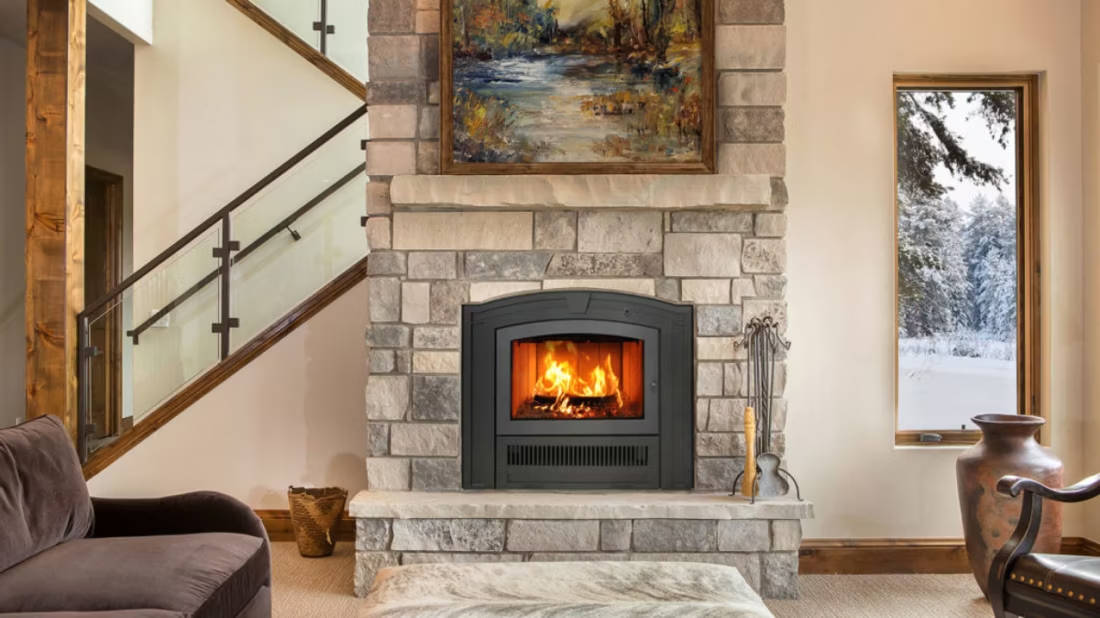
Four fuels. One honest answer for Hamilton County.
Three steps. No salesperson until you're ready.
Tell us about your project
Your zip code, your situation, and the fuel you're leaning toward—or let the answers point you to one.
See what's actually available
The brands dealers within 100 miles genuinely carry—real options, never a catalog mirage.
Get your dealer & Project Guide
A trusted local dealer, plus the free Project Guide & Parts List that names every component of the job.
Frequently Asked Questions
Which fireplace fuel makes the most sense in Hamilton County?
For the vast majority of homes here, it comes down to gas or electric. Direct-vent gas fireplaces and inserts are the default choice in Carmel, Fishers, Noblesville, and Westfield subdivisions because natural gas service from Citizens Energy Group already reaches nearly every lot, and gas gives you real supplemental heat during a 5,758-heating-degree-day winter without touching a woodpile. Electric fireplaces are popular as a second unit—finished basements, primary bedrooms, media rooms—since they need no venting and work in any HOA-governed development. Wood and pellet units are genuinely uncommon here; they're not banned outright, but between subdivision covenants restricting exterior chimneys and insurance underwriters flagging solid-fuel appliances on newer homes, most buyers who want one end up looking at rural acreage near Sheridan or Arcadia instead of a standard cul-de-sac lot.
Why don't more homes in Hamilton County have wood-burning fireplaces given how cold it gets here?
It's not the climate—19°F winter lows and 5,758 heating degree days would easily support a wood stove, similar to what you'd see in Madison, Wisconsin. It's the housing stock and the covenants. Most of the county's homes were built during the 1990s-through-2010s growth boom under HOA rules that restrict exterior wood stacks and solid-fuel chimneys, and insurance carriers for newer construction frequently exclude or upcharge for wood-burning appliances. So wood heat survives mainly as a legacy feature—an original masonry fireplace in an older farmhouse near Sheridan, Atlanta, or Arcadia—rather than something installed fresh in a Fishers or Westfield subdivision. If you're on acreage outside a covenant-controlled development, a wood stove burning local oak or hickory is still entirely workable; you'll just want to confirm your specific lot isn't subject to a deed restriction before you commit.
Do I need a permit for a gas fireplace installation in Hamilton County?
Yes, and where you apply depends on which town you're in. Carmel, Fishers, Noblesville, Westfield, and Zionsville each run their own building department and issue their own permits, while unincorporated areas of the county—including Sheridan, Arcadia, and Atlanta—go through the Hamilton County building department instead. Any gas line extension or new gas connection also requires a licensed gas fitter, separate from the general building permit. Electric fireplace installs usually skip the permit process unless you're adding a new dedicated circuit for a built-in unit. Most gas fireplace retailers in the county handle permitting as part of the installation, so it's rarely something you're filing on your own.
Can I still get a pellet stove installed in Hamilton County, or is it just not available?
It's available, but it's a niche request rather than a stocked product line. Very few local hearth retailers keep pellet inserts on the showroom floor because demand is low—most Hamilton County homes are either on gas already or in a development where a pellet stove's exterior venting runs into the same covenant issues as wood. That said, regional pellet fuel brands including Indeck Energy Services, Lignetics, and Somerset Pellet Fuel do distribute into this part of Indiana, so the handful of households running a pellet stove, typically on rural property near Sheridan or Atlanta, aren't stranded on fuel supply. If you want one, expect to special-order the unit through a dealer rather than pick one off a display.
What does a gas or electric fireplace installation typically cost in Hamilton County?
Gas fireplace, insert, or linear-unit installs generally run $4,500–$11,000 in this county, with the wide range driven mostly by whether you're extending a gas line to a new location or converting an existing wood-burning fireplace to gas. Electric fireplaces are the more affordable option—$200–$3,000 for the unit itself, plus $400–$1,200 in labor if you're framing a built-in surround or adding a dedicated circuit rather than plugging in a freestanding model. New-construction and remodel projects in Carmel, Fishers, and Westfield tend to land toward the higher end of these ranges because they're more often full built-ins with custom surrounds, while simpler retrofit installs in older Noblesville or Cicero homes tend to run leaner.
How does installation and service scheduling work across the county—is it different in Carmel versus somewhere like Atlanta or Sheridan?
Most hearth retailers and service techs are based in or around Carmel, Fishers, and Noblesville, where the bulk of the county's population and gas fireplace demand sits, but they regularly run installation and service crews out to Westfield, Cicero, Sheridan, Arcadia, and Atlanta in the rural north county. Expect a modest travel fee on the farthest calls and slightly longer lead times once fall gas-fireplace inspection season picks up. Booking your annual gas fireplace inspection or electric fireplace check in late summer, before the first cold snap arrives in October, is the easiest way to get ahead of the rush regardless of which end of the county you're on.
Can I install a fireplace myself?
If you're putting a fire in your house on purpose, it's best to work with an expert. Unless you're genuinely experienced in framing, gas line, vent pipe, and the national code on clearances to combustibles, have a professional do it—and ideally the same company that sells you the fireplace, so warranty, service, and liability all live under one roof.
Does a fireplace add value to my home?
On average, a fireplace adds back to the home about the same amount you spent installing it. Add the monthly savings from heating the rooms you actually use instead of the whole house—often hundreds of dollars a year—and the value case is strong before you even count what a fire does for how your family uses the room.
What is an in-home preview and do I need one?
It's a visit where a hearth professional measures your space, confirms the model you picked actually works in your home, and walks the specs—framing, gas line, venting, finish work—before anything is ordered. Some details you just can't know until you see the house. Never make a down payment without one; it's the single most-skipped step that burns buyers.
Wood, gas, pellet, or electric—how do I choose?
Match the fuel to your life, not the other way around. Wood: lowest fuel cost and total power-outage independence, but you're hauling and stacking. Gas: press a button, set a thermostat, no maintenance to speak of. Pellet: wood economics with automatic feeding, in exchange for weekly cleaning and a need for electricity. Electric: plugs in anywhere with honest supplemental heat. Nobody regrets the fuel that fits how they actually live.
Stove and Fireplace Dealers in Hamilton County
Listings include WhyFire partner dealers, dealers we have verified as authorized for the brands we recommend, and established local businesses that carry hearth products. Every listing shows which one it is. The ones marked Preferred run on WhyFire's software, so they can show you real pricing and book your appointment right here. No manufacturer pays for placement. How we verify dealers →
O'Malia's Living
Newco Dealers Wholesale
The Cinder Box
Pate's Pool Service & Supply
Mowery Inc.
Kindled Timber
Get matched with a local Hamilton County dealer.
Pick your fuel below and we'll put together a free Project Guide & Parts List—the right unit, the vent kit it needs, and the local dealer we recommend for your Hamilton County project.
Find Your Fireplace →