
Add real warmth to your Pike County home—no chimney required.
From Petersburg to Winslow, Otwell, Spurgeon, and Stendal, Pike County homeowners are turning to electric fireplaces and stoves for supplemental warmth, ambiance, and zone heating that doesn't require a chimney, gas line, or firewood. Find the right unit for your home and connect with a trusted local dealer.
Every Project Starts From One of These Five Situations
Straightforward heat that fits any room in Pike County.
Pike County is home to just over 4,100 residents spread across Petersburg, Winslow, Otwell, Spurgeon, Stendal, and the farmland between them. Winters here sit in climate zone 4A, with a heating season that adds up to a solid, sustained winter and average lows around 22°F—cold enough to need real heat for months, but far short of the sub-zero stretches that hit places like Bismarck, ND or Duluth, MN. That moderate profile is exactly where electric fireplaces earn their keep: they're not usually a furnace replacement, but they're an easy way to add heat and light to a specific room without touching the county's existing wood-burning tradition.
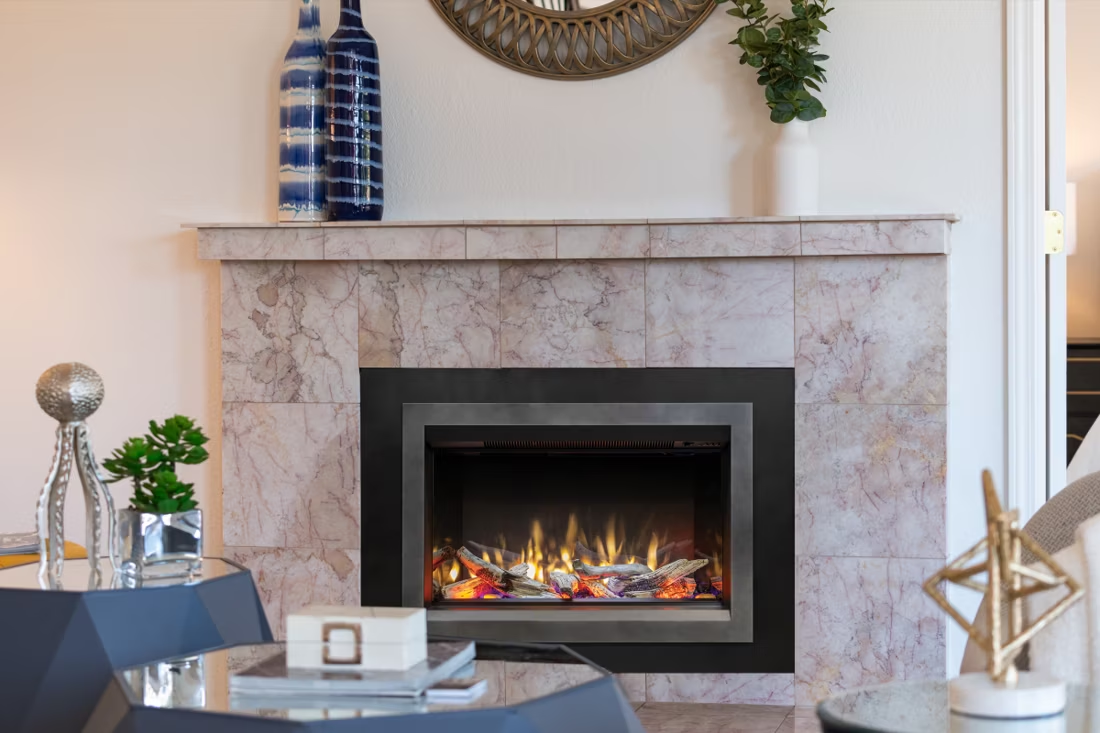
A lot of Pike County homes already burn oak, hickory, maple, or beech in a wood stove or fireplace for primary or backup heat—species that grow throughout the county's hardwood bottomland. Electric units fit alongside that setup rather than replacing it: a plug-in insert can go into an unused masonry fireplace to add zone heat to a living room, a wall-mounted unit can warm a finished basement or bonus room, and a full-surround electric fireplace can anchor a remodel without any venting, gas line, or chimney work. For renters, manufactured homes, and older farmhouses where running a flue isn't practical, electric is often the only realistic fireplace option.
Three steps. No salesperson until you're ready.
Tell us about your project
Your zip code, your situation, and the fuel you're leaning toward—or let the answers point you to one.
See what's actually available
The brands dealers within 100 miles genuinely carry—real options, never a catalog mirage.
Get your dealer & Project Guide
A trusted local dealer, plus the free Project Guide & Parts List that names every component of the job.
Frequently Asked Questions
How much does an electric fireplace installation cost in Pike County?
Electric fireplaces are the least expensive fireplace category to install because there's no venting, gas line, or masonry work involved. A plug-in insert or freestanding stove that runs on a standard 120-volt outlet typically costs $300 to $1,200 installed, since 'installation' often just means setting the unit in place. A built-in wall unit or full mantel surround that needs a dedicated 240-volt circuit runs closer to $1,000 to $3,500, mostly driven by electrician labor to run the new circuit. Local dealers serving Pike County can walk you through which category fits your home and budget.
Can I put an electric insert into my existing wood fireplace?
Yes, and it's one of the more common electric fireplace projects in Pike County. Many older homes in Petersburg and the surrounding townships have masonry fireplaces that aren't used regularly for wood burning anymore. An electric insert slides into that existing opening, plugs into a nearby outlet (or a new outlet added inside the firebox), and gives you flame effect and heat without cutting a new flue or dealing with a damper. It's a straightforward retrofit a local dealer can usually complete in a day.
Do I need a permit to install an electric fireplace in Pike County?
In most cases, no. A plug-in electric fireplace or insert that uses an existing outlet doesn't require a permit through the Pike County Area Plan Commission, since there's no gas line, venting, or structural work involved. If your installation requires a new dedicated circuit or a 240-volt hookup for a larger built-in unit, that electrical work should be done by a licensed electrician and may require an electrical permit depending on the scope. Ask your dealer or electrician to confirm before work begins.
What size electric fireplace do I need for my Pike County home?
Electric fireplaces are rated in BTUs and square footage, similar to a space heater, but most models top out around 5,000 to 5,200 BTUs—enough to comfortably heat a single room of 400 to 1,000 square feet, not a whole house. For a living room or den in a typical Pike County farmhouse or ranch-style home, a 40- to 50-inch insert or wall unit is a common fit. If you're trying to heat a larger open floor plan, plan on electric as a supplemental heat source alongside your existing furnace or wood stove rather than a stand-alone solution.
Will my electric fireplace still work during a power outage?
No—and this is the one real tradeoff worth knowing before you buy. Electric fireplaces run entirely on household power, so if an ice storm or downed line knocks out electricity anywhere in Pike County, the unit goes dark along with everything else. That's different from a wood stove burning local hardwood like oak or hickory, which keeps producing heat with no power at all. If backup heat during outages matters to you, plan on electric for daily convenience and ambiance, and keep a wood stove or generator-ready furnace as your outage plan.
Electric vs. wood—which is right for my home?
Wood stoves burning local oak, hickory, maple, or beech deliver real heat output, work without electricity, and fit the self-sufficient heating tradition that's common on Pike County's larger rural properties. Electric fireplaces trade that heat output for convenience: no wood to split and stack, no ash, no chimney to sweep, and a flame effect you can run for ambiance even in July. For a primary heat source on a farm or acreage, wood often wins. For a den, bedroom, apartment, or a home where nobody wants to deal with firewood, electric is usually the better fit.
Electric vs. pellet stove—which should I choose?
Pellet stoves burning bagged fuel from suppliers like Lignetics or regional producers such as Indeck Energy Services put out real, sustained heat—enough to serve as a primary or near-primary heat source in a Pike County home—but they need a vent, a hopper to load, and periodic ash cleanout. Electric fireplaces skip all of that: no venting, no fuel to store, no maintenance beyond dusting. The tradeoff is heat output—electric units cap out around 5,000 BTUs, well below what a pellet stove can produce. If you want a supplemental, low-maintenance heat source, electric fits. If you want to meaningfully offset your furnace bill, pellet is the stronger option.
Where can I find a dealer to install an electric fireplace near Pike County?
Pike County itself is small—about 4,100 people spread across Petersburg, Winslow, Otwell, and the surrounding area—so most hearth retailers that carry electric fireplace lines are based in nearby Evansville or Jasper, both within about 40 minutes of Petersburg. A local dealer can help you choose between a plug-in insert, a wall-mounted unit, or a built-in surround, and can coordinate with an electrician if your unit needs a dedicated circuit. Working with a dealer who actually installs in Pike County—rather than a big-box store—means someone stands behind the fit and the wiring.
Do electric fireplaces produce real heat, or just a flame effect?
Most electric fireplaces sold today do both—you can run the flame visual with the heater off for ambiance, or turn on the built-in heater (usually a fan-forced or infrared element) for actual warmth. Output is capped around 5,000 BTUs on most residential units, enough to noticeably warm a single room but not to replace a furnace in a Pike County winter, where the heating season runs long and steady across the year. Think of it as zone heat for the room you're in, with the flame effect available any time of year.
Do electric fireplaces actually produce heat?
Yes—most put out around 4,800–5,000 BTUs from a standard outlet, which comfortably warms a bedroom, office, or den as a comfort-zone heater. What they won't do is carry a whole house the way wood, gas, or pellet can. Think of electric as ambiance-first with honest supplemental heat: flames on with no heat in July, flames plus warmth in January.
Can I put a TV above my fireplace?
Yes—with an asterisk. Fireplaces are hot and TVs don't like heat. Either put a mantel between them to deflect rising warmth, or choose a fireplace with heat-management technology that creates a cool zone on the wall above—the wall stays around 125 degrees, barely warm, while the room still gets full heat. If you like clean lines and don't want a mantel, heat management is the answer.
Can I install a fireplace myself?
If you're putting a fire in your house on purpose, it's best to work with an expert. Unless you're genuinely experienced in framing, gas line, vent pipe, and the national code on clearances to combustibles, have a professional do it—and ideally the same company that sells you the fireplace, so warranty, service, and liability all live under one roof.
Can a fireplace actually lower my heating bill?
Yes—by creating a comfort zone. A furnace heats every square foot of the house just to warm the one room you're in; a gas fireplace on low burns roughly a sixth of the gas a typical furnace does. Set the furnace around 55–60 degrees as a baseline, then heat the rooms your family actually uses. Families who heat this way commonly save $20–$60 a month.
Find your electric fireplace in Pike County.
Tell us a bit about your home and we'll match you with the right electric fireplace, insert, or stove—plus a free Project Guide & Parts List and a trusted local dealer to install it.
Find Your Fireplace →