
Reliable Warmth for Goshen's Six-Month Heating Season.
With a heating season about as demanding as Madison, Wisconsin's, Goshen homes need heat that starts fast and runs all winter. Find the right gas fireplace or insert, and connect with a trusted local dealer.
Every Project Starts From One of These Five Situations
Natural gas is the default fuel in Elkhart County.
Goshen sits at 798 feet in the flat farm country of northern Indiana, where climate zone 5A winters bring an average low of 18°F and a heating season about as demanding as Madison, Wisconsin's—heating demand in the same range as Madison, Wisconsin. Unlike mountain or forest towns where households cut and split their own firewood, Elkhart County has no nearby national forest land or public cutting permits, and Goshen's mix of established neighborhoods, newer subdivisions built for the area's RV-manufacturing workforce, and outlying farms rarely lean on wood as a primary heat source. Gas has become the practical default.
NIPSCO (Northern Indiana Public Service Company) supplies both electric and natural gas service across most of Goshen and the surrounding Elkhart County communities, making a direct-vent gas fireplace or insert a straightforward add to most homes already on the gas main. Farther out in rural Elkhart County—including many of the area's Amish farms and outbuildings—propane fills the gap where gas lines don't reach. Either way, a properly sized gas fireplace gives Goshen homeowners instant, thermostatically controlled heat for the coldest months, without splitting wood or hauling pellets through a Midwest winter.
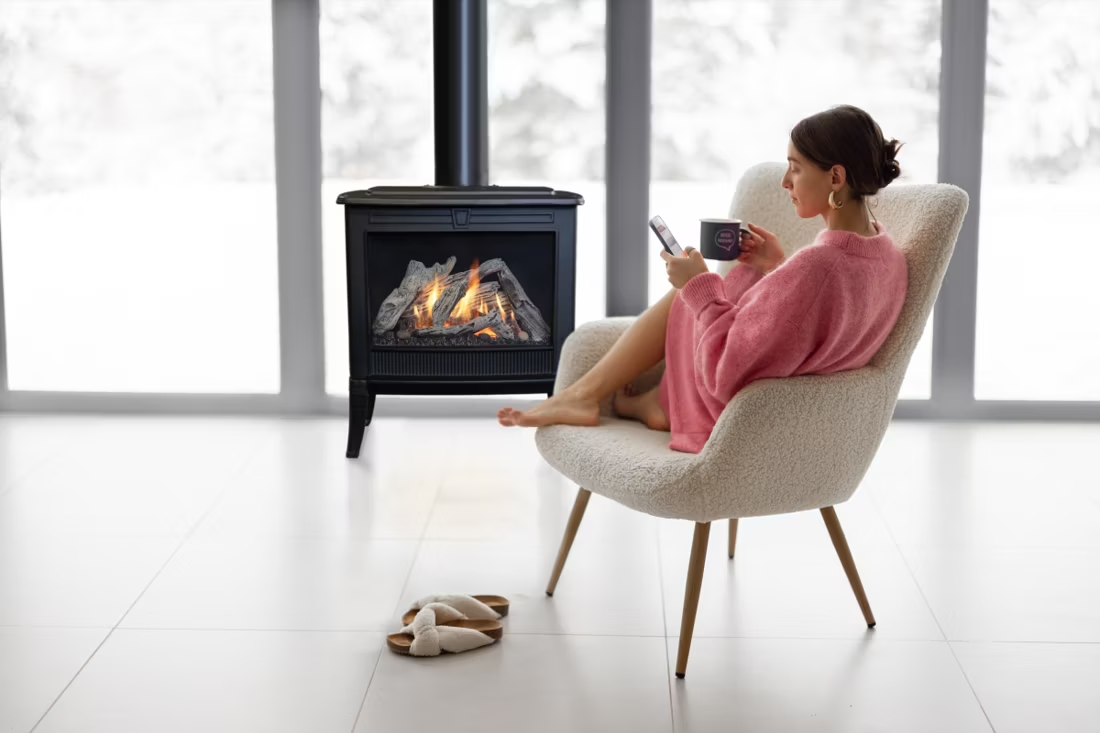
Three steps. No salesperson until you're ready.
Tell us about your project
Your zip code, your situation, and the fuel you're leaning toward—or let the answers point you to one.
See what's actually available
The brands dealers within 100 miles genuinely carry—real options, never a catalog mirage.
Get your dealer & Project Guide
A trusted local dealer, plus the free Project Guide & Parts List that names every component of the job.
Frequently Asked Questions
How much does a gas fireplace installation cost in Goshen?
Costs vary by dealer and scope, but homeowners in the Goshen area typically budget $3,500 to $9,500 for a gas fireplace or insert installation. A direct-vent insert going into an existing masonry fireplace that's already near a gas line sits on the lower end. A new built-in gas fireplace for a remodel or an addition—with framing, venting, and a fresh gas line run from the meter—lands in the middle to upper end. Homes on propane that need a new tank set can run higher once the propane supplier's tank and delivery setup is factored in. A local hearth dealer will give you a firm number after seeing your home.
Can I convert an existing wood-burning fireplace to gas?
Yes, and it's a common request in Goshen's older neighborhoods near downtown, where many homes built before the 1960s still have a masonry fireplace that's rarely used. A gas insert slides into that existing firebox and uses a stainless liner run up the existing chimney for venting, so you keep the look of the original fireplace while gaining real, controllable heat. Because wood-cutting permits and cheap self-cut firewood aren't really an option in this part of Indiana—there's no national forest nearby—most homeowners find the conversion pays for itself in convenience alone within a few winters.
Do I need natural gas service, or can I run my fireplace on propane?
Either works, and which one applies depends on where in Elkhart County you live. Inside Goshen and most of the surrounding towns, NIPSCO's natural gas lines reach the majority of homes, so if you already have gas heat, a gas water heater, or a gas range, adding a fireplace usually just means tapping into the existing line. Out in the county's rural stretches and farmland—where many Amish households and outlying properties sit beyond the gas main—propane is the standard fallback, delivered and stored in a tank on the property. Nearly every gas fireplace on the market can be configured for either fuel; your installer sets the orifice and regulator to match.
Will my gas fireplace still work if the power goes out?
For the most part, yes. Northern Indiana sees its share of winter ice storms and summer thunderstorms that can knock out power for hours, so this is a real consideration for Elkhart County homeowners. Most gas fireplaces with intermittent pilot ignition (IPI) run their electronics off AA batteries, which take over automatically the moment the power drops—you won't notice a difference. Valor fireplaces go a step further: their pilot assembly generates its own electricity through a thermocouple, so there are no batteries to check or replace, ever. If backup heat during outages is a priority, ask your local dealer to walk you through the ignition system on any model you're considering.
What's the difference between a gas fireplace, a gas insert, and a gas stove?
A gas fireplace is a fully built-in unit framed into a wall—the right choice for new construction or a remodel where there's no existing masonry opening, which describes a lot of Goshen's newer subdivision homes. A gas insert is sized to slide into an existing masonry firebox, which fits many of the older homes around downtown Goshen and Elkhart. A gas stove is a freestanding cast-iron or steel unit that sits on the floor on its own hearth pad, useful in a room that has no fireplace at all. Local dealers can walk your specific room through all three options.
Do I need a permit to install a gas fireplace in Goshen?
Yes. Gas fireplace installations in Goshen require a building permit and, because it involves running or tapping a gas line, a licensed gas-fitter to complete that portion of the work. Permits are typically pulled through the City of Goshen or Elkhart County building department depending on where the home sits, and most established hearth dealers handle the paperwork and inspection scheduling as part of the installation so you're not coordinating separate trades yourself.
What's the difference between vented and vent-free gas fireplaces?
Vented (direct-vent) gas fireplaces pull combustion air from outside and exhaust the byproducts back outside through a sealed pipe—they're the most common option and the one most local dealers recommend by default. Vent-free units burn directly into the room with no outside venting; they're legal in Indiana under specific room-size and oxygen-sensor requirements, but they release some water vapor and combustion byproducts into your living space. With no air quality non-attainment issues in Elkhart County, either option is technically on the table here, but most Goshen homeowners still choose vented units for the cleaner indoor air and the more authentic flame appearance.
How often should a gas fireplace be serviced?
An annual inspection before the start of the heating season is the standard recommendation for any gas appliance, including direct-vent fireplaces and inserts. A technician checks the burner, pilot assembly, venting, and gas connections, and cleans the glass and interior—usually a $125 to $225 visit in the Goshen area. It's a lighter lift than a wood chimney sweep, but skipping it is how minor issues like a dirty pilot or a failing thermocouple turn into a fireplace that won't light on the coldest night of the year.
Gas vs. wood—why do most Goshen homes choose gas?
Wood heat is genuinely uncommon in Goshen and across most of Elkhart County. There's no nearby national forest land offering cheap cutting permits the way there is in mountain states, so firewood has to be purchased from local tree services or orchards rather than self-cut—even though oak, hickory, maple, and beech are all common regional species. Combine that with widely available NIPSCO natural gas service and reliable propane delivery in the rural areas, and gas ends up being the more practical, lower-maintenance choice for most homeowners here. Wood stoves still show up occasionally in older farmhouses or as a deliberate off-grid backup, but they're the exception rather than the rule in this part of Indiana.
Why is a fireplace insert so efficient?
An insert does two things: it seals the chimney completely, so you stop losing air you already paid to heat, and it radiates warmth into the room through the firebox and glass. Most add a heat-exchange fan that pulls cool room air underneath, wraps it around the hot firebox, and pushes it back out warm. Your home is more efficient before you've even lit the first fire.
Why is my open fireplace making my house colder?
Open fireplaces suck—literally. As the fire burns, it consumes air your furnace already paid to heat and pulls it out through the chimney, so the house is actually colder after the fire goes out than before you lit it. An insert fixes this: it seals the chimney, puts fixed glass across the front, and turns that hole in your house into a real heat source.
Does a fireplace add value to my home?
On average, a fireplace adds back to the home about the same amount you spent installing it. Add the monthly savings from heating the rooms you actually use instead of the whole house—often hundreds of dollars a year—and the value case is strong before you even count what a fire does for how your family uses the room.
Can I install a fireplace myself?
If you're putting a fire in your house on purpose, it's best to work with an expert. Unless you're genuinely experienced in framing, gas line, vent pipe, and the national code on clearances to combustibles, have a professional do it—and ideally the same company that sells you the fireplace, so warranty, service, and liability all live under one roof.
Nearby Dealers
Hearth shops serving Goshen and the surrounding area.
Find your gas fireplace in Goshen.
Tell us a bit about your home and we'll match you with the right gas fireplace, insert, or stove, plus a free Project Guide & Parts List with the exact vent kit and parts you'll need—and a trusted local dealer in Elkhart County to install it.
Find Your Fireplace →