
Instant heat for Elkhart County's long, gray winters.
With over 6,100 heating degree days and average lows near 18°F, Elkhart County homes lean on gas for dependable zone heat from October through April. We'll match you with a trusted local dealer who knows what's installable in your home.
Every Project Starts From One of These Five Situations
Reliable warmth without the woodpile.
Elkhart County sits in climate zone 5A, with winter lows averaging around 18°F and roughly 6,100 heating degree days a year—a heating season on par with Madison, WI. That's cold enough that most households want more than a decorative flame in the living room. Across Elkhart, Goshen, Nappanee, Middlebury, and the smaller communities scattered through the county's RV-manufacturing corridor, gas fireplaces and inserts have become the default upgrade for homeowners replacing an old wood-burning fireplace or adding heat to a room the furnace never quite reaches.
Elkhart County's mix of established neighborhoods and newer subdivisions means natural gas service is widely available across most of the county's population centers, with propane filling in for homes on the rural fringes near Wakarusa, Bristol, and the unincorporated townships. Either fuel source supports the same range of direct-vent fireplaces, inserts, and freestanding stoves—the kind of unit that lights instantly on a January morning and, with the right ignition system, keeps running even when a winter storm knocks out power to the block.
Three steps. No salesperson until you're ready.
Tell us about your project
Your zip code, your situation, and the fuel you're leaning toward—or let the answers point you to one.
See what's actually available
The brands dealers within 100 miles genuinely carry—real options, never a catalog mirage.
Get your dealer & Project Guide
A trusted local dealer, plus the free Project Guide & Parts List that names every component of the job.
Frequently Asked Questions
How much does a gas fireplace installation cost in Elkhart County?
Most gas fireplace and insert installations in Elkhart County run in the $4,500 to $11,000 range, with the low end covering a direct-vent insert dropped into an existing masonry fireplace that already has gas nearby, and the high end covering new construction or remodels that need framing, venting through an exterior wall, and a fresh gas line run. Homes in newer Goshen and Elkhart subdivisions with gas already piped to the house tend to land toward the lower end; older farmhouses around Nappanee or Wakarusa converting from wood sometimes need more gas line work, which pushes the estimate up. A local dealer will give you a firm number after seeing the space.
Can I convert my existing wood fireplace to gas?
Yes, and it's a common project for older homes in Elkhart, Goshen, and Nappanee that were built with a traditional masonry fireplace burning oak or hickory. A gas insert typically slides into the existing firebox and vents through the current chimney using a stainless liner, which keeps the original brick surround intact while swapping out the wood-handling and ash cleanup for a switch-operated flame. Expect the conversion to run toward the lower half of the typical installation range if the home already has natural gas service nearby, and somewhat higher if a new gas line has to be run from the meter.
Do I need natural gas, or can I run a fireplace on propane?
Either works. Natural gas service covers most of Elkhart County's population centers—Elkhart, Goshen, Nappanee, Middlebury—so if your home already has gas for a furnace or water heater, adding a fireplace is usually a straightforward tie-in. Homes further out in the county's rural stretches, where natural gas mains don't reach, typically run on propane instead, either from an existing tank or a new tank installed by a local propane supplier. Nearly every direct-vent fireplace and insert on the market can be configured for either fuel—your dealer sets the correct orifice and regulator for whichever you have.
Will my gas fireplace still work if the power goes out?
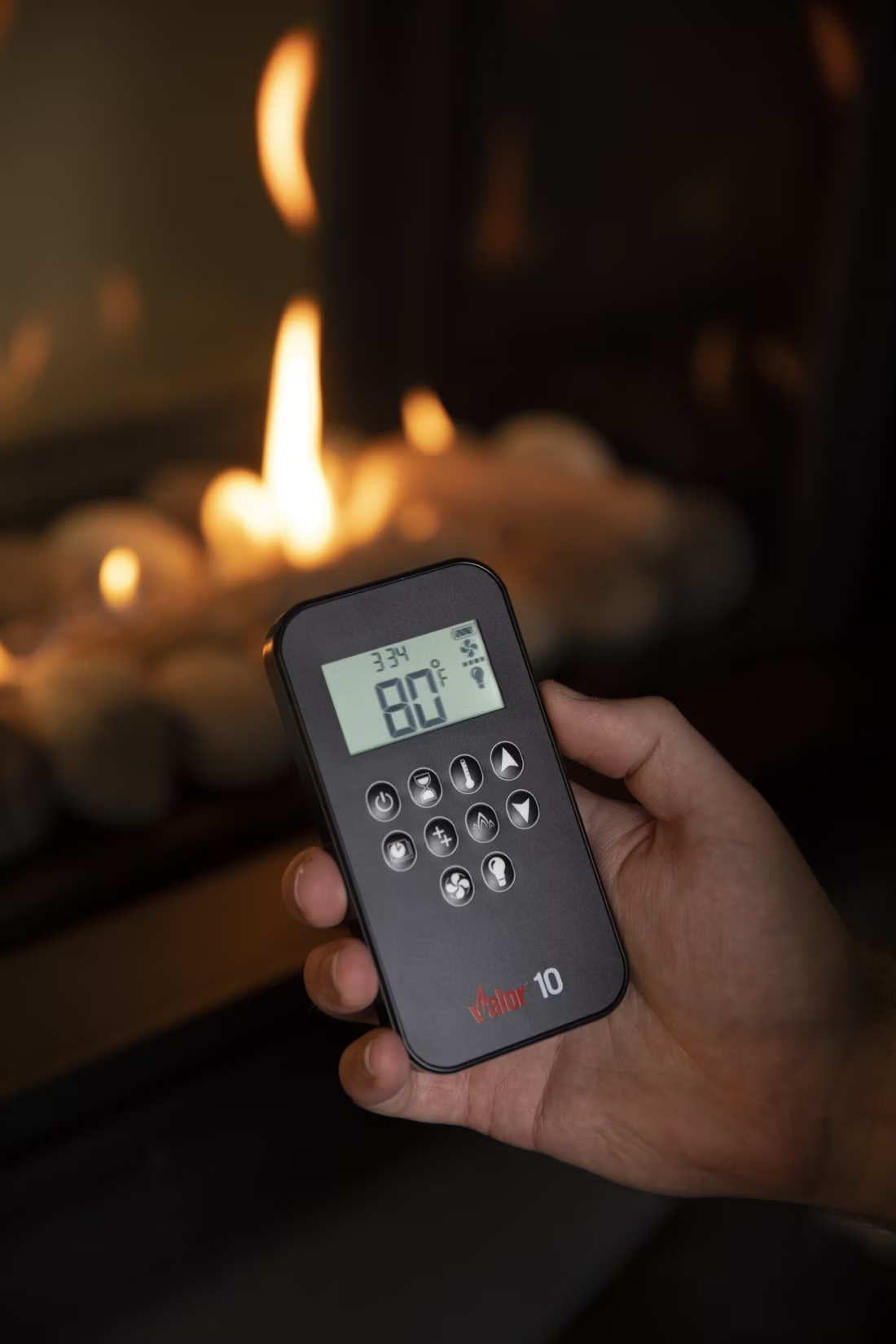
Most will, with the right ignition system. Units with intermittent pilot ignition (IPI) include a battery backup that takes over automatically when power drops, so the fireplace lights on demand just like normal. Valor fireplaces go a step further—their pilot assembly generates its own electricity through the thermocouple, so there's no battery to remember at all. Given how often a Michiana ice storm can knock out power to rural stretches of Elkhart County for hours or longer, this is worth asking about directly when you're comparing units with a local dealer.
What's the difference between a gas fireplace, gas insert, and gas stove?
A gas fireplace is a built-in unit installed into a framed wall opening—the right call for new construction or a full remodel. A gas insert is built to slide into an existing masonry firebox, turning an old wood fireplace into a sealed, efficient heat source that still vents through the existing chimney. A gas stove is a freestanding unit that sits on the floor like a wood stove but runs on gas, often chosen for a room with no existing fireplace at all. Most Elkhart County homeowners upgrading a fireplace they already have go with an insert; those adding heat to a bonus room or finished basement usually go with a stove.
Do I need a permit to install a gas fireplace in Elkhart County?
Yes—Elkhart County requires a building permit for new gas fireplace installations, and the gas line connection itself has to be done by a licensed gas-fitter. Depending on where the home sits, that permit is pulled either through the county building department or the applicable city office in Elkhart, Goshen, or Nappanee. A trusted local dealer typically handles the permitting and coordinates the gas line, venting, and inspection as a single package, rather than leaving the homeowner to line up separate trades.
What's the difference between vented and vent-free gas fireplaces?
Vented gas fireplaces—direct-vent or B-vent—pull combustion air from outside and exhaust the byproducts back outside through a sealed pipe. Vent-free units burn gas directly into the room with no external venting, which makes installation simpler but releases some water vapor and combustion byproducts indoors, and requires strict adherence to room-size and ventilation rules. Vent-free units are legal in Indiana, but for Elkhart County's tightly sealed, well-insulated newer homes, direct-vent units are the more common and more broadly recommended choice—they deliver strong heat output without any tradeoff on indoor air quality.
How often should a gas fireplace be serviced?
An annual inspection is standard for any gas fireplace or insert. A technician checks the burner, pilot assembly, venting, and gas connections, and cleans the glass and interior—a shorter visit than a wood chimney sweep, but not one to skip. Plan on scheduling it in late summer or early fall, before the unit gets heavy use through Elkhart County's long heating season, which typically runs from October into April.
Gas vs. wood—which makes more sense for an Elkhart County home?
Wood—burned locally as oak, hickory, maple, or beech—offers lower fuel cost if you have access to cut wood, the ambiance of a real fire, and heat that doesn't depend on electricity or gas service. Gas offers instant on-off operation, no ash or creosote to manage, and steadier output for rooms used daily. Around Elkhart County, it's common to see both in the same house: a gas insert or fireplace in the main living area for everyday convenience, and a wood-burning setup in a den, cabin, or outbuilding for backup heat and atmosphere. If your priority is a reliable zone-heat source you can rely on every winter without tending a fire, gas is the more practical fit.
Is my gas fireplace wasting gas?
If it was installed more than 15 years ago, probably. Older gas fireplaces keep a standing pilot light burning all the time, and that little flame can cost a couple hundred dollars a year. Newer models use pilot-on-demand ignition—the pilot lights only when you use the fireplace and goes out when you turn it off.
What's the difference between an insert and a zero-clearance fireplace?
An insert is a fireplace that slides into a pre-existing wood-burning fireplace—if you don't have one, there's nothing to insert it into. A zero-clearance fireplace is built into a framed wall, which makes it the answer for remodels and new construction. Simple test: existing masonry fireplace means insert; blank or framed wall means zero-clearance.
Can a fireplace actually lower my heating bill?
Yes—by creating a comfort zone. A furnace heats every square foot of the house just to warm the one room you're in; a gas fireplace on low burns roughly a sixth of the gas a typical furnace does. Set the furnace around 55–60 degrees as a baseline, then heat the rooms your family actually uses. Families who heat this way commonly save $20–$60 a month.
What is an in-home preview and do I need one?
It's a visit where a hearth professional measures your space, confirms the model you picked actually works in your home, and walks the specs—framing, gas line, venting, finish work—before anything is ordered. Some details you just can't know until you see the house. Never make a down payment without one; it's the single most-skipped step that burns buyers.
Stove and Fireplace Dealers in Elkhart County
Find your gas fireplace in Elkhart County.
Tell us about your home and heating goals, and we'll match you with a trusted local dealer plus a free Project Guide & Parts List—the exact parts, including the vent kit, for your Elkhart County gas fireplace project.
Find Your Fireplace →