
The Cleanest Fireplace Upgrade in Vernon Hills.
No chimney, no gas line, no permit hassle—just plug in real ambiance and supplemental warmth for Lake County's long heating season. Find the right unit and connect with a trusted local dealer.
Every Project Starts From One of These Five Situations
No Chimney, No Gas Line, No Hassle.
Vernon Hills sits in Lake County in climate zone 5A, where winters average a low around 14°F and the area sees a long, cold Chicago-suburb winter with a heating season stretching well into spring. Most homes here are newer subdivision construction, and a lot of the housing stock—townhomes, condos, finished basements—was never built with a masonry chimney or a flue to tap into. Wood-burning and pellet appliances are effectively a non-factor in Vernon Hills for that reason; there's no local cordwood or forest-permit culture the way there is in rural parts of the state, and many HOAs here restrict solid-fuel combustion appliances outright.
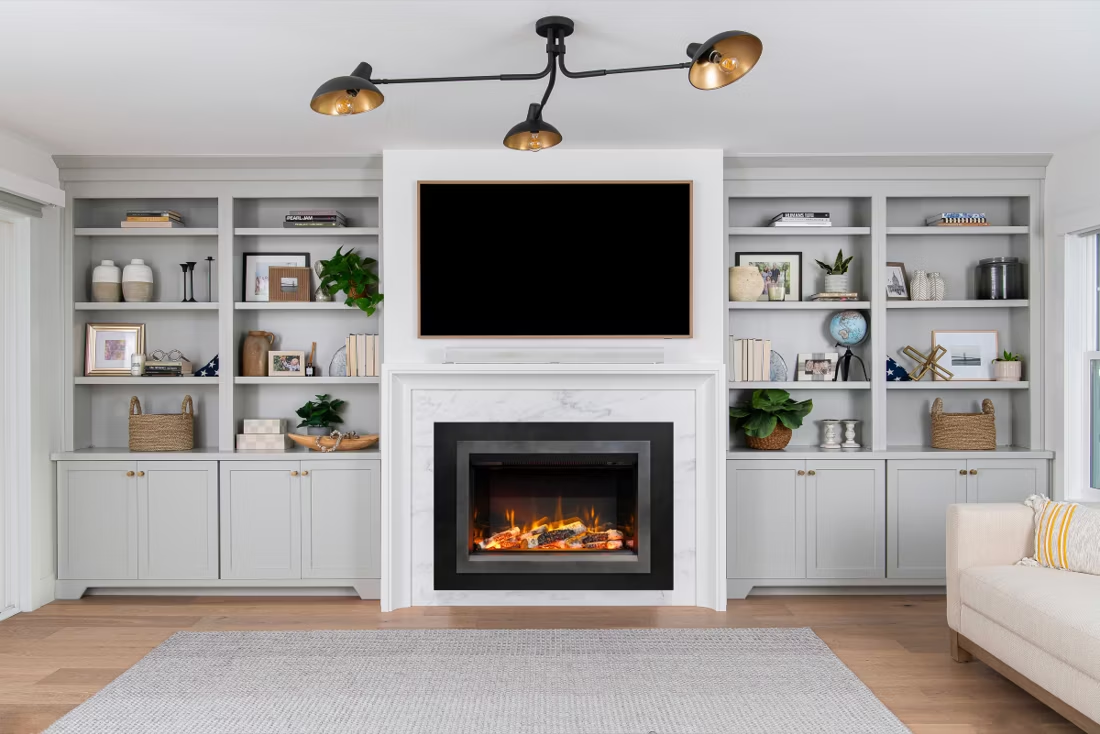
That's part of why electric has become the practical default for a lot of Vernon Hills homeowners. Commonwealth Edison serves the area at a residential rate around 13.4 cents per kWh, which makes running a standard 1,500-watt electric unit cost roughly 20 cents an hour—cheap enough for daily ambiance and real zone heat in a bedroom, basement, or living room without touching a gas line or opening a wall for venting. For condos and HOA-governed townhomes especially, a plug-in or hardwired electric insert is often the only fireplace option that doesn't require exterior venting approval at all.
Three steps. No salesperson until you're ready.
Tell us about your project
Your zip code, your situation, and the fuel you're leaning toward—or let the answers point you to one.
See what's actually available
The brands dealers within 100 miles genuinely carry—real options, never a catalog mirage.
Get your dealer & Project Guide
A trusted local dealer, plus the free Project Guide & Parts List that names every component of the job.
Frequently Asked Questions
How much does an electric fireplace installation cost in Vernon Hills?
A plug-in electric insert or freestanding unit typically runs $300 to $800 fully set up, since there's no venting or gas line to run—you're mostly paying for the unit and any surround or mantel work. A built-in wall unit or linear electric fireplace that needs a dedicated 120V or 240V circuit runs higher, usually $1,200 to $2,500, once a licensed electrician is brought in to run new wiring. Local dealers can walk you through which tier fits your room before you buy anything.
How much does it cost to run an electric fireplace in Vernon Hills?
At Commonwealth Edison's residential rate of about $0.1339 per kWh, a typical 1,500-watt electric fireplace heater costs roughly 20 cents an hour to run on full heat. Run it 6 to 8 hours a day through a Vernon Hills winter and you're looking at $1.20 to $1.60 a day—cheap enough that most homeowners run theirs for ambiance year-round and lean on the heat function during the coldest stretches of a long, cold winter without worrying about the bill.
Do I need a permit to install an electric fireplace in Vernon Hills?
Plug-in units need no permit at all—they run off a standard household outlet like any other appliance. If you're installing a built-in unit that requires a new dedicated circuit, the electrical work does need a permit through the Village of Vernon Hills Building Department. Most local installers and electricians pull that permit as part of the job, so you're not left coordinating it yourself.
Electric vs. gas fireplace—which is right for my Vernon Hills home?
Gas is the standard choice for whole-room primary or supplemental heat in a climate that sees average lows around 14°F, since a gas insert or fireplace puts out real BTUs and can carry a room through a Lake County cold snap. Electric can't match that heat output, but it wins on flexibility—no gas line, no venting, and it works in condos, finished basements, or upper-floor bedrooms where running gas simply isn't practical. A lot of Vernon Hills homeowners end up with gas in the main living space and electric in a secondary room for exactly that reason.
What's the difference between an electric insert, built-in, and mantel package?
An electric insert is sized to slide into an existing fireplace opening, which is useful if you're converting an old masonry firebox that's rarely used. A built-in (or linear) electric fireplace is designed to be framed into a wall during a remodel, giving you a flush, modern look with a wide flame display. A mantel package pairs a freestanding or recessed electric unit with a surrounding mantel and hearth for a more traditional look without any construction. For most Vernon Hills homes without an existing fireplace, the mantel package or a linear built-in in a new wall are the two most common routes.
How much space can an electric fireplace actually heat?
Most electric fireplace heaters are rated for 400 to 1,000 square feet as supplemental heat—enough for a living room, finished basement, or bedroom, but not a whole-home heating solution on a 14°F night. Think of it the way you'd think of a space heater with better looks: it's there to take the edge off a room and add ambiance, not replace your furnace. If you need more heat than that, a gas insert or a larger zone-heating setup is the better call.
Are electric fireplaces a good fit for condos and townhomes in Vernon Hills?
Yes, and it's one of the most common reasons homeowners in Vernon Hills's townhome and condo communities go electric in the first place. Many of those associations restrict or outright prohibit exterior venting and solid-fuel appliances, which rules out wood and often complicates gas installs. An electric insert or built-in sidesteps that entirely—no venting, no chimney, no HOA approval process for combustion appliances—while still giving you a real flame display and usable heat in a living room or finished basement.
What about wood or pellet stoves in Vernon Hills—are they an option?
They're a rare choice here, and honestly not a great fit for most Vernon Hills homes. This is a suburban subdivision community without much masonry-chimney housing stock, no nearby forest land for a cutting-permit culture, and no real local wood or pellet supply infrastructure to speak of. A handful of older homes with an existing chimney could retrofit a wood insert, but for the overwhelming majority of Vernon Hills homeowners, gas or electric is the realistic path—and it's what local dealers are actually set up to install and service.
Where can I buy an electric fireplace in Vernon Hills?
I don't sell fireplaces directly—Find My Fireplace matches you with a trusted local dealer who actually stocks and installs units that fit your room, your electrical setup, and your budget, then hands you a free Project Guide & Parts List so you walk in knowing what you need instead of guessing at a big-box store. For anything beyond a simple plug-in unit, that local expertise on circuit sizing and clearances is worth more than browsing a catalog on your own.
Can I put a TV above my fireplace?
Yes—with an asterisk. Fireplaces are hot and TVs don't like heat. Either put a mantel between them to deflect rising warmth, or choose a fireplace with heat-management technology that creates a cool zone on the wall above—the wall stays around 125 degrees, barely warm, while the room still gets full heat. If you like clean lines and don't want a mantel, heat management is the answer.
What fireplace styles should I know before shopping?
Four cover most of the market: screen-front traditional (mesh front, open feel, fits craftsman homes), traditional door set (the classic look you grew up with), modern linear (wide, low, the statement piece for entertaining), and clean face contemporary (no trim—your tile or stone runs right to the fire's edge). Walk in knowing those four terms and you're ahead of most buyers.
How much should I budget for a fireplace?
For an average home—covering the fireplace, the vent pipe, and basic installation—a budget between $3,900 and $5,500 gives you a lot of options across wood, gas, and pellet. By the time you add finish work, gas line, and electrical, the average complete installation lands between $5,000 and $12,000 all-in. In a remodel or new build, a good rule is to put about 2.5% of the total project cost toward the fireplace.
What is an in-home preview and do I need one?
It's a visit where a hearth professional measures your space, confirms the model you picked actually works in your home, and walks the specs—framing, gas line, venting, finish work—before anything is ordered. Some details you just can't know until you see the house. Never make a down payment without one; it's the single most-skipped step that burns buyers.
Nearby Dealers
Hearth shops serving Vernon Hills and the surrounding area. Every listing shows whether it is a WhyFire partner, a dealer we have verified as authorized for the brands we recommend, or a local business carrying hearth products. No manufacturer pays for placement. How we verify dealers →
Fireplaces Plus
Smokin' Deal Bbq
General Masonry Supply
Fireplace And Patio
Jhb Group, Inc.
Ember Glow
Electric Service in Vernon Hills
An electric fireplace's heater draws about 1,500 watts—pennies per hour at local rates.
Commonwealth Edison Co
Find your electric fireplace in Vernon Hills.
Tell us a bit about your home and we'll put together a free Project Guide & Parts List for your electric fireplace project, then match you with a trusted local Vernon Hills dealer to install it.
Find Your Fireplace →