
Gas heat built for Chicago winters.
With winter lows averaging 16°F and over 6,300 heating degree days a year, Skokie homes need heat that turns on instantly and keeps up. Find the right gas fireplace or insert, and get matched with a trusted local dealer.
Every Project Starts From One of These Five Situations
The default heat source for a dense Chicago suburb.
Skokie sits in climate zone 5A with roughly 6,366 heating degree days a year—a cold-climate load in the same range as Madison, Wisconsin. Winter lows average 16°F, and Cook County sees its share of single-digit nights and lake-effect chill blowing in off Lake Michigan. Unlike lower-density, rural parts of the Midwest, wood-burning is genuinely uncommon here—small residential lots, close-set housing, and local burning ordinances mean very few Skokie homeowners heat with cordwood, and pellet stoves are similarly rare. Gas has become the near-universal default for supplemental and zone heat.
Natural gas service is available throughout Skokie, with Nicor Gas as the primary distribution utility for most Cook County suburbs. That widespread infrastructure—paired with Commonwealth Edison's residential electric rate of roughly 13.4 cents per kWh, which makes electric-only heat comparatively pricier to run around the clock—is a big part of why gas fireplaces and inserts dominate here. There's no air quality non-attainment designation or winter burn-ban concern in Skokie, so gas installations move through permitting without the smoke-related restrictions some other regions impose. The result: instant, thermostat-controlled heat that works whether you're in a 1950s ranch, a brick bungalow, or a newer townhome.
Three steps. No salesperson until you're ready.
Tell us about your project
Your zip code, your situation, and the fuel you're leaning toward—or let the answers point you to one.
See what's actually available
The brands dealers within 100 miles genuinely carry—real options, never a catalog mirage.
Get your dealer & Project Guide
A trusted local dealer, plus the free Project Guide & Parts List that names every component of the job.
Frequently Asked Questions
How much does a gas fireplace installation cost in Skokie?
Most gas fireplace and insert installations in Skokie run somewhere between $4,500 and $10,500, depending on the unit, the venting path, and whether new gas line work is needed. A direct-vent insert going into an existing masonry fireplace with a gas line already nearby tends to land on the lower end. A new built-in gas fireplace in a remodel—with framing, venting through an exterior wall, and a fresh gas line run from the meter—sits toward the higher end. Local dealers will give you a firm number after seeing your space, since venting distance and wall type matter more than the sticker price of the unit itself.
Can I convert my existing wood-burning fireplace to gas?
Yes, and it's a common project in Skokie's older housing stock—plenty of the brick ranches and bungalows built in the 1950s and 60s have a masonry fireplace that was rarely used even before natural gas access. In most cases, a gas insert goes into the existing firebox with a stainless liner run up the chimney, using the masonry chase you already have. That typically runs $4,500 to $9,000 depending on the insert and whether the gas line needs to be extended from an existing appliance. It keeps the look of the original fireplace while giving you real, controllable heat output instead of an open box that mostly lost heat up the flue.
Do I need natural gas service, or is propane an option in Skokie?
Nearly every home in Skokie already has natural gas service through Nicor Gas, since it's used for furnaces, water heaters, and ranges throughout the village. That makes adding a gas fireplace straightforward in almost all cases—your installer taps into the existing gas infrastructure rather than starting from scratch. Propane is a rare choice here, mostly limited to detached structures like a garage or outbuilding that isn't already plumbed for natural gas. If that's your situation, a small propane tank setup is possible, but most Skokie installers will point you toward natural gas whenever it's an option.
Will my gas fireplace still work if the power goes out?
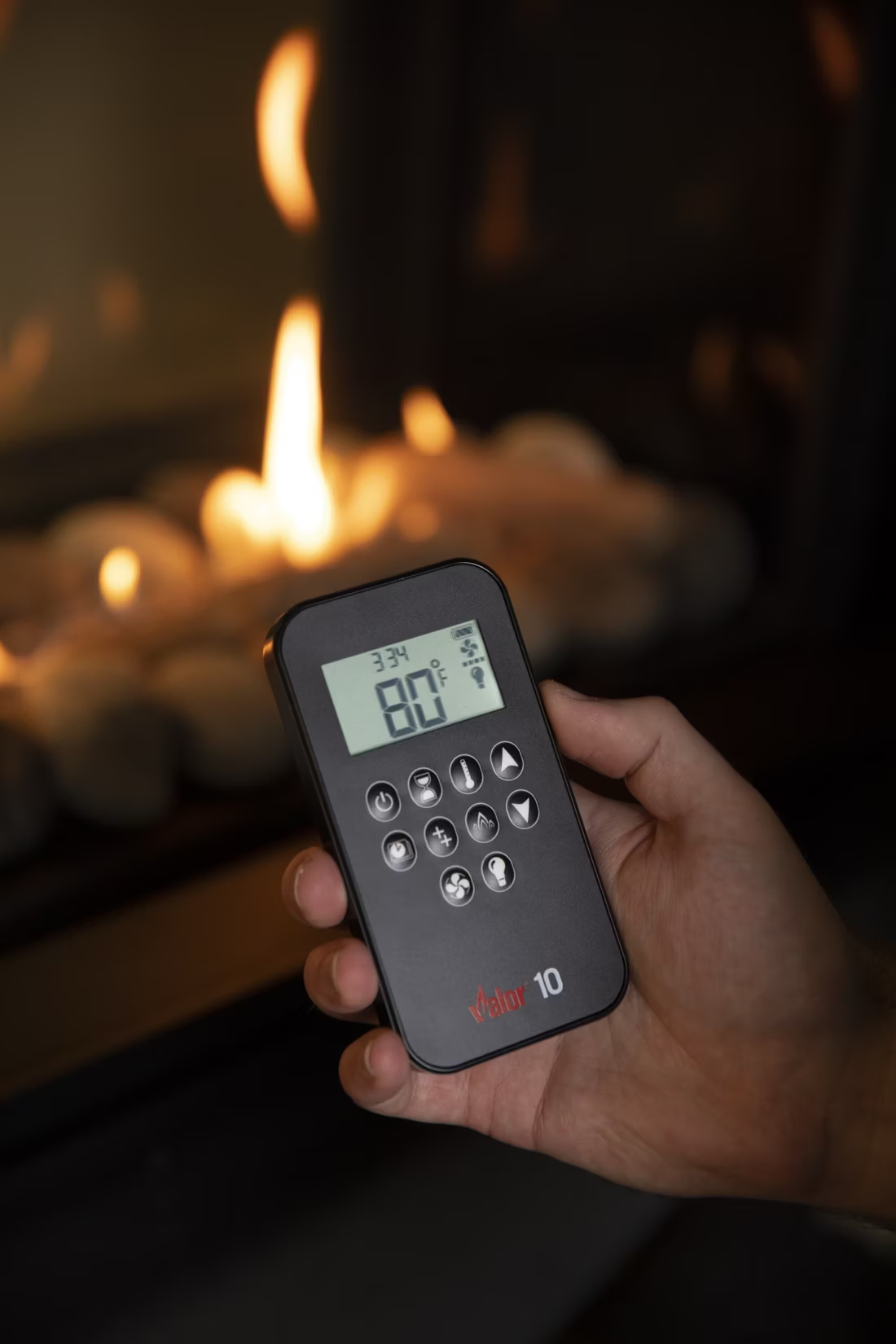
Most direct-vent gas fireplaces use IPI (intermittent pilot ignition) with a battery backup—typically AA batteries built into the unit—that keeps the fireplace working when ComEd service drops during a winter storm. The fireplace lights on demand off the batteries until power is restored, so it's worth checking those batteries each fall before heating season. Valor fireplaces take a different approach: their pilot assembly generates its own electricity through the thermocouple, so there's no battery to remember at all. Either way, ask your local dealer about the ignition system on any unit you're considering if outage backup matters to you.
What's the difference between a gas fireplace, gas insert, and gas stove?
A gas fireplace is a fully built-in unit, framed into a wall—the right choice for new construction or a remodel without an existing hearth. A gas insert slides into an existing masonry fireplace opening and uses the chimney as its vent path, which is the common route for Skokie's older homes with unused wood-burning fireplaces. A gas stove is a freestanding cabinet-style unit that sits on the floor and vents through a wall or existing chimney, often used in a den or basement where there's no fireplace opening at all. Most Skokie homeowners upgrading an existing hearth land on an insert; those adding heat to a room without one usually go with a stove or built-in unit.
Do I need a permit to install a gas fireplace in Skokie?
Yes—a building permit is required through the Village of Skokie, and any new or modified gas line needs to be run by a licensed gas-fitter as part of that permit process. Most established hearth dealers handle the permit application and inspection scheduling as part of the installation, so you typically don't have to coordinate it yourself. This is one of the reasons it's worth using a dealer who does gas installs regularly rather than a general handyman—coordinating the gas line, venting, and village inspection together avoids delays.
Should I get a vented or vent-free gas fireplace?
Vented (direct-vent) units pull combustion air from outside and exhaust the byproducts back outside through sealed venting—they're the standard, code-friendly choice almost everywhere, including Skokie. Vent-free gas fireplaces burn without any external venting and are legal in Illinois, but they come with strict room-size and ventilation requirements, and they release some water vapor and combustion byproducts into the living space. Given Skokie's cold winters and the amount of time these units run, most local dealers steer homeowners toward direct-vent models—they put out more usable heat and don't require any compromise on indoor air quality. Vent-free tends to make more sense as a secondary, occasional-use unit in a room where venting isn't feasible.
How often does a gas fireplace need to be serviced?
Plan on an annual inspection, ideally before the start of heating season each fall. A technician checks the burner, pilot assembly, venting, and gas connections, and cleans the glass and interior—a much lighter job than chimney sweeping but still important, since a dirty burner or degraded gasket can affect both safety and efficiency. Most Skokie-area service providers charge in the $150 to $250 range for a standard annual visit, and it's a good time to catch a failing thermocouple or battery backup issue before you actually need the fireplace during a cold snap.
Gas vs. electric fireplace—which makes sense for my Skokie home?
Gas delivers real, substantial heat output and can meaningfully offset furnace use during Skokie's long heating season—with roughly 6,366 heating degree days a year, that's not nothing on a ComEd bill. Electric fireplaces need no venting or gas line at all, which makes them a fit for condos, townhomes, or rental units around Skokie where running new gas line or venting isn't practical or allowed by the building. The tradeoff is heat output and ongoing cost: at Commonwealth Edison's residential rate of about 13.4 cents per kWh, electric units are cheaper to install but more expensive to run as a serious heat source. For a primary living space in a single-family home, gas is usually the better long-term choice; for a condo, rental, or secondary room, electric is often the only realistic option.
Can I put a TV above my fireplace?
Yes—with an asterisk. Fireplaces are hot and TVs don't like heat. Either put a mantel between them to deflect rising warmth, or choose a fireplace with heat-management technology that creates a cool zone on the wall above—the wall stays around 125 degrees, barely warm, while the room still gets full heat. If you like clean lines and don't want a mantel, heat management is the answer.
Why is my open fireplace making my house colder?
Open fireplaces suck—literally. As the fire burns, it consumes air your furnace already paid to heat and pulls it out through the chimney, so the house is actually colder after the fire goes out than before you lit it. An insert fixes this: it seals the chimney, puts fixed glass across the front, and turns that hole in your house into a real heat source.
How much should I budget for a fireplace?
For an average home—covering the fireplace, the vent pipe, and basic installation—a budget between $3,900 and $5,500 gives you a lot of options across wood, gas, and pellet. By the time you add finish work, gas line, and electrical, the average complete installation lands between $5,000 and $12,000 all-in. In a remodel or new build, a good rule is to put about 2.5% of the total project cost toward the fireplace.
Can a fireplace actually lower my heating bill?
Yes—by creating a comfort zone. A furnace heats every square foot of the house just to warm the one room you're in; a gas fireplace on low burns roughly a sixth of the gas a typical furnace does. Set the furnace around 55–60 degrees as a baseline, then heat the rooms your family actually uses. Families who heat this way commonly save $20–$60 a month.
Nearby Dealers
Hearth shops serving Skokie and the surrounding area.
Fireside Collection By Fireplaces Plus
Find your gas fireplace in Skokie.
Tell us about your home and we'll match you with a trusted local Skokie dealer and send over a free Project Guide & Parts List—the exact parts, vent kit, and installer recommendation for your gas fireplace project.
Find Your Fireplace →