
Warmth on Demand for McLean County Winters.
No chimney, no gas line, no venting—just plug in and go. Find the right electric fireplace or insert for your Normal home, and connect with a trusted local dealer.
Every Project Starts From One of These Five Situations
Clean heat without a flue, chimney, or gas line.
Normal sits in the flat farmland of McLean County in central Illinois, at about 829 feet elevation, where winters bring roughly 6,023 heating degree days a year and average lows around 16°F—a real heating season, though not quite the deep-freeze territory of a place like Buffalo, NY. Illinois State University's presence has shaped a lot of the housing stock here: newer subdivisions, condos, and rental units built without masonry fireplaces or chimneys, which is exactly the kind of housing an electric fireplace is built for.
Ameren Illinois serves most electric accounts within Normal city limits, with Corn Belt Energy Corporation serving rural and outlying parts of McLean County at a noticeably higher residential rate. Because an electric fireplace needs nothing more than an outlet or a dedicated circuit—no flue, no gas line, no annual chimney sweep—it's become a practical fit for the apartments, rentals, and newer homes that make up so much of Normal's housing, as well as for homeowners who want supplemental zone heat in a bedroom or den without touching their furnace.
Three steps. No salesperson until you're ready.
Tell us about your project
Your zip code, your situation, and the fuel you're leaning toward—or let the answers point you to one.
See what's actually available
The brands dealers within 100 miles genuinely carry—real options, never a catalog mirage.
Get your dealer & Project Guide
A trusted local dealer, plus the free Project Guide & Parts List that names every component of the job.
Frequently Asked Questions
How much does an electric fireplace installation cost in Normal?
A plug-in electric fireplace insert sized to fit a standard 23" to 33" firebox opening typically runs $300 to $700 for the unit and needs no professional installation beyond plugging it in. Built-in wall or linear electric fireplaces recessed into new framing run $1,500 to $3,500 installed once you factor in a licensed electrician running a dedicated 20-amp circuit—most units draw close to 1,500 watts on the heat setting—plus finish carpentry around the opening. Mantel-style units that sit like furniture land in between, usually $600 to $1,200 fully assembled. A local dealer can tell you which category fits your Normal home after a quick look at the space.
What does it cost to run an electric fireplace in Normal?
Electric fireplaces convert nearly all their electricity into heat at the unit, and most draw 1,200 to 1,500 watts on high. At Ameren Illinois's residential rate of roughly $0.1176 per kWh, running one four hours a night costs about 55 to 70 cents a day, or $15 to $20 a month. If your address is served by Corn Belt Energy Corporation instead, expect a noticeably higher bill—their residential rate runs closer to $0.1576 per kWh, pushing that same four-hour daily habit toward $19 to $27 a month.
Do I need a permit to install an electric fireplace in Normal?
A plug-in insert or freestanding electric unit that runs off an existing outlet generally doesn't require a permit. A built-in electric fireplace wired to its own dedicated circuit involves electrical work that falls under the Town of Normal's building and electrical permitting process, and any wall framing changes may also need a building permit. Local electricians and hearth dealers who regularly handle built-in installations in McLean County can confirm which category your project falls into and pull the necessary permits.
Can an electric fireplace actually heat my home through a Normal winter?
Not as a primary heat source. Normal averages about 6,023 heating degree days a year with winter lows near 16°F—cold enough that a single electric fireplace, which typically tops out around 5,000 to 9,000 BTUs, can only really heat the room it's in. Most local homeowners use them for zone heating: closing off a bedroom or den and letting the unit carry that space, while the furnace still handles the rest of the house. That's a different job than a McLean County farmhouse asking a wood stove to be the primary heat source.
What's the difference between an electric insert, a wall-mount, and a built-in electric fireplace?
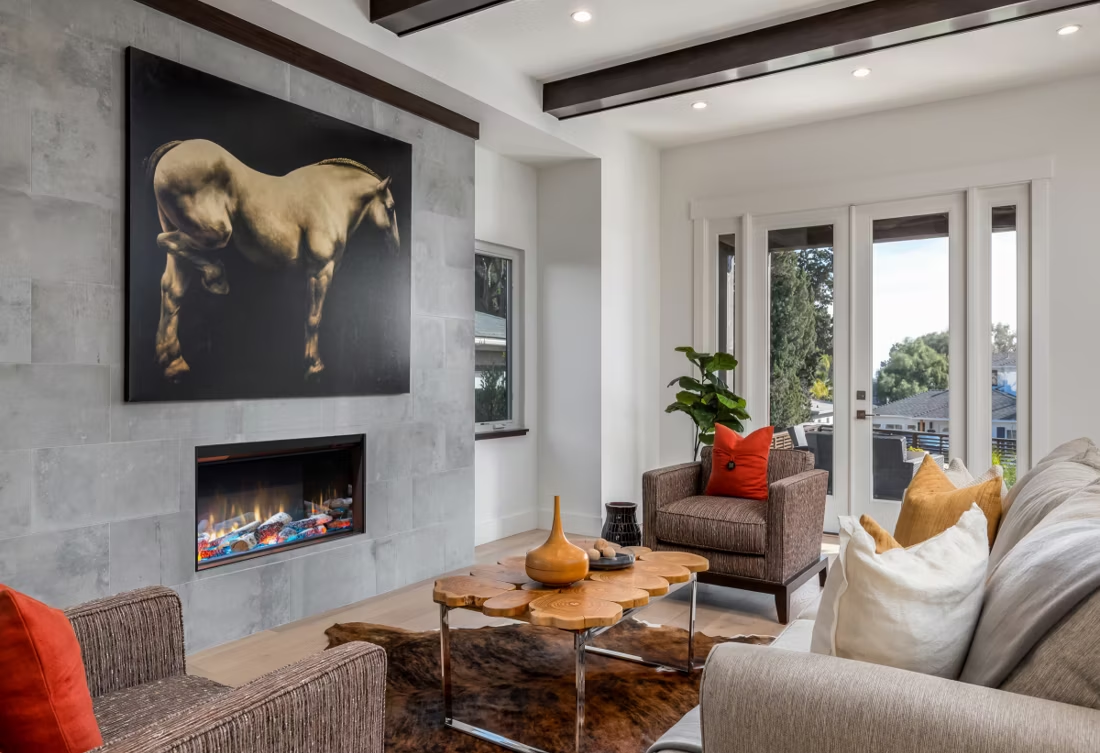
An electric insert slides into an existing masonry or factory-built firebox opening, which makes it a fast upgrade for older Normal homes with an unused wood fireplace. A wall-mount, or linear, electric fireplace hangs flush on the wall like a large flat-screen and doesn't need an existing firebox at all. A built-in electric fireplace is recessed into new wall framing during a remodel, finished with tile or shiplap, and usually wired to a dedicated circuit. Homes with an existing fireplace opening are simplest to convert with an insert; new construction and basement remodels more often go wall-mount or built-in.
Will my electric fireplace work during a power outage?
No—an electric fireplace needs utility power to run, so it isn't backup heat the way a wood stove or a gas fireplace with battery-backup ignition can be. Ice storms and downed lines are a more common outage cause in McLean County than extreme cold snaps, but either way, if outage-proof heat matters to you, a wood or gas appliance is the better fit. Think of an electric fireplace as reliable everyday ambiance and supplemental warmth, not emergency heat.
Why don't more homes in Normal use wood-burning fireplaces?
McLean County's oak, hickory, walnut, and maple woodlots supply plenty of good firewood out in the countryside, but within the Town of Normal itself, wood-burning setups are uncommon. Much of the housing stock is newer construction or college-town infill built without masonry chimneys, and retrofitting a full wood-burning chimney system into a home that never had one is a major project. Electric and gas fireplaces, which need no chimney at all, simply fit the way most homes here were actually built.
Electric vs. gas fireplace—which is right for my home in Normal?
Ameren Illinois provides both electric and natural gas service through much of Normal, so both are realistic options. Gas fireplaces put out real heat—typically 20,000 to 30,000 BTUs—and can genuinely supplement your furnace on the coldest days, but they need venting and a gas line, with installed costs commonly running several thousand dollars. Electric fireplaces install in a fraction of the time, cost less upfront, use LED technology for a convincing flame effect, and work in rooms with no gas line or chimney access—a common situation in condos and apartments near Illinois State University. If you want meaningful supplemental heat, look at gas; if you want fast, flexible ambiance with minimal installation, electric usually wins.
Are electric fireplaces a good option for rentals or apartments near Illinois State University?
Yes—it's one of the more common uses for electric fireplaces in Normal. Plug-in inserts and freestanding electric stoves need no venting, no gas line, and no permanent changes to the unit, which makes them landlord-friendly and easy to move when a lease ends. Given how much of Normal's housing is rental or student-adjacent, a freestanding electric stove or mantel-style unit is often the more practical choice over a built-in installation.
Can I put a TV above my fireplace?
Yes—with an asterisk. Fireplaces are hot and TVs don't like heat. Either put a mantel between them to deflect rising warmth, or choose a fireplace with heat-management technology that creates a cool zone on the wall above—the wall stays around 125 degrees, barely warm, while the room still gets full heat. If you like clean lines and don't want a mantel, heat management is the answer.
How much does an electric fireplace cost to run?
With the heater on, a typical unit draws about 1,500 watts—at average electric rates that's roughly 20 cents an hour. Run the flame effect alone and it costs pennies; the flames are LED-driven and use about as much power as a light bulb. There's no pilot light, no fuel delivery, and essentially no maintenance.
What is an in-home preview and do I need one?
It's a visit where a hearth professional measures your space, confirms the model you picked actually works in your home, and walks the specs—framing, gas line, venting, finish work—before anything is ordered. Some details you just can't know until you see the house. Never make a down payment without one; it's the single most-skipped step that burns buyers.
Can a fireplace actually lower my heating bill?
Yes—by creating a comfort zone. A furnace heats every square foot of the house just to warm the one room you're in; a gas fireplace on low burns roughly a sixth of the gas a typical furnace does. Set the furnace around 55–60 degrees as a baseline, then heat the rooms your family actually uses. Families who heat this way commonly save $20–$60 a month.
Nearby Dealers
Hearth shops serving Normal and the surrounding area.
Electric Service in Normal
An electric fireplace's heater draws about 1,500 watts—pennies per hour at local rates.
Ameren Illinois Company
Corn Belt Energy Corporation
Find your electric fireplace in Normal.
Tell us a bit about your home and we'll put together a free Project Guide & Parts List—the right unit, the electrical work it needs, and a trusted local Normal dealer to install it.
Find Your Fireplace →