
Instant Gas Heat Built for Lincolnshire's Chicago-Area Winters.
With winter lows averaging 18°F and a long, six-plus-month heating season in Lake County, a direct-vent gas fireplace gives Lincolnshire homes dependable zone heat without a woodpile. Find the right unit and connect with a trusted local dealer.
Every Project Starts From One of These Five Situations
The default heat source for Lincolnshire's newer homes.
Lincolnshire sits on flat glacial plain in Lake County, about 35 miles north of the Chicago Loop, at roughly 646 feet of elevation. Winters here are long and genuinely cold—climate zone 5A, average lows around 18°F, and a heating season that runs well over six months, putting Lincolnshire in the same general cold-climate range as Madison, WI. Unlike older Illinois river towns with a long wood-burning tradition, Lincolnshire's housing stock skews newer: corporate-campus-adjacent subdivisions, colonials, and ranch homes built from the 1970s onward, most of which came pre-plumbed for gas rather than built around a masonry hearth.
That's part of why wood-burning fireplaces are genuinely uncommon here—new construction in this part of Lake County was largely built gas-first, and there's no local wood-fuel culture or firewood-permit infrastructure to speak of the way there is in more rural or forested parts of the state. Gas fills that gap well: natural gas service is standard throughout the village (Nicor Gas is the regional provider across most of Lake County), there are no local air quality burn restrictions to navigate, and a direct-vent gas fireplace or insert delivers instant, thermostat-controlled heat that suits a commuter household better than tending a fire before a 6 a.m. train into the city.
Three steps. No salesperson until you're ready.
Tell us about your project
Your zip code, your situation, and the fuel you're leaning toward—or let the answers point you to one.
See what's actually available
The brands dealers within 100 miles genuinely carry—real options, never a catalog mirage.
Get your dealer & Project Guide
A trusted local dealer, plus the free Project Guide & Parts List that names every component of the job.
Frequently Asked Questions
How much does a gas fireplace installation cost in Lincolnshire?
Local installers typically quote $5,000 to $12,000 for a gas fireplace installation in Lincolnshire, with the spread driven mostly by venting. A direct-vent insert going into an existing chase or masonry opening with gas already run nearby sits on the lower end. A new built-in unit in a great-room remodel—framing, a fresh gas line from the meter, and through-wall or roof venting—lands in the middle to upper range. Homes on larger Lincolnshire lots where the gas line has to travel further from the meter to the fireplace location can push toward the top of that range. A local dealer will give you a firm number after seeing the space in person.
Can I convert an existing wood-burning fireplace to gas?
Yes, and it's a common request even though full wood-burning setups are rare in Lincolnshire. If your home has an older masonry firebox—more likely in the village's original mid-century homes than in the newer subdivisions—a gas insert with a stainless liner run up the existing chimney is usually the cleanest path. Expect somewhere in the $4,500 to $9,500 range depending on the insert and whether the existing flue needs relining. Homes already on natural gas service typically come in on the lower end since there's no new utility connection to arrange.
Is Lincolnshire on natural gas, or would I need propane?
The overwhelming majority of Lincolnshire homes are already on natural gas service, with Nicor Gas serving most of Lake County. If you have a gas range, water heater, or furnace, adding a fireplace is typically a straightforward tap into your existing service. Propane is rarely necessary here—it mainly comes up for standalone outbuildings or unusual site conditions where running a gas line isn't practical. Most gas fireplace models can be configured for either fuel, so it's a non-issue for equipment selection either way.
Will a gas fireplace still work if ComEd power goes out?
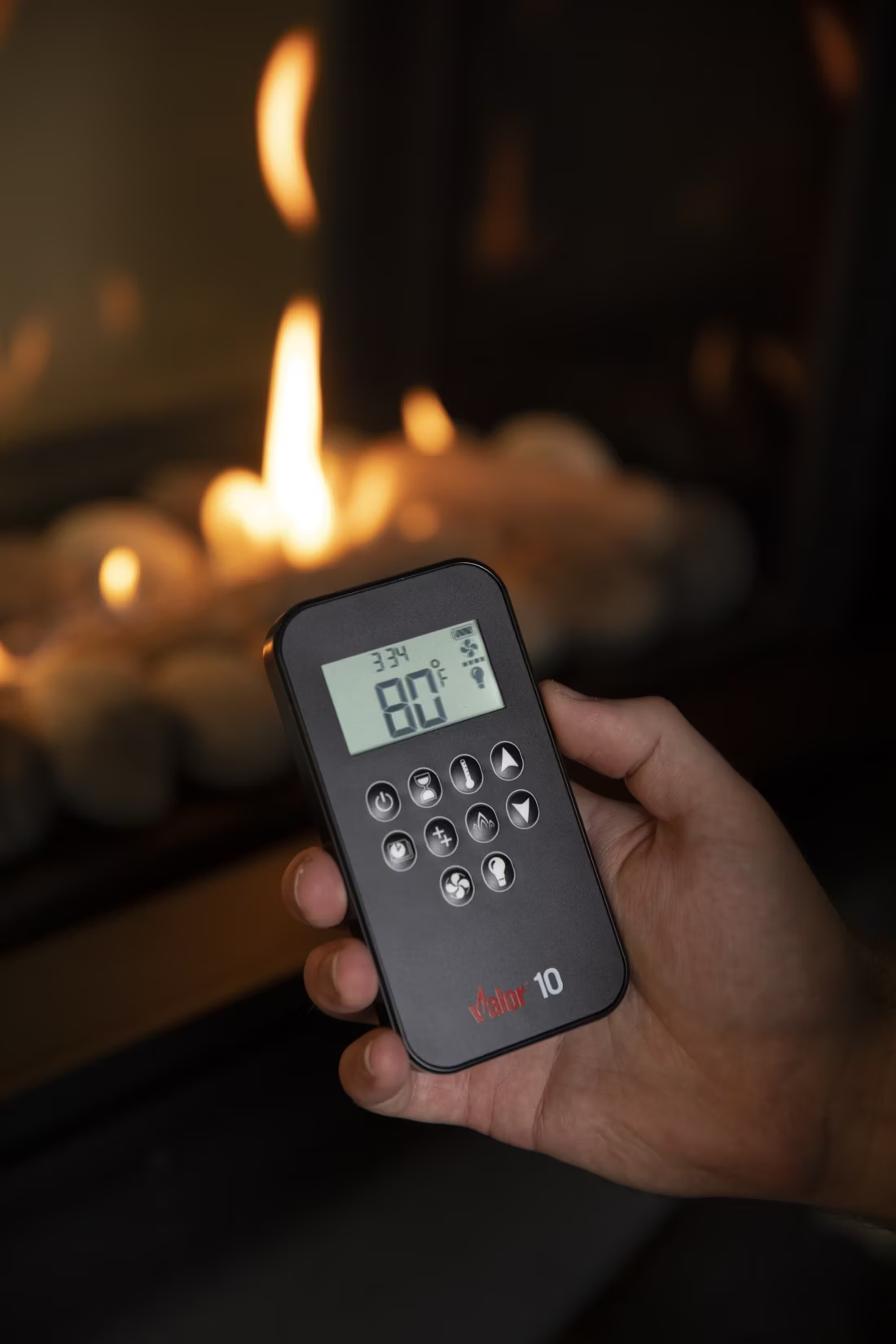
Most modern gas fireplaces will, with the right ignition system. Units with IPI (intermittent pilot ignition) run on a small battery backup that automatically takes over when ComEd power drops, so the fireplace still lights on demand—just remember to keep the batteries fresh, since it's easy to forget until an outage hits during a Lake County ice storm. Valor fireplaces solve this differently: their pilot assembly generates its own electricity through the thermocouple, so there are no batteries to maintain at all. Either approach beats a fireplace that goes dark exactly when you need the heat most—worth asking your local dealer which ignition system a given model uses.
What's the difference between a gas fireplace, gas insert, and gas stove?
A gas fireplace is a fully built-in unit framed into a wall—the standard choice for new construction or a great-room remodel, which describes a lot of Lincolnshire's housing stock. A gas insert is sized to drop into an existing masonry firebox, useful for the village's older homes that still have a wood-era fireplace opening. A gas stove is a freestanding cabinet-style unit that sits on the floor, which some homeowners choose for a den or finished basement where a full built-in isn't practical. For most Lincolnshire homeowners without an existing masonry fireplace, a built-in direct-vent unit is the more common fit.
Do I need a permit to install a gas fireplace in Lincolnshire?
Yes—the Village of Lincolnshire requires a building permit for new gas fireplace installations, along with a gas line permit for any new piping, and both require licensed trades to pull. Most established hearth dealers in the area handle this paperwork as part of the job, coordinating the gas-fitter, the venting inspection, and the final building sign-off so you're not managing three separate contractors. Because Lincolnshire is largely built out with newer homes, inspectors here are generally very familiar with direct-vent gas installations, which tends to keep the process quick.
Should I get a vented or vent-free gas fireplace?
Vented (direct-vent) gas fireplaces pull combustion air from outside and exhaust it back outside through a sealed pipe—they're the cleanest, safest option and the one that shows up in nearly every newer Lincolnshire installation. Vent-free units burn directly into the room and are legal in Illinois under specific room-size and ventilation rules, but they release some combustion byproducts indoors and many HOA-governed subdivisions and newer-construction communities in this area simply don't spec them. For a village where most of the housing stock is recent construction with efficient, well-sealed envelopes, direct-vent is the practical default—it doesn't compete with the home's air handling system for oxygen or humidity balance.
How often does a gas fireplace need to be serviced?
Plan on an annual inspection, ideally in early fall before the heating season ramps up. A technician checks the burner, pilot assembly, venting, and gas connections, and cleans the glass—a much lighter lift than wood-stove chimney sweeping, but it matters just as much for safety and for keeping the glass from developing that hazy discoloration common on units run hard through a full Lake County winter. Local service providers typically charge $150 to $250 for this visit.
Gas, wood, or electric—what actually makes sense for a Lincolnshire home?
Wood fireplaces are genuinely uncommon in Lincolnshire—there's little local wood-burning infrastructure, most homes were built gas-ready rather than around a masonry hearth, and the regional hardwoods you'd associate with an Illinois wood stove (oak, hickory, walnut, maple) are more relevant a bit further out in unincorporated Lake County than in the village itself. Between gas and electric, gas wins for anyone who wants real heat output and the look of a live flame at a reasonable operating cost. Electric fireplaces cost far less to install—often under $1,200 with no venting required—and run on ComEd power at about $0.1339 per kWh, making them a good fit for a bedroom, basement, or rental unit where ambiance matters more than serious heat. For a primary living space, most Lincolnshire homeowners land on gas.
Why is my open fireplace making my house colder?
Open fireplaces suck—literally. As the fire burns, it consumes air your furnace already paid to heat and pulls it out through the chimney, so the house is actually colder after the fire goes out than before you lit it. An insert fixes this: it seals the chimney, puts fixed glass across the front, and turns that hole in your house into a real heat source.
What's the difference between an insert and a zero-clearance fireplace?
An insert is a fireplace that slides into a pre-existing wood-burning fireplace—if you don't have one, there's nothing to insert it into. A zero-clearance fireplace is built into a framed wall, which makes it the answer for remodels and new construction. Simple test: existing masonry fireplace means insert; blank or framed wall means zero-clearance.
Can I install a fireplace myself?
If you're putting a fire in your house on purpose, it's best to work with an expert. Unless you're genuinely experienced in framing, gas line, vent pipe, and the national code on clearances to combustibles, have a professional do it—and ideally the same company that sells you the fireplace, so warranty, service, and liability all live under one roof.
How much should I budget for a fireplace?
For an average home—covering the fireplace, the vent pipe, and basic installation—a budget between $3,900 and $5,500 gives you a lot of options across wood, gas, and pellet. By the time you add finish work, gas line, and electrical, the average complete installation lands between $5,000 and $12,000 all-in. In a remodel or new build, a good rule is to put about 2.5% of the total project cost toward the fireplace.
Nearby Dealers
Hearth shops serving Lincolnshire and the surrounding area. Every listing shows whether it is a WhyFire partner, a dealer we have verified as authorized for the brands we recommend, or a local business carrying hearth products. No manufacturer pays for placement. How we verify dealers →
Fireplaces Plus
Smokin' Deal Bbq
General Masonry Supply
Ember Glow
Fireplace And Patio
Jhb Group, Inc.
Urban Rooftops
Find your gas fireplace in Lincolnshire.
Tell us about your home and we'll put together a free Project Guide & Parts List—the exact equipment and vent kit your Lincolnshire gas fireplace project needs, plus a match with a trusted local dealer who can install it.
Find Your Fireplace →