
Add warmth without touching your chimney.
Zone heat for Leland Grove's established homes, sunrooms, and additions—no venting, no gas line, no masonry work. Find the right unit and connect with a trusted local dealer.
Every Project Starts From One of These Five Situations
A small village with real heating flexibility.
Leland Grove is a village of about 1,478 people, entirely encircled by the city of Springfield in Sangamon County—one of the smallest incorporated municipalities in central Illinois. Winters here sit in climate zone 5A with a heating season on par with places like Columbus, OH, and average lows near 19°F. That's not the brutal cold of Fargo, ND, but it's enough sustained chill from November through March that a lot of homeowners look for a way to warm a favorite room without running the furnace harder than it needs to.
Leland Grove's housing stock leans toward larger, well-established homes, many with older masonry fireplaces that were never great heat sources to begin with. An electric insert or built-in unit drops into that existing opening with no chimney liner, no gas line, and no combustion byproducts—just a cord or a dedicated circuit. One quirk worth knowing before you budget: depending on the exact address, Leland Grove homes are served by Ameren Illinois, Menard Electric Cooperative, or the City of Springfield's municipal utility, and residential rates across those three run from about 11.8¢ to 18.1¢ per kWh. That spread is real money over a heating season, so it's worth checking which utility serves your property before comparing operating costs.
Three steps. No salesperson until you're ready.
Tell us about your project
Your zip code, your situation, and the fuel you're leaning toward—or let the answers point you to one.
See what's actually available
The brands dealers within 100 miles genuinely carry—real options, never a catalog mirage.
Get your dealer & Project Guide
A trusted local dealer, plus the free Project Guide & Parts List that names every component of the job.
Frequently Asked Questions
How much does an electric fireplace installation cost in Leland Grove?
Plug-in freestanding units start around $300–$600 installed, since they just need a standard 120V outlet. Built-in electric fireplaces and inserts that require a dedicated circuit, wall framing, or a custom mantel surround typically run $1,200–$2,500 once an electrician and installer are involved. Because Leland Grove's older homes often have plaster walls and knob-and-tube or early-generation wiring in parts of the house, a licensed electrician should confirm the panel and circuit can handle the load before any built-in unit goes in—local dealers usually coordinate that as part of the install.
Does an electric fireplace need a chimney or venting?
No. Electric fireplaces and inserts produce heat and flame effect without combustion, so there's no venting, chimney, or gas line required at all. That makes them the simplest retrofit option for Leland Grove's older masonry fireplaces—an insert can drop into an existing opening that hasn't drawn well in years, or a built-in unit can go into a wall in a sunroom or addition that never had a chimney to begin with.
What will an electric fireplace cost to run in Leland Grove?
Most electric fireplaces draw about 1,500 watts on the heat setting, or roughly 1.5 kWh per hour. On Ameren Illinois' residential rate (about 11.76¢/kWh) or Springfield's municipal utility rate (about 11.95¢/kWh), that works out to roughly 17–18 cents an hour. On Menard Electric Cooperative's rate (about 18.05¢/kWh), the same unit costs closer to 27 cents an hour. Since Leland Grove properties can fall under any of the three providers, it's worth checking a recent bill to see which utility serves your address before estimating seasonal operating cost.
Can I put an electric insert into my existing wood fireplace?
Yes, and it's one of the most common projects in Leland Grove's older housing stock. An electric insert slides into the existing firebox opening, uses the mantel and surround you already have, and typically plugs into a nearby outlet or a new dedicated circuit if the unit draws a full 1,500 watts. There's no need to address the chimney at all—it can stay capped and unused, or you can leave it open for airflow. It's the fastest way to get a working fireplace back in a room where the masonry hasn't been used in years.
Do I need a permit to install an electric fireplace in Leland Grove?
A simple plug-in unit generally doesn't require a permit. A built-in electric fireplace that needs a new dedicated circuit does typically require an electrical permit, handled through the Village of Leland Grove's building department, which follows the same NEC-based electrical code used across Sangamon County. Most licensed electricians and hearth dealers pull this permit as part of the installation, so it's rarely something a homeowner has to manage directly.
What type of electric fireplace works best for a Leland Grove home?
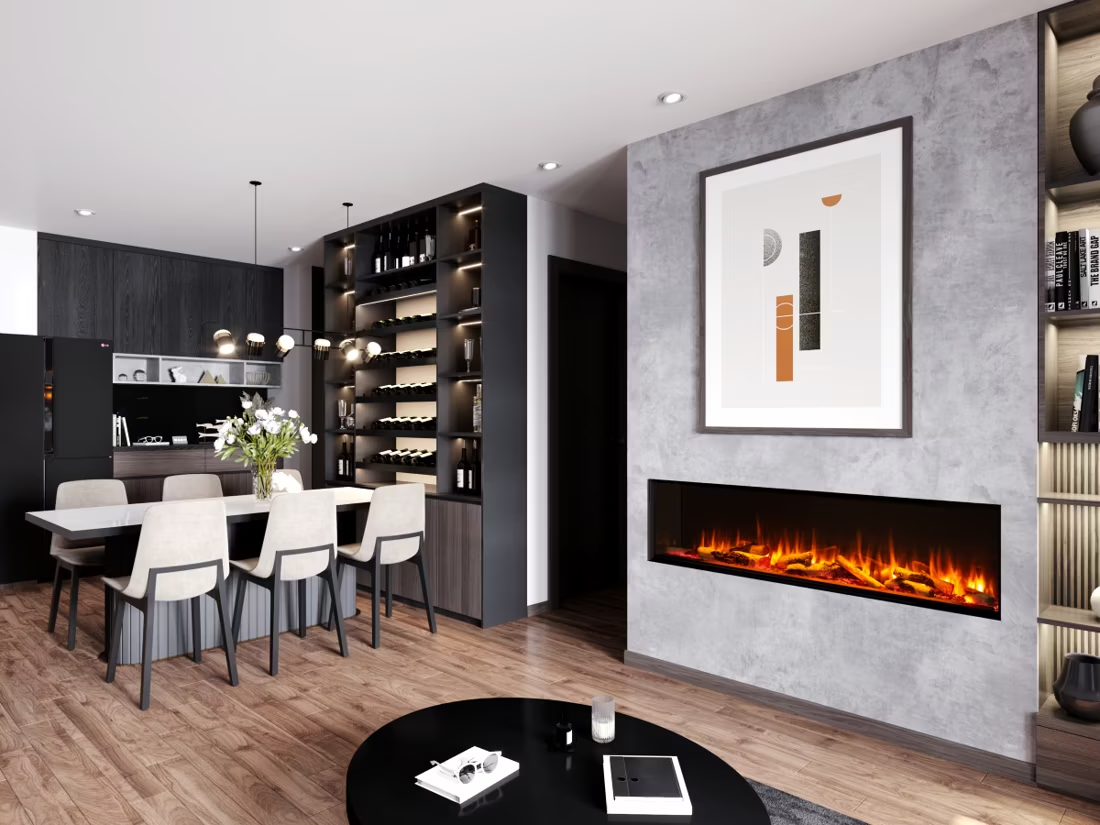
For retrofitting an existing masonry fireplace, an insert from a brand like Dimplex or Amantii is the standard choice—it matches common firebox openings and includes a flush-mount frame kit. For sunrooms, additions, or basements without an existing fireplace, a wall-mounted linear unit gives a modern look with minimal footprint, while a mantel package works better in a more traditional living room. A local dealer can measure your opening or wall space and steer you toward the right form factor.
Will an electric fireplace heat my whole house?
No—electric fireplaces are zone heaters, not whole-home furnaces. A typical 1,500-watt unit is rated to comfortably heat a single room of roughly 400 to 1,000 square feet, depending on insulation and ceiling height. In a 5A climate with a long, demanding heating season, Leland Grove homes still need a central furnace or boiler for whole-house heat; the electric unit is best used to take the edge off a family room, sunroom, or home office so the main system doesn't have to work as hard.
Electric vs. gas fireplace—which is right for my home?
Gas fireplaces are common in this part of Sangamon County and deliver real heat output with instant on-off operation, but they require a gas line and venting work, and installation typically costs several thousand dollars more than an electric unit. Electric fireplaces cost less to install, need no venting or gas line, and can go almost anywhere with an outlet—but they produce less usable heat for a whole room and cost more per BTU to run at Illinois electric rates than natural gas costs per therm. For a Leland Grove homeowner who wants ambiance and light supplemental warmth in a room without existing gas service, electric is usually the simpler, faster project. For a primary heat source in a main living space, gas is often worth the extra install cost.
Will my electric fireplace work during a power outage?
No—electric fireplaces need household power to run the heater, blower, and flame effect, so they won't operate during an outage unless you have a generator or battery backup system for the circuit. That's a meaningful difference from a wood or gas unit with standing pilot ignition, which can provide heat when the grid goes down. If backup heat during winter storms is a priority alongside everyday electric convenience, it's worth discussing a generator-ready circuit with your electrician when the fireplace is installed.
Can I put a TV above my fireplace?
Yes—with an asterisk. Fireplaces are hot and TVs don't like heat. Either put a mantel between them to deflect rising warmth, or choose a fireplace with heat-management technology that creates a cool zone on the wall above—the wall stays around 125 degrees, barely warm, while the room still gets full heat. If you like clean lines and don't want a mantel, heat management is the answer.
Do electric fireplaces actually produce heat?
Yes—most put out around 4,800–5,000 BTUs from a standard outlet, which comfortably warms a bedroom, office, or den as a comfort-zone heater. What they won't do is carry a whole house the way wood, gas, or pellet can. Think of electric as ambiance-first with honest supplemental heat: flames on with no heat in July, flames plus warmth in January.
What is an in-home preview and do I need one?
It's a visit where a hearth professional measures your space, confirms the model you picked actually works in your home, and walks the specs—framing, gas line, venting, finish work—before anything is ordered. Some details you just can't know until you see the house. Never make a down payment without one; it's the single most-skipped step that burns buyers.
Can a fireplace actually lower my heating bill?
Yes—by creating a comfort zone. A furnace heats every square foot of the house just to warm the one room you're in; a gas fireplace on low burns roughly a sixth of the gas a typical furnace does. Set the furnace around 55–60 degrees as a baseline, then heat the rooms your family actually uses. Families who heat this way commonly save $20–$60 a month.
Nearby Dealers
Hearth shops serving Leland Grove and the surrounding area. Every listing shows whether it is a WhyFire partner, a dealer we have verified as authorized for the brands we recommend, or a local business carrying hearth products. No manufacturer pays for placement. How we verify dealers →
Marx Fireplaces & Lighting
Quality Lighting
Electric Service in Leland Grove
An electric fireplace's heater draws about 1,500 watts—pennies per hour at local rates.
Ameren Illinois Company
Menard Electric Coop
City Of Springfield - (Il)
Find your electric fireplace in Leland Grove.
Tell us a bit about your home and we'll put together a free Project Guide & Parts List for your electric fireplace project—sized right, with the exact parts and a trusted local dealer to install it.
Find Your Fireplace →