
Warm Up Fast, No Chimney Required in Heritage Lake.
Plug-in and hardwired electric fireplaces for lake cottages, manufactured homes, and year-round residences around Heritage Lake—find the right unit and connect with a trusted local dealer.
Every Project Starts From One of These Five Situations
No gas line, no chimney, just plug in and go.
Heritage Lake is a small lake community of roughly 1,600 people tucked into the farmland of Tazewell County, where winter lows average 16°F and the area faces a long, cold heating season—a cold-climate load closer to Madison, Wisconsin than most of central Illinois. A lot of the housing stock here is lake cottages, manufactured homes, and smaller seasonal properties, where running a new gas line or building a masonry chimney isn't practical or affordable.
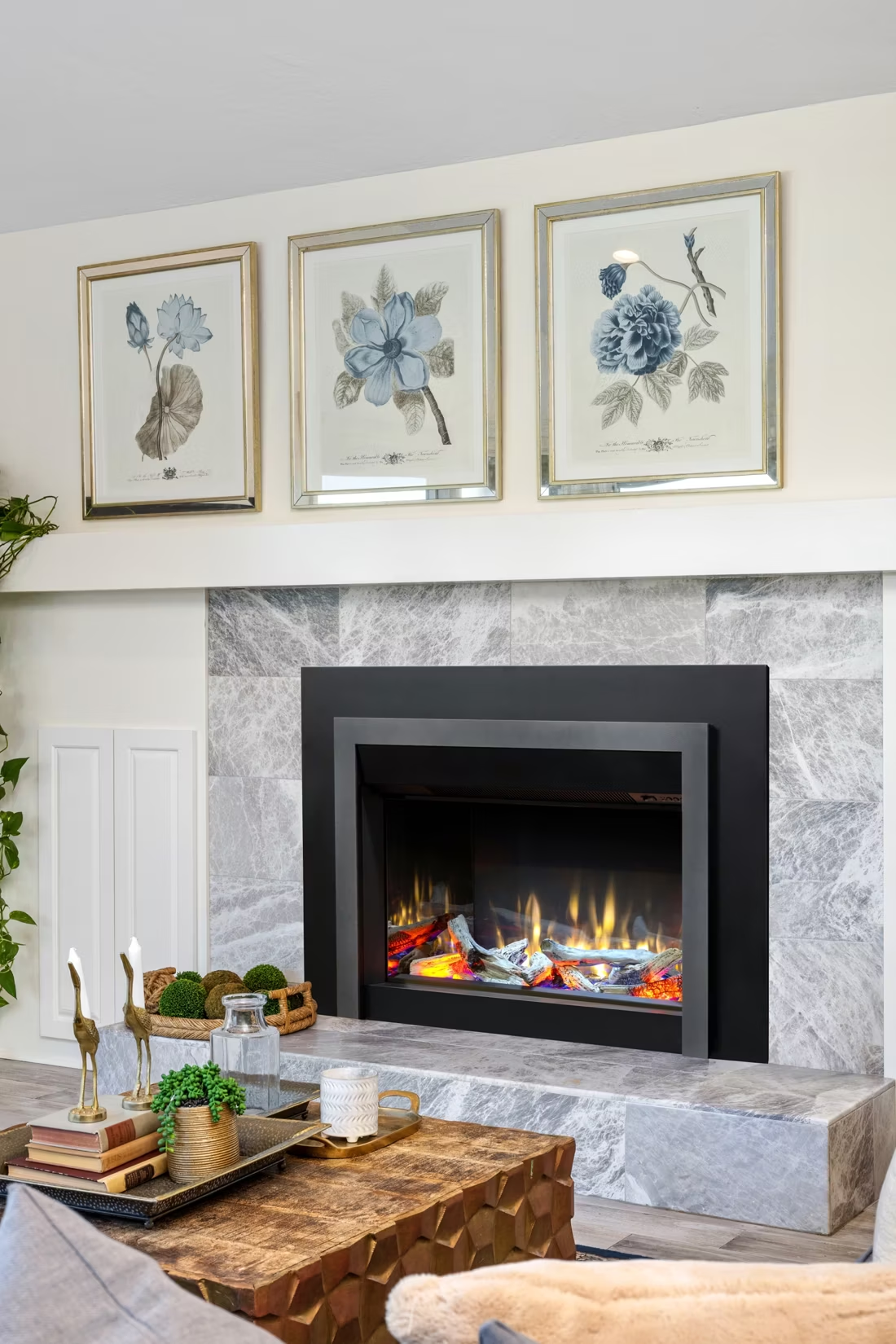
That's where electric fireplaces earn their keep. A plug-in insert or wall-mounted linear unit needs nothing more than a standard outlet (or a dedicated circuit for larger units), no venting, no permit hassle for most installs, and no combustion byproducts to worry about. Two electric providers serve the area—Ameren Illinois and Corn Belt Energy Corporation, a rural electric cooperative—and residential rates differ meaningfully between them (roughly 11.8¢/kWh for Ameren customers versus roughly 15.8¢/kWh for Corn Belt members), which is worth knowing before you size up a full-wall unit for daily use.
Three steps. No salesperson until you're ready.
Tell us about your project
Your zip code, your situation, and the fuel you're leaning toward—or let the answers point you to one.
See what's actually available
The brands dealers within 100 miles genuinely carry—real options, never a catalog mirage.
Get your dealer & Project Guide
A trusted local dealer, plus the free Project Guide & Parts List that names every component of the job.
Frequently Asked Questions
How much does an electric fireplace installation cost in Heritage Lake?
Electric fireplaces are the least expensive hearth option to install because there's no venting or gas line involved. A simple plug-in electric insert or stove runs $150 to $600 for the unit itself, with little to no install cost beyond fitting it into an existing opening. A wall-mounted linear electric fireplace with custom trim or a mantel surround typically runs $700 to $2,500 installed. Larger built-in units that need a dedicated 20-amp circuit run by an electrician—common for bigger living rooms or lake-house great rooms—land in the $2,000 to $4,000 range. Local dealers can walk you through which tier fits your space and your panel capacity.
Will an electric fireplace actually heat my home in Heritage Lake's winters?
Not on its own, and it's not designed to. Most residential electric fireplaces top out around 5,000 BTU (roughly 1,500 watts), which is enough to comfortably heat a single room but won't keep pace with a Tazewell County winter across a whole house—not with a heating season this long and lows regularly in the teens. Think of electric heat as zone heating: it warms the room you're actually using and lets you turn down the furnace, rather than replacing your primary heat source. For lake cottages used seasonally, it can be the primary heat for short stays.
Does it matter whether I'm on Ameren Illinois or Corn Belt Energy Corporation?
Yes, for your running costs. Ameren Illinois customers in the area pay closer to 11.8¢ per kWh, while Corn Belt Energy Corporation members—a rural electric cooperative that serves a lot of the outlying Heritage Lake properties—pay closer to 15.8¢ per kWh. On a 1,500-watt electric fireplace run for six hours a day, that's roughly $32 a month on Ameren versus $43 a month on Corn Belt. It's not a huge gap, but if you're comparing the running cost of electric heat against a gas insert, knowing which utility serves your address matters.
Do I need a permit to install an electric fireplace in Heritage Lake?
In most cases, no. A plug-in electric insert or freestanding stove that runs off an existing outlet doesn't require a permit. If you're installing a larger built-in unit that needs a new dedicated circuit, an electrician will need to pull an electrical permit through Tazewell County's building department, since Heritage Lake itself is unincorporated. Most local dealers or electricians handle that paperwork as part of the install, so it's rarely something a homeowner has to manage directly.
What's the difference between an electric insert, a freestanding stove, and a wall-mounted linear fireplace?
An electric insert is built to slide into an existing fireplace opening—a common fit for older Heritage Lake homes with a masonry firebox that's no longer used for wood. A freestanding electric stove looks like a traditional wood stove but plugs into any outlet, which makes it a good option for manufactured homes and lake cottages without an existing fireplace. A wall-mounted linear fireplace is a modern, low-profile unit recessed into or mounted on a wall—popular for newer builds and remodels where a wide, low-flame look is the goal. All three run on standard household power; the choice usually comes down to whether you're retrofitting an existing opening or building the look from scratch.
Can I install a wood stove in Heritage Lake instead?
It's uncommon here. Even though the surrounding Tazewell County woodlots are full of oak, hickory, walnut, and maple, Heritage Lake is a town of under 1,600 people without a local hearth retailer or chimney sweep based in town—most wood stove sales, chimney work, and NFI-certified installers are based in Pekin or Peoria, roughly 20 to 30 minutes away. Between that logistical gap and the fact that many homes here are smaller lake cottages or manufactured homes where a masonry chimney isn't practical, electric and gas have become the default choices for most homeowners in the area.
Electric vs. gas fireplace—which makes more sense for my Heritage Lake home?
Gas is available in the area and gives you higher heat output—enough to genuinely offset furnace use on a cold night—plus the look of a real flame, but it requires venting and, for propane homes, a tank. Electric skips all of that: no venting, no gas line, and it can go anywhere you have an outlet, which is a real advantage for a rented lake cottage or a manufactured home where permanent gas line work isn't an option. If your goal is ambiance and light supplemental warmth in a spare bedroom or lake-house den, electric is usually the simpler and cheaper path. If you want a unit that can meaningfully cut your heating bill on a January night with lows in the teens, gas is the stronger performer.
Will my electric fireplace work during a power outage?
No—electric fireplaces need grid power to run, so they'll go dark along with everything else if the power drops. That's worth factoring in if you're on Corn Belt Energy Corporation's rural distribution lines, where outages after ice storms or high winds can run longer than they do closer to town on Ameren's grid. If backup heat during an outage matters to you—which it often does out here—a propane or wood option as a secondary heat source is worth discussing with a local dealer alongside your electric fireplace plans.
What's the best electric fireplace for a Heritage Lake home?
For a supplemental-heat unit in a main living space, look at mid-size linear models from Dimplex or Napoleon, both of which offer realistic flame effects and a 1,500-watt heater sized for a single room. For lake cottages or smaller cabins where floor space and simplicity matter more, a freestanding electric stove from brands like Duraflame or ClassicFlame gives you a traditional look without any electrical work beyond a standard outlet. A local dealer can match the unit to your room size and your panel's available capacity.
Can I put a TV above my fireplace?
Yes—with an asterisk. Fireplaces are hot and TVs don't like heat. Either put a mantel between them to deflect rising warmth, or choose a fireplace with heat-management technology that creates a cool zone on the wall above—the wall stays around 125 degrees, barely warm, while the room still gets full heat. If you like clean lines and don't want a mantel, heat management is the answer.
Do electric fireplaces actually produce heat?
Yes—most put out around 4,800–5,000 BTUs from a standard outlet, which comfortably warms a bedroom, office, or den as a comfort-zone heater. What they won't do is carry a whole house the way wood, gas, or pellet can. Think of electric as ambiance-first with honest supplemental heat: flames on with no heat in July, flames plus warmth in January.
Can I install a fireplace myself?
If you're putting a fire in your house on purpose, it's best to work with an expert. Unless you're genuinely experienced in framing, gas line, vent pipe, and the national code on clearances to combustibles, have a professional do it—and ideally the same company that sells you the fireplace, so warranty, service, and liability all live under one roof.
Can a fireplace actually lower my heating bill?
Yes—by creating a comfort zone. A furnace heats every square foot of the house just to warm the one room you're in; a gas fireplace on low burns roughly a sixth of the gas a typical furnace does. Set the furnace around 55–60 degrees as a baseline, then heat the rooms your family actually uses. Families who heat this way commonly save $20–$60 a month.
Nearby Dealers
Hearth shops serving Heritage Lake and the surrounding area. Every listing shows whether it is a WhyFire partner, a dealer we have verified as authorized for the brands we recommend, or a local business carrying hearth products. No manufacturer pays for placement. How we verify dealers →
We’ve paused dealer listings for this connection today. Enter your zip or postal code above to find dealers near you, or come back tomorrow.
Popular Electric Brands
Where each brand came from, what's inside it today, and every current model. No brand pays to be here. Not every dealer carries every brand, so enter your zip code to see what's sold near Heritage Lake.
Fireplace Xtrordinair
Fireplace Xtrordinair, now often called FireplaceX, is the fireplace brand of Travis Industries, Inc., of Mukilteo, Washington.
5 electric models →DaVinci
DaVinci Custom Fireplaces is a brand of Travis Industries, Inc., of Mukilteo, Washington, the company behind Lopi and Fireplace Xtrordinair.
5 electric models →Kozy Heat
Kozy Heat was founded in 1976 by Dudley Hussong in Lakefield, Minnesota, and incorporated as Hussong Manufacturing Co., Inc. in 1978.
3 electric models →Forge & Flame
Forge & Flame is the stove brand Hearth & Home Technologies introduced in August 2023 to bring Vermont Castings, Harman, and Quadra-Fire under one name.
1 electric model →Electric Service in Heritage Lake
An electric fireplace's heater draws about 1,500 watts—pennies per hour at local rates.
Ameren Illinois Company
Corn Belt Energy Corporation
Find your electric fireplace in Heritage Lake.
Tell us about your home and we'll put together a free Project Guide & Parts List—the right electric fireplace or insert for your space, plus a trusted local dealer who can install it.
Find Your Fireplace →