
Keep Your Family Warm and Safe—No Matter What
At 2,564 feet in the Idaho Panhandle, Spirit Lake's winters demand more heating, on paper, than Burlington, Vermont's. Find the right wood stove or insert for your home, sized correctly, and get matched with a trusted local dealer.
Every Project Starts From One of These Five Situations
Wood heat runs deep in the Idaho Panhandle.
Spirit Lake sits in the Selkirk foothills of Kootenai County, a lake town of under 2,400 people bordered on nearly every side by Idaho Panhandle National Forest and BLM land. Winter lows average 23°F, and the town's winters run about as cold and long as Burlington, Vermont's—colder, by that measure, than plenty of places that get more attention for hard winters. For homes outside city water and gas service, and there are many around Spirit Lake, a wood stove isn't a mood-setter. It's the thing that keeps pipes from freezing when a January cold snap sits on the region for a week.
Cutting your own firewood is a normal part of life here. Permits through the Idaho Panhandle National Forests, BLM Coeur d'Alene District, and BLM Spokane District run $5 to $20 per cord, with cutting seasons open April through October depending on the district. Lodgepole pine, ponderosa pine, Douglas fir, and larch (tamarack) are the four species that fill most local woodsheds—larch burns notably hotter and denser than the pines, closer to what you'd expect from a hardwood. The tradeoff to manage: winter inversions and wildfire smoke both affect air quality in the Rathdrum Prairie and Coeur d'Alene basin, so a newer EPA-certified stove that burns clean matters here as much for the neighbors as for your own chimney.
Firewood Cutting Permits Near Spirit Lake
Three steps. No salesperson until you're ready.
Tell us about your project
Your zip code, your situation, and the fuel you're leaning toward—or let the answers point you to one.
See what's actually available
The brands dealers within 100 miles genuinely carry—real options, never a catalog mirage.
Get your dealer & Project Guide
A trusted local dealer, plus the free Project Guide & Parts List that names every component of the job.
Frequently Asked Questions
How much does a wood stove installation cost in Spirit Lake?
Most wood stove installations around Spirit Lake run roughly $4,000 to $9,500, depending on the stove, whether you're venting through an existing chimney or running new Class A pipe, and whether the hearth pad needs to be built out or upgraded for clearance. Homes without an existing chimney—common in older lake cabins and manufactured homes in the area—tend to land on the higher end once through-roof venting and framing are added in. Kootenai County requires a building permit for new installations, and most local installers fold the permitting into the job so you're not chasing paperwork yourself.
What size wood stove do I need for a Spirit Lake home?
With a long, cold heating season and long stretches below freezing, undersizing is the more common mistake here than oversizing. A small stove (up to roughly 1,000 sq ft) suits a cabin or single main room; a medium stove (1,000–2,000 sq ft) covers most year-round homes; larger, well-insulated homes may need a 2,000+ sq ft rated unit or a second heat source for outbuildings. Older homes and cabins with single-pane windows and minimal insulation—not unusual on properties near the lake—often need a size class up from what square footage alone would suggest. A local dealer can walk your home and give you an accurate number for free.
Where can I find a certified wood stove installer near Spirit Lake?
Spirit Lake itself is small, so most certified installers serving the area are based in Coeur d'Alene, Post Falls, or Rathdrum and travel out to Kootenai County homes regularly. Look for NFI (National Fireplace Institute) or CSIA (Chimney Safety Institute of America) certification—both indicate real training in wood-burning appliance clearances and venting, not just retail sales experience. Skipping a certified installer in favor of a handyman install is where most local chimney fire and creosote problems trace back to; venting a wood stove correctly through a roofline in a snow-load climate like this one isn't a guess-and-check job.
Wood stove or wood insert—which fits my Spirit Lake home?
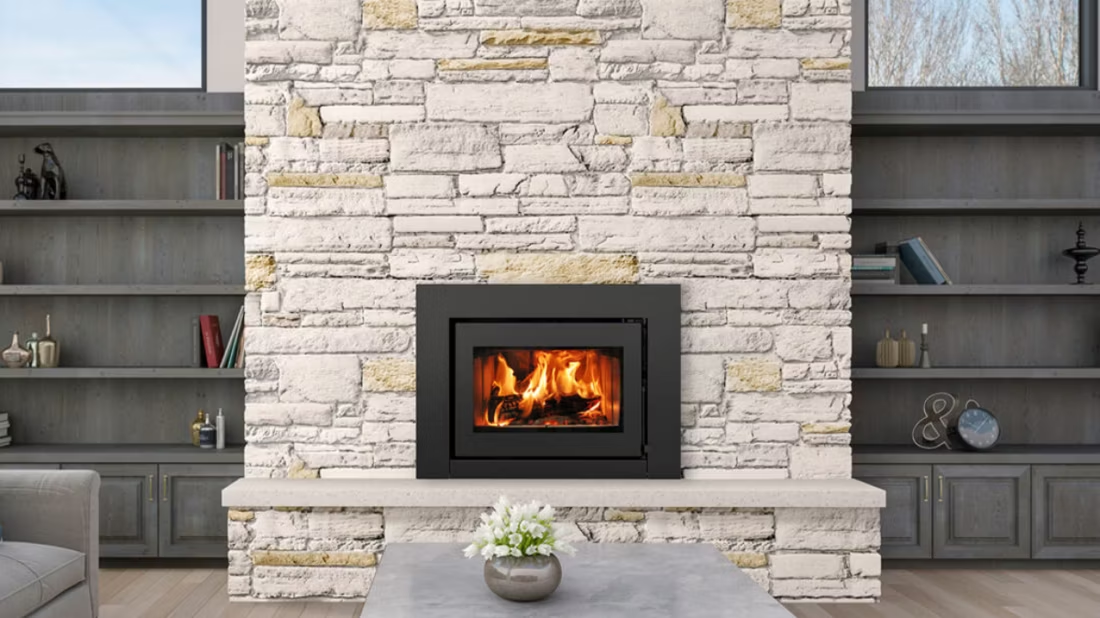
A freestanding wood stove sits on a hearth pad and can go almost anywhere with the right clearances—the more flexible option for cabins, additions, or homes without a fireplace. A wood insert drops into an existing masonry fireplace and uses your current chimney (relined) as the vent path, turning a drafty open hearth into a real heat source. A lot of the older stone fireplaces built into lake cabins around Spirit Lake are strong insert candidates—you keep the look, but the heat output and efficiency jump considerably. New builds or additions without a fireplace already in place are usually better served by a freestanding stove.
Do I need a permit to install a wood stove in Spirit Lake?
Yes. New wood stove installations require a building permit, and the unit itself needs to meet current EPA 2020 NSPS emissions standards. In-town Spirit Lake addresses go through the city; properties outside city limits go through the Kootenai County Building and Planning Department. Most local dealers handle the permit filing as part of the install. There's no formal burn-curtailment program here the way there is in some Pacific Northwest non-attainment areas, but winter inversions do settle smoke over the Rathdrum Prairie basin, so a clean-burning certified stove is worth prioritizing regardless of the permit requirement.
What's the best wood stove for Spirit Lake's climate?
For homes outside town that lose power during winter storms—a real consideration with Avista Corp's rural lines in this terrain—a catalytic wood stove from a brand like Blaze King or Woodstock Soapstone is worth the extra upfront cost. Catalytic models can hold a fire 20+ hours on a load, which matters when it's single digits overnight and the power's out. For supplemental heat in a main living area with reliable electric service, a non-catalytic stove from Pacific Energy or Lopi burns efficiently and costs less. Either way, size the stove to your actual square footage—an oversized unit run low to avoid overheating a small space is a leading cause of creosote buildup with dense woods like larch and Douglas fir.
How often should my chimney be inspected in Spirit Lake?
Annually, per CSIA guidelines, ideally in late summer before the burning season starts. Homes burning larch and Douglas fir as a primary heat source—dense, resinous woods that are common locally—can build creosote faster than homes burning only pine, so a mid-season check is worth adding if you're going through more than four or five cords a winter. Given how remote some properties around Spirit Lake are, scheduling your sweep before the first snow closes in on rural roads is worth doing early rather than waiting until October.
Where can I get firewood in or near Spirit Lake?
Self-cutting is the most common route: permits through the Idaho Panhandle National Forests, BLM Coeur d'Alene District, and BLM Spokane District run $5 to $20 per cord, with cutting seasons generally open April through October. Lodgepole pine, ponderosa pine, Douglas fir, and larch are all commonly available on permit land near town. For homeowners who'd rather buy delivered wood, a handful of small local suppliers and seasonal sellers serve the Spirit Lake and Rathdrum area—prices vary more here than in bigger markets, so it's worth asking whether a cord is full-size (4×4×8 feet) before you buy.
Wood stove vs. pellet stove—which makes more sense in Spirit Lake?
A wood stove runs on cordwood you can cut yourself under a $5-to-$20-per-cord national forest permit, and it keeps working when the power doesn't—a real factor here given how ice and windstorms can knock out Avista Corp service on rural lines for a day or more. A pellet stove is more convenient day-to-day—load the hopper, set it, less ash—and burns cleaner, which helps during winter inversion periods, but it needs electricity to run the auger and blower, so it goes dark in an outage unless you add a battery backup. For year-round or off-grid-adjacent properties around Spirit Lake, wood tends to be the more resilient choice. For in-town homes with steady power and less interest in cutting and hauling wood, pellet is a reasonable alternative.
Why is a fireplace insert so efficient?
An insert does two things: it seals the chimney completely, so you stop losing air you already paid to heat, and it radiates warmth into the room through the firebox and glass. Most add a heat-exchange fan that pulls cool room air underneath, wraps it around the hot firebox, and pushes it back out warm. Your home is more efficient before you've even lit the first fire.
Why won't my new wood stove get going like my old one?
New wood stoves are 70%+ efficient, so far less heat goes up the flue—which also means less draft to get a fire established. The rule: build a genuinely hot fire for about 45 minutes before you choke it down. Skip that and you get smoke in the room, creosote in the chimney, and a fire that never takes off. Most performance complaints trace straight back to this.
Does a fireplace add value to my home?
On average, a fireplace adds back to the home about the same amount you spent installing it. Add the monthly savings from heating the rooms you actually use instead of the whole house—often hundreds of dollars a year—and the value case is strong before you even count what a fire does for how your family uses the room.
Can a fireplace actually lower my heating bill?
Yes—by creating a comfort zone. A furnace heats every square foot of the house just to warm the one room you're in; a gas fireplace on low burns roughly a sixth of the gas a typical furnace does. Set the furnace around 55–60 degrees as a baseline, then heat the rooms your family actually uses. Families who heat this way commonly save $20–$60 a month.
Nearby Dealers
Hearth shops serving Spirit Lake and the surrounding area. Every listing shows whether it is a WhyFire partner, a dealer we have verified as authorized for the brands we recommend, or a local business carrying hearth products. No manufacturer pays for placement. How we verify dealers →
Armour Chimney Service
Lake Creek Consulting LLC, Dba Lake Creek Comfort
Iron Stone
Priest River Ace Hardware
Andy's Heating & Cooling
Selkirk Ace Hardware
All About Chimneys
Lake Creek Comfort Systems
Find your wood fireplace in Spirit Lake.
Tell us about your home and heating goals, and we'll match you with a trusted local dealer and put together a free Project Guide & Parts List—a plan for your wood project in Spirit Lake with the exact parts, including the vent kit, and our recommended installer near you.
Find Your Fireplace →