
Heat that plugs in, no chimney required.
Simple, ventless heat for Lincoln County's small towns and scattered ranch homes—from Shoshone to Richfield to Dietrich. Find the right electric fireplace or insert, and get matched with a trusted local dealer.
Every Project Starts From One of These Five Situations
Reliable warmth without a wood pile or a gas line.
Lincoln County is one of Idaho's smallest and least populated counties—just under 2,500 people spread across Shoshone, Richfield, Dietrich, and the open range between them on the Snake River Plain. Winters here average lows near 23°F with roughly 5,541 heating degree days, cold enough that most homes run a primary heat source hard for five or six months a year, but not the extreme, sustained sub-zero stretches you'd find in Bozeman or Helena. That gap matters for electric heat: in a climate this size, a well-placed electric fireplace or stove can genuinely take the edge off a room without asking a homeowner to run a flue or manage a fuel supply.
Wood is still common here—lodgepole pine, ponderosa pine, Douglas fir, and larch come off Sawtooth National Forest and BLM Twin Falls District cutting permits for a few dollars a cord—and pellet stoves stocked with Bear Mountain, Lignetics, or Pacific Pellet fuel show up in plenty of rural homes too. But wildfire smoke is a real seasonal concern across this stretch of Idaho, and electric units give homeowners a clean-burning option that doesn't add smoke to the air or require a chimney sweep. For manufactured homes, additions, and older houses in Shoshone and Richfield without existing masonry, electric is often the easiest unit to install—no gas line, no venting, and a plug-in or 240V hardwire is usually all it takes.
Three steps. No salesperson until you're ready.
Tell us about your project
Your zip code, your situation, and the fuel you're leaning toward—or let the answers point you to one.
See what's actually available
The brands dealers within 100 miles genuinely carry—real options, never a catalog mirage.
Get your dealer & Project Guide
A trusted local dealer, plus the free Project Guide & Parts List that names every component of the job.
Frequently Asked Questions
How much does an electric fireplace installation cost in Lincoln County?
Electric fireplaces are the least expensive hearth product to install, and that holds true in Lincoln County. A simple plug-in insert or freestanding stove that runs on a standard 120V outlet can be in place in under an hour with no permit and no contractor needed. A built-in electric fireplace or a larger unit that requires a dedicated 240V circuit runs higher once an electrician is involved, particularly in older farmhouses around Shoshone and Richfield where panel capacity can be limited. Because there's no venting, chimney, or gas line to plan around, most of the cost difference comes down to the unit itself and any electrical work needed to support it.
Do electric fireplaces actually put out real heat, or are they just for looks?
Most electric fireplaces and stoves sold today include a real heating element—typically a fan-forced or infrared heater rated around 1,500 watts—that can meaningfully warm a single room. They won't replace a wood stove or a furnace as primary heat through a Lincoln County winter with lows regularly near 23°F, but they're effective as supplemental or zone heat: warming a bedroom or living room without running the furnace harder, or keeping a room comfortable during shoulder-season cold before full winter sets in on the Snake River Plain. Some models let you run the flame effect with the heater off, popular on milder days.
Can I install an electric fireplace in a manufactured or mobile home?
Yes, and it's one of the more common installs in Lincoln County given how many manufactured and modular homes are spread across Shoshone, Richfield, and Dietrich. Electric units have no combustion, so there's none of the clearance-to-combustibles or venting concerns that come with a wood or gas install in a manufactured home. Most plug-in models are approved for use in manufactured housing as-is; larger built-in units may need a licensed electrician to confirm the home's panel can support a dedicated circuit before installation.
Do I need a permit to install an electric fireplace in Lincoln County?
In most cases, no. A plug-in electric fireplace or stove doesn't require a building permit because there's no venting or gas work involved. If you're having a built-in unit hardwired to a dedicated 240V circuit, the electrical work itself may require a permit and inspection, which a licensed electrician typically pulls as part of the job. Unlike wood stove installs, there's no EPA certification or chimney inspection to schedule—electric is the simplest permitting path of any hearth fuel in the county.
What's the difference between an electric insert and an electric stove?
An electric insert is built to slide into an existing masonry fireplace opening or a framed cavity, giving an old fireplace a heat source and a flame effect without touching the chimney. An electric stove is a freestanding cabinet-style unit that sits anywhere in a room, plugs into a standard outlet, and can be moved if needed. For Lincoln County homes with an existing but rarely used wood fireplace, an insert is often the simplest upgrade. For homes without a fireplace at all—including many of the ranch-style and manufactured homes common in the county—a freestanding electric stove is usually the easier fit.
How does electric heat compare to wood heat during a Lincoln County winter?
Wood remains the backbone of rural heat in Lincoln County—lodgepole pine, ponderosa pine, Douglas fir, and larch are all locally available, and Sawtooth National Forest and BLM Twin Falls District cutting permits run $5 to $20 per cord, which keeps self-cut firewood cheap. Wood also keeps working during a power outage, which matters on a rural grid serving scattered ranch properties. Electric heat can't do that—it goes down with the power—but it produces zero smoke, a real advantage during wildfire smoke season when air quality concerns are common across this part of Idaho. Many Lincoln County homes end up running both: wood as primary or backup heat, electric for a smoke-free, low-maintenance option in a bedroom or living space.
Are electric fireplaces expensive to run?
Running cost depends on your electric rate and how many hours a day the heater element runs, but a typical 1,500-watt electric fireplace costs somewhere around 15 to 25 cents an hour on heat mode at full output—closer to pennies an hour with just the flame effect and no heat. For supplemental use—a few hours a day in one room—that's usually cheaper than running a whole-home furnace harder to compensate for a cold room. For anyone trying to use electric as a primary heat source across a whole home through a full Lincoln County winter, the bill will run noticeably higher than wood or propane, which is why most local homes treat electric as a zone-heat or backup option.
Will an electric fireplace work if the power goes out?
No—electric fireplaces and stoves require power to run the heating element, fan, and flame effect, so they won't function during an outage. For rural Lincoln County properties on longer feeder lines out past Shoshone and Dietrich, that's worth planning around. Homeowners who want heat resilience during winter storms typically pair an electric unit for everyday convenience with a wood stove or propane heater as backup, rather than relying on electric alone for a home's only heat source.
What size electric fireplace do I need for my room?
Most electric fireplaces are sized for a single room rather than a whole house, so the key number is the square footage of the room you're heating, not the whole home. A standard 1,500-watt unit can comfortably supplement heat in a room up to roughly 400 square feet, which covers most bedrooms and living rooms in the county's ranch-style and manufactured homes. Larger open-concept spaces may need a higher-wattage unit or a second heat source to keep up on the coldest nights near 23°F. A local dealer can walk through your specific room dimensions and ceiling height to recommend the right size.
Can I put a TV above my fireplace?
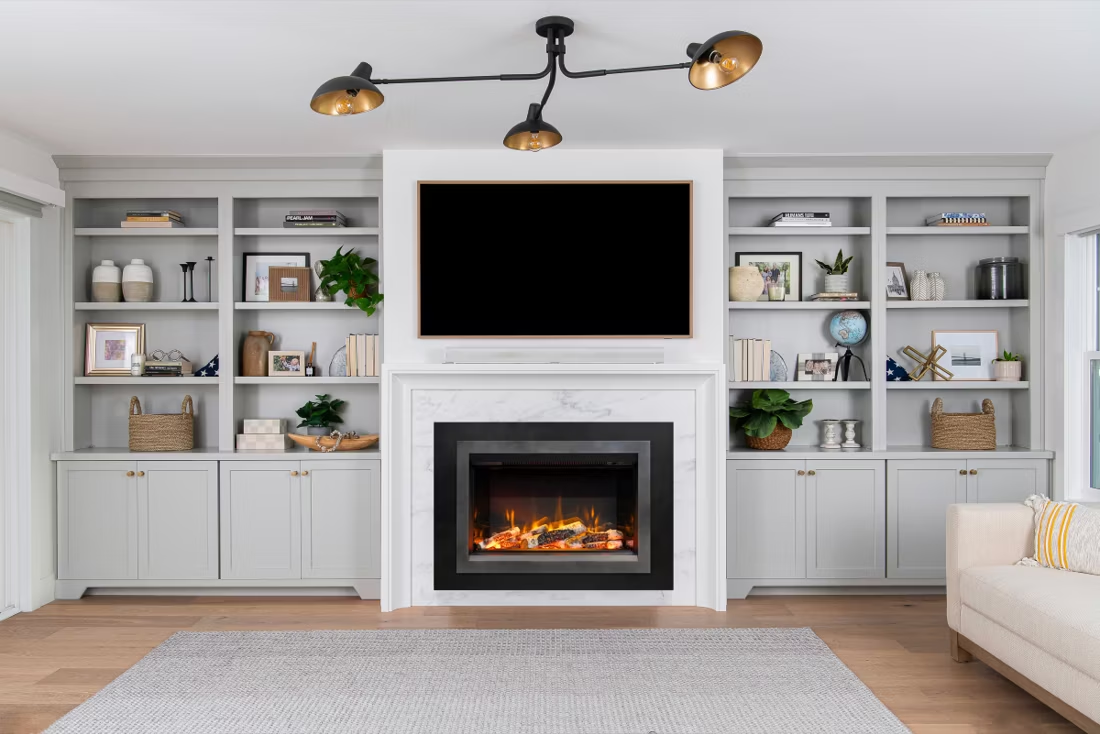
Yes—with an asterisk. Fireplaces are hot and TVs don't like heat. Either put a mantel between them to deflect rising warmth, or choose a fireplace with heat-management technology that creates a cool zone on the wall above—the wall stays around 125 degrees, barely warm, while the room still gets full heat. If you like clean lines and don't want a mantel, heat management is the answer.
Do electric fireplaces actually produce heat?
Yes—most put out around 4,800–5,000 BTUs from a standard outlet, which comfortably warms a bedroom, office, or den as a comfort-zone heater. What they won't do is carry a whole house the way wood, gas, or pellet can. Think of electric as ambiance-first with honest supplemental heat: flames on with no heat in July, flames plus warmth in January.
Can a fireplace actually lower my heating bill?
Yes—by creating a comfort zone. A furnace heats every square foot of the house just to warm the one room you're in; a gas fireplace on low burns roughly a sixth of the gas a typical furnace does. Set the furnace around 55–60 degrees as a baseline, then heat the rooms your family actually uses. Families who heat this way commonly save $20–$60 a month.
How much should I budget for a fireplace?
For an average home—covering the fireplace, the vent pipe, and basic installation—a budget between $3,900 and $5,500 gives you a lot of options across wood, gas, and pellet. By the time you add finish work, gas line, and electrical, the average complete installation lands between $5,000 and $12,000 all-in. In a remodel or new build, a good rule is to put about 2.5% of the total project cost toward the fireplace.
Find your electric fireplace in Lincoln County.
Tell us a bit about your home in Shoshone, Richfield, Dietrich, or anywhere else in Lincoln County, and we'll match you with a trusted local dealer and send over a free Project Guide & Parts List—the exact parts and recommended dealer for your electric fireplace project.
Find Your Fireplace →