
Add electric warmth to your Lemhi County home.
In a county this remote and this cold, electric heat plays a specific role—zone heat, ambiance, and rooms your main heat source doesn't reach. Find the right unit and connect with a trusted local dealer.
Every Project Starts From One of These Five Situations
Electric heat earns its place as backup and zone heat.
Lemhi County is one of the most sparsely populated counties in Idaho—about 3,279 people spread across a valley framed by the Bitterroot and Lemhi ranges, with Salmon as the county seat. Climate zone 6B and 7,765 heating degree days put this valley in the same cold-climate bracket as Bozeman, Montana, just over the Beaverhead-Deerlodge divide. Average winter lows sit around 11°F, and cold snaps drop well below that. Most homes here were built around wood heat, using lodgepole pine, ponderosa, douglas fir, and larch cut under Salmon-Challis or Beaverhead-Deerlodge National Forest permits—a longstanding local habit that electric heat doesn't replace so much as complement.
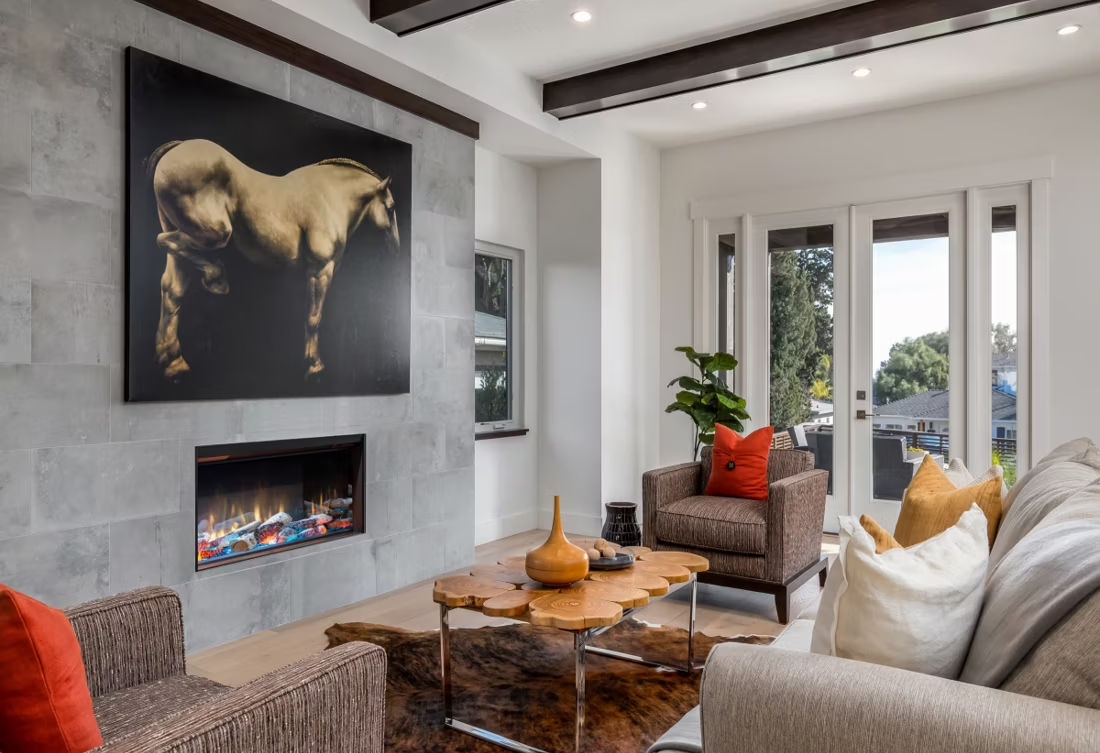
Where electric fireplaces earn their keep is in the rooms wood or gas can't reach efficiently: a finished bonus room, a bedroom addition, a cabin along the Salmon River used only part of the year. A 240V built-in electric fireplace or insert gives instant, thermostat-controlled heat with no venting and no combustion byproducts—useful in a tightly built addition where running a flue isn't practical. What it won't do is replace whole-home heat at this HDD level; resistance electric heat gets expensive fast when it's carrying the full load through a Lemhi County winter, and rural power service here isn't immune to outage-causing storms. Most electric installs I see in this county are paired with wood or propane as the primary system, not standing alone.
Three steps. No salesperson until you're ready.
Tell us about your project
Your zip code, your situation, and the fuel you're leaning toward—or let the answers point you to one.
See what's actually available
The brands dealers within 100 miles genuinely carry—real options, never a catalog mirage.
Get your dealer & Project Guide
A trusted local dealer, plus the free Project Guide & Parts List that names every component of the job.
Frequently Asked Questions
How much does an electric fireplace installation cost in Lemhi County?
Plug-in electric fireplace inserts and stoves—the kind that run on a standard 120V outlet—typically cost $200 to $600 for the unit, with no wiring work needed beyond an outlet in the right spot. Built-in electric fireplaces or wall units on a dedicated 240V circuit run higher, often $1,500 to $3,500 installed once you factor in a licensed electrician running new circuit wiring, especially in older Salmon or Leadore homes with panels that need updating. Framing an electric unit into an existing masonry fireplace opening adds modest labor but no venting cost, since electric units don't require a flue.
Will an electric fireplace actually heat my home in a Lemhi County winter?
Not on its own, in most cases. At 7,765 heating degree days and average winter lows around 11°F, resistance electric heat is expensive to run as a sole heat source across a whole house—the math works much better for wood or propane as the primary system. Where an electric unit earns its cost is zone heating: a single room, a converted garage, a river cabin used seasonally, or a bonus space added after the original heating system was sized. Size the unit to the room, not the house, and expect it to supplement rather than replace your main heat.
What's the difference between an electric fireplace, insert, and stove?
An electric fireplace is typically a built-in unit set into a wall or existing fireplace opening, often with a flame-effect display and a heater rated for a single room. An electric insert is sized to slide into an existing masonry firebox, giving an old wood fireplace opening a clean, no-venting heat source. An electric stove is a freestanding cabinet-style unit that mimics a wood stove's look without any chimney or clearance requirements. For Lemhi County homes with an existing but unused masonry fireplace, an insert is usually the simplest upgrade—no chimney work, no permit for the fireplace opening itself.
Will my electric fireplace work during a power outage?
No—and this matters more in Lemhi County than in a lot of places. Electric fireplaces and inserts require power to run their heating element and blower, so during a winter storm outage they go dark along with everything else on the circuit. That's the main reason wood heat remains the backbone of most homes in this valley: a wood stove keeps a house livable through a multi-day outage in a way an electric unit can't. If backup heat during outages is a real concern for your home, pair an electric fireplace for everyday convenience with a wood stove or propane unit as your outage plan, rather than relying on electric alone.
Do I need a permit to install an electric fireplace in Lemhi County?
Plug-in electric fireplace units generally don't require a building permit since there's no venting, gas line, or structural change involved. A built-in electric fireplace or insert wired to a dedicated 240V circuit typically does require an electrical permit, since that work falls under standard electrical code regardless of fuel type. Local electricians who handle these installs in Salmon and the surrounding valley usually pull the permit as part of the job, so it's worth confirming that's included in your quote.
What's the best electric fireplace for a cold-climate home like mine?
For Lemhi County's cold, dry winters, look for units with a true 240V heating element rather than a small 120V plug-in model if you're trying to meaningfully heat a room rather than just add ambiance—120V units are capped at roughly 1,500 watts, which struggles in a poorly insulated space at 11°F outside. Brands with dual-function models (heat plus flame effect that can run independently) give you the option of running the visual flame without the heater in shoulder-season months, which is common in this valley's long fall and spring. Talk to a local dealer about your room's insulation and square footage before choosing a wattage.
Electric vs. wood—which should be my primary heat in Lemhi County?
Wood wins as primary heat for most homes in this valley, and the local habits reflect that—cutting permits through Salmon-Challis and Beaverhead-Deerlodge National Forests run $5 to $20 per cord during the May-to-October season, making self-cut firewood the cheapest fuel available here, and a wood stove keeps working through the power outages that come with mountain-valley winter storms. Electric heat wins on convenience: no ash, no wood handling, no chimney to sweep, and instant on-off control from a thermostat. Most practical setups in Lemhi County use wood as the primary heat source with electric covering a specific room or serving as a low-maintenance option for a part-time cabin.
Where can I get an electric fireplace installed near me in Lemhi County?
Given the county's small population, there isn't a hearth showroom on every corner—most residents work with a local electrician for the wiring and a hearth dealer (sometimes based out of Salmon or a nearby larger market) for the unit itself and any surround or mantel work. Avoid big-box installs for anything beyond a simple plug-in unit; a dedicated circuit needs to be sized correctly for the wattage, and a licensed electrician familiar with local code and permitting will get that right the first time. A trusted local dealer can also help you decide whether an insert, built-in, or stove-style unit fits your space.
Electric vs. pellet stove—which is right for my home?
Pellet stoves burn compressed wood pellets from regional brands like Bear Mountain, Lignetics, or Pacific Pellet, and produce real, substantial heat output suited to whole rooms or small homes—but they still need electricity to run the auger and blower, so they go down in an outage just like an electric fireplace does. Electric fireplaces skip the pellet hopper and ash cleanup entirely, trading some heat output for simplicity and instant control. For a Lemhi County home that already has wood as backup heat, either electric or pellet can serve as a clean, low-maintenance secondary source—the choice usually comes down to whether you want a stronger heater (pellet) or a simpler, ash-free unit (electric).
Can I put a TV above my fireplace?
Yes—with an asterisk. Fireplaces are hot and TVs don't like heat. Either put a mantel between them to deflect rising warmth, or choose a fireplace with heat-management technology that creates a cool zone on the wall above—the wall stays around 125 degrees, barely warm, while the room still gets full heat. If you like clean lines and don't want a mantel, heat management is the answer.
Does an electric fireplace need a vent or chimney?
No—that's its superpower. An electric fireplace needs a wall and an outlet, period. No vent pipe, no gas line, no clearances to design around, which is why it works in bedrooms, offices, apartments, and walls where venting a gas or wood unit would be impractical or impossible. Installation is typically the simplest and least expensive of any fireplace type.
What is an in-home preview and do I need one?
It's a visit where a hearth professional measures your space, confirms the model you picked actually works in your home, and walks the specs—framing, gas line, venting, finish work—before anything is ordered. Some details you just can't know until you see the house. Never make a down payment without one; it's the single most-skipped step that burns buyers.
How much should I budget for a fireplace?
For an average home—covering the fireplace, the vent pipe, and basic installation—a budget between $3,900 and $5,500 gives you a lot of options across wood, gas, and pellet. By the time you add finish work, gas line, and electrical, the average complete installation lands between $5,000 and $12,000 all-in. In a remodel or new build, a good rule is to put about 2.5% of the total project cost toward the fireplace.
Stove and Fireplace Dealers in Lemhi County
Find your electric fireplace in Lemhi County.
Tell us about your home and where you need the heat, and we'll match you with a trusted local dealer and send over a free Project Guide & Parts List—the exact unit, wiring needs, and installer recommended for your space.
Find Your Fireplace →