
A fireplace for a place that rarely drops below 65°F.
East Honolulu doesn't need heat—it wants ambiance. Find the right electric fireplace for your Hawaii Kai or Aina Haina home and connect with a trusted local dealer.
Every Project Starts From One of These Five Situations
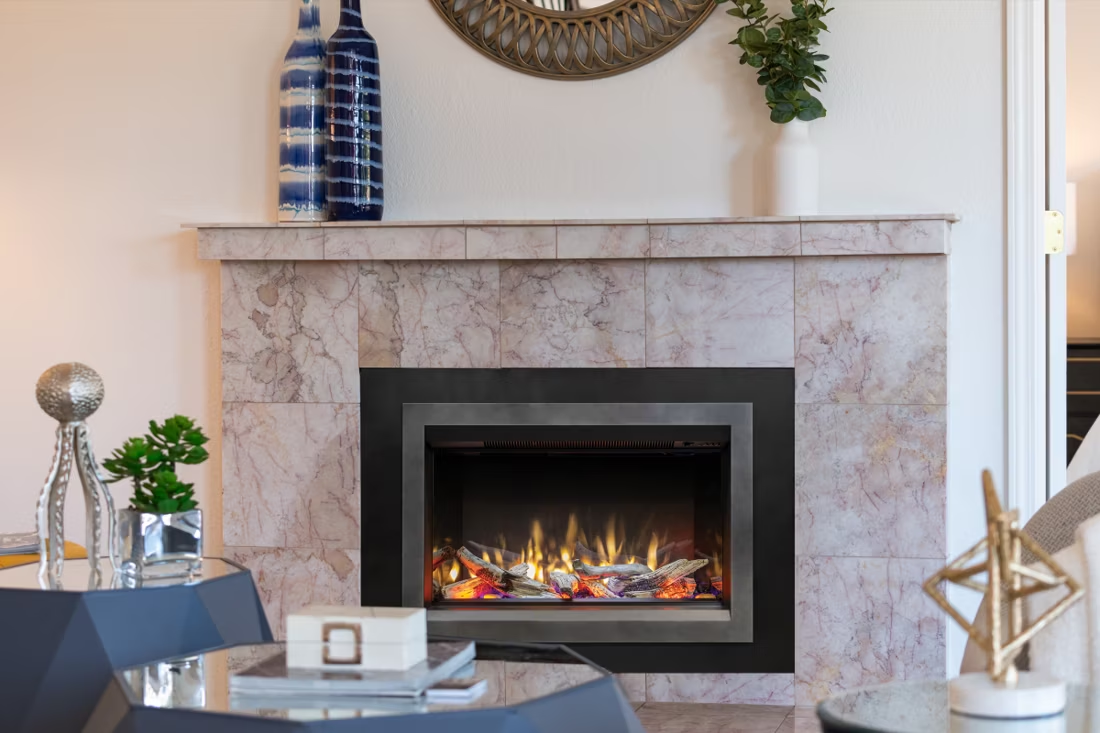
Here, a fireplace is about ambiance, not survival heat.
East Honolulu sits at 528 feet in climate zone 1A with essentially no winter heating season—winter lows average 65°F, which is about as far from a heating emergency as a U.S. zip code gets. There's no cold front coming through Hawaii Kai, Aina Haina, or Kuliouou that a fireplace needs to fight off. What homeowners here actually want is the visual and emotional effect of a fire—the glow, the movement, the focal point in a living room—without smoke, venting, or a chimney that makes no sense on a lanai-style home.
Electric is the only fuel that fits this cleanly. Wood isn't practical in a tropical climate with no cutting season or cold-weather demand, and gas fireplaces are rare across Oahu since there's no natural gas utility here—propane tank installs exist but they're uncommon and mostly limited to cooking. Electric units plug in or hardwire with no venting, no gas line, and no combustion byproducts, which also makes them the only fireplace option that works cleanly in East Honolulu's condos and townhomes. Hawaiian Electric Co Inc serves the area at a residential rate around $0.4287 per kWh—one of the highest in the country—so most homeowners here run the flame effect on its own and skip the heater entirely, since there's rarely a night that calls for it.
Three steps. No salesperson until you're ready.
Tell us about your project
Your zip code, your situation, and the fuel you're leaning toward—or let the answers point you to one.
See what's actually available
The brands dealers within 100 miles genuinely carry—real options, never a catalog mirage.
Get your dealer & Project Guide
A trusted local dealer, plus the free Project Guide & Parts List that names every component of the job.
Frequently Asked Questions
How much does an electric fireplace installation cost in East Honolulu?
A plug-in freestanding or mantel-style electric fireplace typically runs $400 to $1,200 installed, since there's no venting or gas line to run—most of the cost is the unit itself and any cabinetry or surround work. A built-in wall-mounted or linear electric fireplace that requires a dedicated 120V or 240V circuit and an electrician to open the wall runs closer to $1,200 to $2,800 in East Honolulu, depending on whether the wall is drywall or block construction common in older Hawaii Kai homes. There's no chimney, flue, or masonry work involved either way, which keeps electric well below wood or gas installation costs.
Do I need a permit to install an electric fireplace in East Honolulu?
A plug-in unit that uses an existing outlet generally doesn't require a permit. A built-in electric fireplace that needs a new dedicated circuit or any wiring modification falls under the City and County of Honolulu Department of Planning and Permitting's electrical permit requirements, and the work needs to be done by a licensed electrician. Most local hearth and electrical contractors who install built-in units handle this permitting as part of the job, so it's rarely something a homeowner has to manage directly.
Will an electric fireplace actually heat my house?
Technically yes, but in East Honolulu it's almost never necessary. With essentially no winter heating season and winter lows averaging 65°F, there simply isn't cold weather to fight off. Most local homeowners run their electric fireplace for the flame effect alone—which draws under 100 watts—and leave the heater function off entirely, saving it for the rare evening in January or February when a cool trade-wind night dips into the low 60s. If you're buying one purely for looks, that's the norm here, not an exception.
What does it cost to run an electric fireplace given Hawaiian Electric's rates?
Hawaiian Electric Co Inc bills residential customers around $0.4287 per kWh, among the highest rates in the U.S., so the heater function is worth budgeting for if you plan to use it. A typical 1,500-watt heater setting costs roughly $0.64 per hour to run—about $2 for a three-hour evening. The flame-only mode, by contrast, usually draws 50-100 watts and costs a few cents an hour, which is why most East Honolulu households leave the heater off and just enjoy the visual effect.
What type of electric fireplace fits an East Honolulu home best?
Open, indoor-outdoor living spaces common in Hawaii Kai and Aina Haina—with lanais, sliding doors, and tile or polished concrete floors—tend to pair well with a linear wall-mounted electric fireplace as a clean focal point rather than a bulky mantel unit. Condos and townhomes in the 96825 and 96821 zips often go with a freestanding or tabletop electric unit since it requires no wall modification and can move with a tenant or owner. A local retailer can walk through your specific layout and recommend a size and style that fits the room without overpowering it.
Can I install an electric fireplace in a Hawaii Kai condo or high-rise?
Yes—this is actually where electric fireplaces have a real advantage over every other fuel. Condo associations across East Honolulu generally prohibit wood-burning and gas appliances because of venting and chimney requirements, but electric units need neither. A plug-in model requires no building approval beyond typical HOA aesthetic guidelines, and even a hardwired built-in only needs standard electrical permitting, not structural chimney work. That makes electric the practical choice for most multi-family buildings in the area.
Does an electric fireplace add resale value in East Honolulu's housing market?
In a market where East Honolulu homes routinely list well above the state median, a well-placed electric fireplace reads as a design upgrade rather than a heating feature—buyers here respond to the ambiance and built-in look, not warmth. Real estate agents in Hawaii Kai and Aina Haina often note that a clean linear electric fireplace in a living room or primary suite photographs well and signals a recently updated interior, which matters more in staging than any BTU output.
How much maintenance does an electric fireplace need?
Very little. There's no chimney to sweep, no creosote, and no combustion byproducts to inspect. Maintenance is limited to occasionally dusting the unit, replacing LED flame bulbs every several years, and checking that the heater fan isn't clogged with dust—a five-minute task once or twice a year. This low-maintenance profile is one more reason electric fits East Honolulu's low-heating-demand, high-humidity environment better than a wood or gas alternative would.
Why is electric the standard choice over gas or wood in East Honolulu?
Wood isn't a realistic option here—with essentially no winter heating season and no cutting season, there's no functional demand for it, even though eucalyptus, ohia, and koa grow locally. Gas is technically possible through a propane tank, but it's rare on Oahu since there's no natural gas utility, and running a tank and line for a fireplace that will almost never provide needed heat is hard to justify for most homeowners. Electric sidesteps all of that: no fuel storage, no venting, no combustion, and a straightforward install that works in a single-family home in Kuliouou or a high-rise unit near Diamond Head. For a fireplace that exists mainly for atmosphere, it's the fuel that makes sense.
Do electric fireplaces actually produce heat?
Yes—most put out around 4,800–5,000 BTUs from a standard outlet, which comfortably warms a bedroom, office, or den as a comfort-zone heater. What they won't do is carry a whole house the way wood, gas, or pellet can. Think of electric as ambiance-first with honest supplemental heat: flames on with no heat in July, flames plus warmth in January.
Can I put a TV above my fireplace?
Yes—with an asterisk. Fireplaces are hot and TVs don't like heat. Either put a mantel between them to deflect rising warmth, or choose a fireplace with heat-management technology that creates a cool zone on the wall above—the wall stays around 125 degrees, barely warm, while the room still gets full heat. If you like clean lines and don't want a mantel, heat management is the answer.
How much should I budget for a fireplace?
For an average home—covering the fireplace, the vent pipe, and basic installation—a budget between $3,900 and $5,500 gives you a lot of options across wood, gas, and pellet. By the time you add finish work, gas line, and electrical, the average complete installation lands between $5,000 and $12,000 all-in. In a remodel or new build, a good rule is to put about 2.5% of the total project cost toward the fireplace.
Can a fireplace actually lower my heating bill?
Yes—by creating a comfort zone. A furnace heats every square foot of the house just to warm the one room you're in; a gas fireplace on low burns roughly a sixth of the gas a typical furnace does. Set the furnace around 55–60 degrees as a baseline, then heat the rooms your family actually uses. Families who heat this way commonly save $20–$60 a month.
Nearby Dealers
Hearth shops serving East Honolulu and the surrounding area. Every listing shows whether it is a WhyFire partner, a dealer we have verified as authorized for the brands we recommend, or a local business carrying hearth products. No manufacturer pays for placement. How we verify dealers →
Island Pool And Supply
Hawaii Fireplace – Wailuku
Island Pool And Spa Supply
Electric Service in East Honolulu
An electric fireplace's heater draws about 1,500 watts—pennies per hour at local rates.
Hawaiian Electric Co Inc
Find your electric fireplace in East Honolulu.
Tell us a bit about your home and we'll match you with a trusted local dealer and send you a free Project Guide & Parts List—sized and specified for your East Honolulu space.
Find Your Fireplace →