
Add electric warmth without the wood pile.
Winder's mild Piedmont winters call for flexible, zone-based heat. Find the right electric fireplace or insert and connect with a trusted local dealer who can wire it in correctly.
Every Project Starts From One of These Five Situations
Electric fits Winder's mild winters.
Winder sits in the rolling Piedmont northeast of Atlanta at just under 1,000 feet elevation, in climate zone 3A. Winters here are short and mild—the average winter low hovers around 32°F, and the area logs a winter heating need of only about 2,931 on the standard scale used to measure how much heating a winter demands, a fraction of what a place like Duluth, MN sees in a single hard winter. That changes the heating equation: most Barrow County homes lean on central HVAC for the handful of genuinely cold nights, and wood or pellet stoves as primary heat sources are rare here—the climate simply doesn't demand them the way it does farther north.
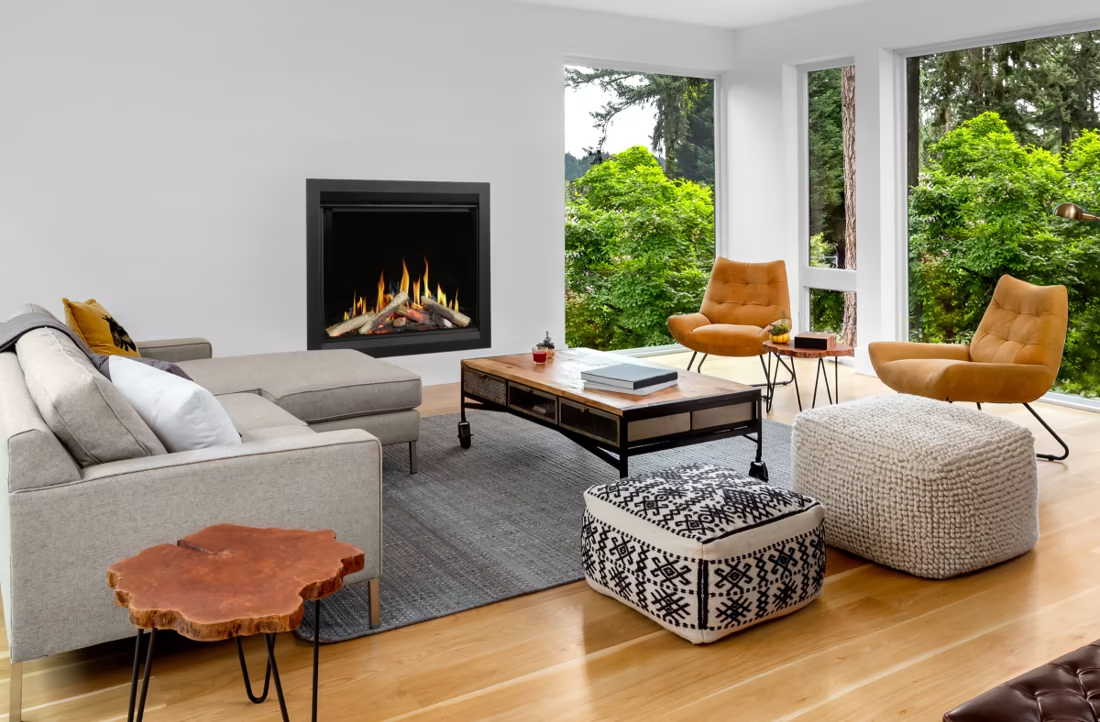
Electric fireplaces fill a different, very real need: supplemental warmth in a home office or bonus room, ambiance in a living room without a chimney, or a safe, no-venting heat source for a nursery or in-law suite. Winder is split between two electric providers—Georgia Power and Jackson Electric Membership Corporation—with residential rates around $0.1549/kWh and $0.1138/kWh respectively, so which side of a Jackson EMC service line your home falls on actually affects what an electric fireplace costs to run night after night. No chimney, no gas line, no combustion byproducts—just plug in or wire in and go.
Three steps. No salesperson until you're ready.
Tell us about your project
Your zip code, your situation, and the fuel you're leaning toward—or let the answers point you to one.
See what's actually available
The brands dealers within 100 miles genuinely carry—real options, never a catalog mirage.
Get your dealer & Project Guide
A trusted local dealer, plus the free Project Guide & Parts List that names every component of the job.
Frequently Asked Questions
How much does it cost to install an electric fireplace in Winder?
A plug-in electric insert or freestanding unit can be as simple as $200-$800 installed, since many models just need a standard 120V outlet already in the wall. Built-in wall units or mantel packages that require a dedicated circuit, in-wall wiring, or a mantel surround typically run $1,200-$3,500 including electrician labor. If you're converting an existing masonry fireplace opening to an electric insert, expect $800-$2,000 depending on the insert size and whether the old firebox needs any framing or trim work to accept it. A local dealer can tell you in one visit whether your existing outlet or panel capacity works or whether you'll need an electrician for a new circuit.
Does an electric fireplace make sense given how mild Winder's winters are?
Yes—arguably more sense than in a colder climate. With Winder's winter heating need adding up to only about 2,931 on that same standard scale, most homes don't need a dedicated whole-room heat source; they need something for the handful of nights that dip near freezing and for ambiance the rest of the year. Electric fireplaces are built for exactly that supplemental role—instant heat at the flip of a switch, no standing pilot, no fuel to store. Compare that to a place like Bozeman, MT, where a household might run a wood stove nightly for five months; in Winder, an electric unit gets used heavily maybe six to eight weeks a year and purely for ambiance the rest of the time.
How much does it cost to run an electric fireplace with Georgia Power versus Jackson EMC?
Most electric fireplace inserts draw around 1,500 watts on the heat setting (1.5 kWh per hour) and far less—often under 100 watts—running flame-effect only with the heater off. At Georgia Power's residential rate of roughly $0.1549/kWh, an hour of heater use costs about 23 cents. At Jackson EMC's rate of roughly $0.1138/kWh, that same hour runs closer to 17 cents. Over a typical Winder cold spell—a few hours a night for a week or two—the difference between providers is real but modest, usually a few dollars either way.
Do I need a permit to install an electric fireplace in Winder?
A simple plug-in unit that uses an existing outlet generally doesn't trigger a permit. But if your installer is running a new dedicated circuit, adding an outlet inside a mantel surround, or doing any panel work, that's electrical work that falls under Barrow County's building and electrical permitting process, and it should be pulled by a licensed electrician. Most local hearth and electrical retailers who install built-in units handle this as part of the job, so you typically don't have to coordinate it yourself.
Should I get an electric insert, a wall-mounted unit, or a mantel package?
It depends on the room and whether you already have a fireplace opening. Homes with an existing masonry or builder-grade fireplace box are usually best served by an electric insert, which slides into the opening and uses the existing mantel and surround. Rooms with no fireplace at all—a bonus room, home office, or primary bedroom—are good candidates for a wall-mounted linear unit, which mounts flush and needs only shallow depth, or a mantel package if you want a more traditional look. A local dealer walking your specific room will steer you toward the right footprint and heat output for the space.
Electric or gas—which is the better fit for a Winder home?
Gas is standard in this area too and makes sense for homeowners who want real, consistent heat output and are willing to run a gas line or use propane. Electric is the simpler, lower-cost path: no venting, no gas line, no annual gas-appliance service call, and it can go in almost any room since it just needs power. Given Winder's mild winter demand, a lot of homeowners choose electric for secondary rooms and save gas for a primary living space where they want a fireplace to function as genuine everyday heat. Both are reasonable choices here—it comes down to how much heat output you actually need versus how much simplicity you want.
What about a wood-burning fireplace instead—is that an option in Winder?
It's an option, but it's genuinely uncommon here as a heating decision rather than a purely aesthetic one. Winder's mild Piedmont climate, with average winter lows around 32°F, doesn't generate the heating demand that makes wood a practical primary or supplemental fuel the way it is farther north. Local oak, pine, and hickory are all available if a homeowner wants a wood-burning fireplace for occasional ambiance or a rustic look, but most Winder households choosing a heat source for actual warmth land on electric or gas instead, since neither requires firewood storage, chimney sweeping, or seasoning time.
How much maintenance does an electric fireplace actually need?
Very little, which is part of the appeal. There's no chimney to sweep and no gas line to inspect. Periodically wipe dust off the heater's intake and exhaust vents so the fan doesn't work harder than it needs to, and check that the flame-effect LED bulbs are functioning—most last 15,000-25,000 hours before needing replacement, which for typical use is many years. If the blower starts making noise or the heat output drops off, that's usually a sign the internal fan needs cleaning or the heating element needs a service check, which a local dealer can handle.
What size electric fireplace do I need for my room?
Electric fireplace heaters are typically rated for spaces up to about 400-1,000 square feet, but in Winder most homeowners aren't asking the unit to heat that much space—it's supplementing central HVAC in a single room. For a bedroom or home office, a smaller 26-40 inch insert or wall unit with a 1,500-watt heater is plenty. For an open living or great room where you want more visual presence and some real heat contribution on cold nights, a 50-60 inch linear unit gives better coverage. A local dealer can match wattage and unit width to your actual room rather than relying on the manufacturer's maximum-square-footage claim, which tends to run optimistic.
Do electric fireplaces actually produce heat?
Yes—most put out around 4,800–5,000 BTUs from a standard outlet, which comfortably warms a bedroom, office, or den as a comfort-zone heater. What they won't do is carry a whole house the way wood, gas, or pellet can. Think of electric as ambiance-first with honest supplemental heat: flames on with no heat in July, flames plus warmth in January.
Can I put a TV above my fireplace?
Yes—with an asterisk. Fireplaces are hot and TVs don't like heat. Either put a mantel between them to deflect rising warmth, or choose a fireplace with heat-management technology that creates a cool zone on the wall above—the wall stays around 125 degrees, barely warm, while the room still gets full heat. If you like clean lines and don't want a mantel, heat management is the answer.
Can a fireplace actually lower my heating bill?
Yes—by creating a comfort zone. A furnace heats every square foot of the house just to warm the one room you're in; a gas fireplace on low burns roughly a sixth of the gas a typical furnace does. Set the furnace around 55–60 degrees as a baseline, then heat the rooms your family actually uses. Families who heat this way commonly save $20–$60 a month.
How much should I budget for a fireplace?
For an average home—covering the fireplace, the vent pipe, and basic installation—a budget between $3,900 and $5,500 gives you a lot of options across wood, gas, and pellet. By the time you add finish work, gas line, and electrical, the average complete installation lands between $5,000 and $12,000 all-in. In a remodel or new build, a good rule is to put about 2.5% of the total project cost toward the fireplace.
Nearby Dealers
Hearth shops serving Winder and the surrounding area. Every listing shows whether it is a WhyFire partner, a dealer we have verified as authorized for the brands we recommend, or a local business carrying hearth products. No manufacturer pays for placement. How we verify dealers →
We’ve paused dealer listings for this connection today. Enter your zip or postal code above to find dealers near you, or come back tomorrow.
Popular Electric Brands
Where each brand came from, what's inside it today, and every current model. No brand pays to be here. Not every dealer carries every brand, so enter your zip code to see what's sold near Winder.
Fireplace Xtrordinair
Fireplace Xtrordinair, now often called FireplaceX, is the fireplace brand of Travis Industries, Inc., of Mukilteo, Washington.
5 electric models →DaVinci
DaVinci Custom Fireplaces is a brand of Travis Industries, Inc., of Mukilteo, Washington, the company behind Lopi and Fireplace Xtrordinair.
5 electric models →Kozy Heat
Kozy Heat was founded in 1976 by Dudley Hussong in Lakefield, Minnesota, and incorporated as Hussong Manufacturing Co., Inc. in 1978.
3 electric models →Forge & Flame
Forge & Flame is the stove brand Hearth & Home Technologies introduced in August 2023 to bring Vermont Castings, Harman, and Quadra-Fire under one name.
1 electric model →Electric Service in Winder
An electric fireplace's heater draws about 1,500 watts—pennies per hour at local rates.
Georgia Power Co
Jackson Electric Member Corp - (Ga)
Find your electric fireplace in Winder.
Tell us a bit about your home and we'll help you find the right electric fireplace, insert, or wall unit—plus a free Project Guide & Parts List and a trusted local dealer to install it.
Find Your Fireplace →