
Real flame look, zero chimney work, in Washington, GA.
Electric heat built for Wilkes County's mild Piedmont winters and historic homes. Find the right unit and connect with a trusted local dealer.
Every Project Starts From One of These Five Situations
Mild winters, historic mantels, simple heat.
Washington sits in Zone 3A at just 607 feet of elevation, and winters here are genuinely mild—average lows around 34°F and a heating season that's just a fraction of what a town like Bozeman, MT or Burlington, VT deals with. That changes the math on hearth heat: most Wilkes County homes don't need a wood-burning primary heat source or a new gas line, they need supplemental warmth and ambiance in the rooms people actually live in. Electric delivers that without a chimney, without venting, and without a burn permit.
Washington's downtown and surrounding county are full of Greek Revival and antebellum homes with original masonry fireboxes that haven't drawn a real fire in decades—often because the flue is capped, cracked, or was never meant for daily use. An electric insert drops into that existing opening and gives the mantel a working fire again with no chimney inspection required. Power here comes from a mix of Georgia Power, Rayle Electric Membership Corporation, and the City of Washington's own municipal utility, with residential rates running from about 14.4 to 16.1 cents per kWh depending on which one serves your address—worth knowing before you compare running costs between units.
Three steps. No salesperson until you're ready.
Tell us about your project
Your zip code, your situation, and the fuel you're leaning toward—or let the answers point you to one.
See what's actually available
The brands dealers within 100 miles genuinely carry—real options, never a catalog mirage.
Get your dealer & Project Guide
A trusted local dealer, plus the free Project Guide & Parts List that names every component of the job.
Frequently Asked Questions
How much does it cost to install an electric fireplace in Washington, GA?
A plug-in electric insert or freestanding unit is the cheapest path—often $300 to $900 installed, since most just need an existing outlet and a local carpenter to trim it into a mantel or cabinet opening. A built-in linear electric fireplace or a unit drawing more than 1,500 watts typically needs a dedicated 20-amp circuit, which means an electrician's visit and pushes total cost to roughly $1,200 to $3,500 depending on wall framing and how far the panel is from the install location. Because there's no venting, flue, or gas line involved, electric is consistently the least expensive hearth upgrade available in Wilkes County.
Can I put an electric insert into my home's original fireplace?
In most cases, yes—and it's one of the more common projects for Washington's older homes. Many of the antebellum and Greek Revival houses around the historic district have masonry fireboxes with flues that are capped, deteriorated, or simply not rated for wood burning anymore. An electric insert sized to the opening slides in without disturbing the chimney or masonry, so you keep the original mantel and surround while getting real heat and a flame effect. A local dealer can measure your firebox opening and match an insert to it—sizing matters more here than with a drop-in furnace, since fireboxes in older homes vary widely.
Do I need a permit to install an electric fireplace in Washington?
A simple plug-in unit generally doesn't require a permit. If your installer needs to run a new dedicated circuit or breaker for a hardwired built-in unit, that electrical work typically requires a permit through the Wilkes County Building Department, and it needs to be pulled by a licensed electrician. If your home is inside Washington's historic district, exterior-visible changes (like a new vent cap, which electric units don't need) would trigger design review—but since electric fireplaces vent nothing to the outside, this is rarely an issue, which is part of why they're popular for historic mantels here.
Which electric utility affects my fireplace's running cost—Georgia Power, Rayle EMC, or the City of Washington?
It depends on your address. In-town customers are typically served by the City of Washington's municipal electric system, while homes outside city limits are more likely served by Rayle Electric Membership Corporation or Georgia Power. Rates among the three currently range from about 14.4 to 16.1 cents per kWh, so the same fireplace can cost a bit more or less to run depending on which utility serves your meter. It's a small difference per hour, but worth checking your bill before comparing units, especially if you're deciding between a 1,500-watt insert and a larger heater-equipped model.
How much does it cost to run an electric fireplace in Wilkes County?
Most electric fireplaces run a 1,500-watt heater on the highest setting, which costs roughly 21 to 24 cents an hour to operate at local rates (about 14.4 to 16.1 cents per kWh across Georgia Power, Rayle EMC, and the City of Washington). Used a few hours an evening on the flame-only setting with the heater off, the cost drops to just a cent or two an hour, since the LED flame effect draws very little power. Given Washington's mild winters—average lows only around 34°F—most homeowners run the heater intermittently rather than continuously, which keeps monthly operating costs modest.
Is electric heat enough, or should I consider wood or gas instead?
For most Washington homes, electric is plenty. With a fairly short, mild heating season and winter lows averaging in the mid-30s, this isn't a climate that demands a 20-hour-burn wood stove or a whole-house gas furnace backup—most homes here already lean on central heat pumps for the bulk of their heating, with the fireplace supplying zone heat and ambiance in the room people use most. Wood remains popular for backyard fire pits and homes with access to local oak, pine, or hickory, and gas is an option where a line is already run to the house. But if your goal is a low-maintenance, no-venting upgrade to an existing mantel, electric is usually the simplest and cheapest fit for this climate.
What size electric fireplace do I need?
Sizing an electric fireplace is mostly about the opening you're filling and the room you want to heat, not BTU output for whole-home heating—even the largest units are only rated to heat about 400 to 1,000 square feet as supplemental warmth. For a mantel insert, measure your existing firebox opening (width, height, depth) since inserts come in standard sizes to match older masonry openings common in Washington's historic homes. For a built-in linear unit in a new wall or media console, sizing is driven by the width of the space and the look you want rather than heat output. A local dealer can walk through both with you before you buy.
How much maintenance does an electric fireplace need?
Very little—this is one of the biggest advantages over wood or gas. There's no chimney to sweep, no annual gas line inspection, and no ash or soot to manage. Maintenance is mostly dusting the glass front, occasionally cleaning the fan or heater vents to keep airflow clear, and replacing the LED flame bulbs every several years once they dim (most last 20,000+ hours). There's no seasonal service call required, and no local chimney sweep or gas technician needed—which is part of why electric is a popular low-hassle choice for second homes and rental properties around Wilkes County.
What's the best time of year to install an electric fireplace in Washington?
Because there's no venting or masonry work involved, electric fireplaces can be installed any time of year without weather-dependent scheduling—unlike a wood chimney installation, which installers prefer to finish before the first cold snap. That said, local dealers and electricians tend to see a rush of requests in October and November as people start thinking about heating season, so booking in late summer or early fall usually means a shorter wait for both the unit and any electrical work needed for a hardwired install.
Can I put a TV above my fireplace?
Yes—with an asterisk. Fireplaces are hot and TVs don't like heat. Either put a mantel between them to deflect rising warmth, or choose a fireplace with heat-management technology that creates a cool zone on the wall above—the wall stays around 125 degrees, barely warm, while the room still gets full heat. If you like clean lines and don't want a mantel, heat management is the answer.
Does an electric fireplace need a vent or chimney?
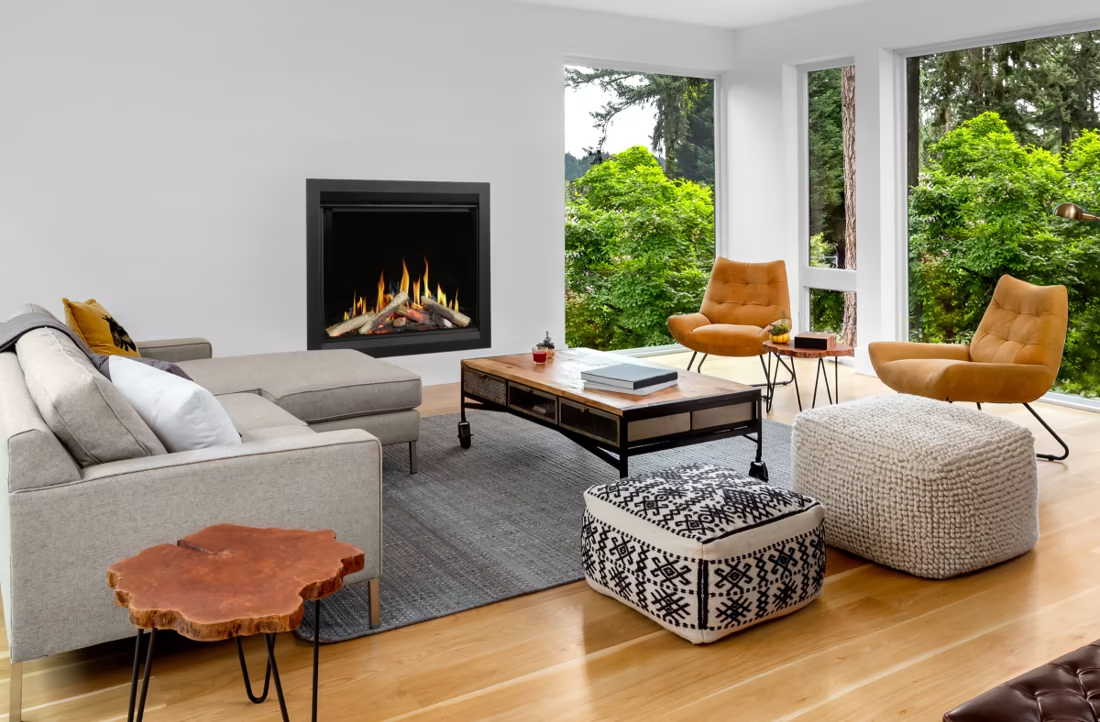
No—that's its superpower. An electric fireplace needs a wall and an outlet, period. No vent pipe, no gas line, no clearances to design around, which is why it works in bedrooms, offices, apartments, and walls where venting a gas or wood unit would be impractical or impossible. Installation is typically the simplest and least expensive of any fireplace type.
Can I install a fireplace myself?
If you're putting a fire in your house on purpose, it's best to work with an expert. Unless you're genuinely experienced in framing, gas line, vent pipe, and the national code on clearances to combustibles, have a professional do it—and ideally the same company that sells you the fireplace, so warranty, service, and liability all live under one roof.
What is an in-home preview and do I need one?
It's a visit where a hearth professional measures your space, confirms the model you picked actually works in your home, and walks the specs—framing, gas line, venting, finish work—before anything is ordered. Some details you just can't know until you see the house. Never make a down payment without one; it's the single most-skipped step that burns buyers.
Nearby Dealers
Hearth shops serving Washington and the surrounding area. Every listing shows whether it is a WhyFire partner, a dealer we have verified as authorized for the brands we recommend, or a local business carrying hearth products. No manufacturer pays for placement. How we verify dealers →
We’ve paused dealer listings for this connection today. Enter your zip or postal code above to find dealers near you, or come back tomorrow.
Popular Electric Brands
Where each brand came from, what's inside it today, and every current model. No brand pays to be here. Not every dealer carries every brand, so enter your zip code to see what's sold near Washington.
Fireplace Xtrordinair
Fireplace Xtrordinair, now often called FireplaceX, is the fireplace brand of Travis Industries, Inc., of Mukilteo, Washington.
5 electric models →DaVinci
DaVinci Custom Fireplaces is a brand of Travis Industries, Inc., of Mukilteo, Washington, the company behind Lopi and Fireplace Xtrordinair.
5 electric models →Kozy Heat
Kozy Heat was founded in 1976 by Dudley Hussong in Lakefield, Minnesota, and incorporated as Hussong Manufacturing Co., Inc. in 1978.
3 electric models →Forge & Flame
Forge & Flame is the stove brand Hearth & Home Technologies introduced in August 2023 to bring Vermont Castings, Harman, and Quadra-Fire under one name.
1 electric model →Electric Service in Washington
An electric fireplace's heater draws about 1,500 watts—pennies per hour at local rates.
Georgia Power Co
Rayle Electric Membership Corp
City Of Washington - (Ga)
Find your electric fireplace in Washington, GA.
Tell us a bit about your home and we'll put together a free Project Guide & Parts List for your electric fireplace project—sized to your firebox or wall, matched to your circuit needs, and paired with a trusted local dealer.
Find Your Fireplace →