
Instant, No-Vent Heat for Pike County Homes.
With mild Piedmont winters and no chimney required, electric fireplaces are an easy fit for homes from Zebulon to Molena, Meansville, and Concord. Find the right unit and connect with a trusted local dealer.
Every Project Starts From One of These Five Situations
Electric heat that fits into any room, any budget.
Pike County sits in Georgia's climate zone 3A, a mixed-humid zone where the average winter low hovers around 34 degrees and the county sees a short, mild heating season—a fraction of what a place like Duluth, MN sees in a single hard month. That mild profile is exactly why electric fireplaces have become such a common choice here. Most Pike County homes, whether a farmhouse outside Molena or a newer build near Zebulon, don't need a whole-house wood or gas heating appliance. They need supplemental warmth and ambiance for a den, a sunroom addition, or a bedroom, and electric delivers that without a flue, a gas line, or a chimney sweep.
Because electric units plug into existing household current or tie into a standard 120V or 240V circuit, they're often the fastest and least invasive project a Pike County homeowner can take on—no masonry work, no venting path to plan around old farmhouse framing in Meansville or Williamson. Power in the county runs through Central Georgia EMC and Georgia Power, and most electric fireplace inserts and linear units draw a manageable load comparable to a space heater. The tradeoff is worth knowing upfront: electric fireplaces need power to run, so they're an ambiance-and-comfort choice rather than a storm-outage backup—a distinction that matters if you're weighing electric against a wood or gas option for the same room.
Three steps. No salesperson until you're ready.
Tell us about your project
Your zip code, your situation, and the fuel you're leaning toward—or let the answers point you to one.
See what's actually available
The brands dealers within 100 miles genuinely carry—real options, never a catalog mirage.
Get your dealer & Project Guide
A trusted local dealer, plus the free Project Guide & Parts List that names every component of the job.
Frequently Asked Questions
How much does an electric fireplace installation cost in Pike County?
Plug-in wall-mount or freestanding electric units are the least expensive option, often $300 to $900 installed, since many simply plug into an existing outlet with no electrical work required. Built-in linear electric fireplaces or inserts that require dedicated 120V or 240V wiring run higher, typically $1,200 to $2,500, once a licensed electrician runs a new circuit and a carpenter frames the surround. Converting an existing masonry fireplace to an electric insert generally falls in the $800 to $1,800 range depending on the insert size and whether the old damper and firebox need modification. Local dealers serving Pike County will size the job during an in-home look at your electrical panel and the room.
Do I need a permit to install an electric fireplace in Pike County?
It depends on the unit. A plug-in electric fireplace that uses an existing outlet typically doesn't require a permit since no new wiring is involved. A built-in or hardwired unit that needs a dedicated circuit does require an electrical permit through the Pike County Building & Development Department in Zebulon, and the work should be done by a licensed electrician. Most hearth dealers who install built-in electric fireplaces coordinate the electrical permit and inspection as part of the job, so you're not left tracking down the paperwork yourself.
What size electric fireplace do I need for my room?
Electric fireplaces are sized more by room dimensions and viewing preference than by BTU output for whole-home heating, since most units in Pike County are used as zone heat or ambiance rather than a primary furnace replacement. As a rough guide, a 30 to 40 inch linear unit heats a bedroom or den-sized space, while a 50 to 60 inch model suits a larger living room or open-concept space common in newer Pike County construction. Given the county's mild winters and short heating season, most homeowners don't need to oversize for extreme cold the way a colder climate would—the bigger decision is usually how the unit looks on the wall and whether it needs to visually anchor the room.
What's the difference between an electric insert and a built-in electric fireplace?
An electric insert is designed to slide into an existing masonry fireplace opening, which makes it a popular option for older Pike County farmhouses around Molena and Concord that have a fireplace but no interest in dealing with wood or a gas line retrofit. A built-in electric fireplace is a self-contained unit designed to be framed into a wall from scratch, which works well for additions, sunrooms, or new construction where there's no existing firebox. Both plug in or hardwire depending on the model and wattage, and neither requires venting of any kind.
Will my electric fireplace work during a power outage?
No—electric fireplaces require power to run the heating element, flame effect, and blower, so they go dark along with everything else on the circuit during an outage. This is the main tradeoff against wood or gas in Pike County: a wood stove keeps working when Central Georgia EMC or Georgia Power lines go down after a storm, while an electric unit doesn't. For most Pike County homeowners this isn't a dealbreaker since the county's mild winters (average low around 34 degrees) rarely create emergency heating situations, but if backup heat during outages is a priority, it's worth discussing a wood or gas option for at least one room alongside the electric installation elsewhere in the house.
How much does it cost to run an electric fireplace in Pike County?
Most electric fireplaces draw between 750 and 1,500 watts on the heat setting, and running one for several hours an evening typically adds a modest amount to a Central Georgia EMC or Georgia Power bill—often less than $20 to $30 a month for regular evening use, well below what heating an equivalent space with central HVAC would cost. Because Pike County's mixed-humid climate rarely demands sustained round-the-clock heating, most homeowners run electric fireplaces on the flame-only setting for ambiance and switch on the heater element only on the occasional colder night, which keeps the running cost low.
Electric vs. gas vs. wood—which is right for my Pike County home?
Wood offers the most heat output and works without power, which appeals to homeowners on larger rural Pike County lots with access to oak, pine, or hickory for burning. Gas offers instant, consistent heat and can be set up with battery-backup ignition for outage resilience, but it requires either a natural gas line or a propane tank. Electric is the simplest and least expensive to install, needs no venting or fuel supply, and is ideal for supplemental heat in a den, bedroom, or converted fireplace opening—but it depends entirely on grid power and costs the most per BTU to run. Many Pike County homes end up with a mix: wood or gas in a main living space, electric in a secondary room or fireplace conversion where simplicity matters more than raw heat output.
Can I put an electric insert into my existing wood-burning fireplace?
Yes, and it's one of the more common projects for older homes around Zebulon, Meansville, and Williamson that have a masonry fireplace they no longer use for wood. The chimney stays in place (or can be capped), and the electric insert sits directly in the firebox opening, plugging into a nearby outlet or, for larger units, a dedicated circuit run by an electrician. This route preserves the mantel and surround you already have while eliminating ash cleanup, wood storage, and chimney maintenance entirely.
How much maintenance does an electric fireplace need?
Very little, which is part of the appeal in a low-humidity-swing, mild climate like Pike County's. There's no chimney to sweep, no gas lines to inspect, and no combustion byproducts to worry about. Maintenance is mostly limited to occasionally dusting the heating element and blower vents and replacing an LED light module every several years if the flame effect dims. Most electric fireplaces carry a manufacturer warranty of 2 to 5 years on parts, and local dealers can handle any repairs that fall outside simple homeowner upkeep.
Can I put a TV above my fireplace?
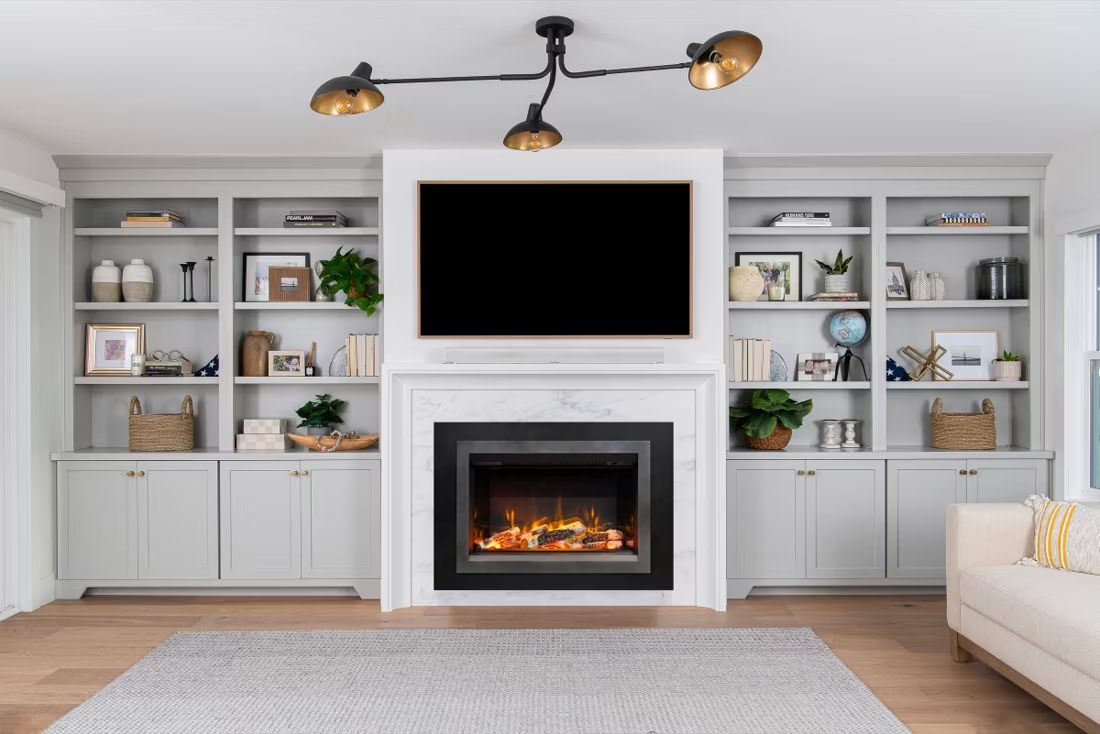
Yes—with an asterisk. Fireplaces are hot and TVs don't like heat. Either put a mantel between them to deflect rising warmth, or choose a fireplace with heat-management technology that creates a cool zone on the wall above—the wall stays around 125 degrees, barely warm, while the room still gets full heat. If you like clean lines and don't want a mantel, heat management is the answer.
Does an electric fireplace need a vent or chimney?
No—that's its superpower. An electric fireplace needs a wall and an outlet, period. No vent pipe, no gas line, no clearances to design around, which is why it works in bedrooms, offices, apartments, and walls where venting a gas or wood unit would be impractical or impossible. Installation is typically the simplest and least expensive of any fireplace type.
How much should I budget for a fireplace?
For an average home—covering the fireplace, the vent pipe, and basic installation—a budget between $3,900 and $5,500 gives you a lot of options across wood, gas, and pellet. By the time you add finish work, gas line, and electrical, the average complete installation lands between $5,000 and $12,000 all-in. In a remodel or new build, a good rule is to put about 2.5% of the total project cost toward the fireplace.
Can a fireplace actually lower my heating bill?
Yes—by creating a comfort zone. A furnace heats every square foot of the house just to warm the one room you're in; a gas fireplace on low burns roughly a sixth of the gas a typical furnace does. Set the furnace around 55–60 degrees as a baseline, then heat the rooms your family actually uses. Families who heat this way commonly save $20–$60 a month.
Find your electric fireplace in Pike County.
Tell us a bit about your home and we'll match you with the right electric fireplace or insert—plus a free Project Guide & Parts List and a trusted local dealer to install it.
Find Your Fireplace →