
No chimney, no wood pile—just heat you control.
For Glascock County's mild Zone 3A winters, an electric fireplace or insert delivers ambiance and supplemental warmth without a chimney, a wood pile, or a permit fight. Find the right unit and connect with a trusted local dealer.
Every Project Starts From One of These Five Situations
Mild winters make electric the practical choice.
Glascock County is one of Georgia's smallest counties by population—roughly 1,044 people spread across Gibson and the surrounding farmland and pine woods. Winters here fall in climate zone 3A: humid, hot summers and short, mild cold seasons where hard freezes happen but sustained bitter cold does not. That's a very different heating problem than a place like Burlington, VT, where the furnace runs nonstop for months. In Glascock County, most homes need supplemental warmth for a handful of cold snaps a year, not a primary heat source that has to carry the whole winter.
Plenty of homes in the county still burn oak, pine, and hickory in a wood stove or open fireplace, especially on older farmsteads. But for a bedroom addition, a mobile or manufactured home, a sunroom, or a house that never had a chimney to begin with, an electric fireplace is often the simpler answer—no venting, no combustion byproducts, and none of the emissions concerns that show up elsewhere (Glascock County has no listed air quality non-attainment issues, so there's no local burn-ban or inversion advisory to work around). Power comes from Central Georgia EMC in most of the county, and running an electric unit for a few hours on a cold evening costs a fraction of firing up a whole-house system.
Three steps. No salesperson until you're ready.
Tell us about your project
Your zip code, your situation, and the fuel you're leaning toward—or let the answers point you to one.
See what's actually available
The brands dealers within 100 miles genuinely carry—real options, never a catalog mirage.
Get your dealer & Project Guide
A trusted local dealer, plus the free Project Guide & Parts List that names every component of the job.
Frequently Asked Questions
How much does an electric fireplace installation cost in Glascock County?
Costs vary a lot by unit type. A plug-in electric insert or freestanding stove that just needs a standard outlet typically runs $150 to $600 installed, since there's no venting or gas line to deal with. A built-in wall unit or a larger insert that requires a dedicated 240-volt circuit and some electrical work generally lands between $800 and $2,500, depending on how far the panel is from the install location and whether an electrician needs to open up drywall. Because Glascock County is rural and small, expect most retailers serving the area to be based out of Sandersville, Louisville, or Augusta, with a modest travel charge for installs out toward Gibson or Edgehill.
Do I need a permit to install an electric fireplace in Glascock County?
A simple plug-in insert or freestanding electric stove usually doesn't require a permit, since it's treated like any other appliance plugged into an existing outlet. If your install involves running a new dedicated circuit, adding a breaker, or any structural work to build in a wall unit, that crosses into electrical permit territory, and you'd go through Glascock County's building office (or Gibson's town hall if the property sits within city limits). Because the county is small, permit review tends to be quick, but it's still worth confirming before work starts—most licensed electricians pulling permits in the area will handle that step for you.
Will an electric fireplace still work if the power goes out?
No—and this matters more in rural Glascock County than in a city with buried lines. Electric fireplaces run entirely on grid power, so an ice storm or a downed line during a summer thunderstorm will take yours offline along with everything else in the house. If backup heat during outages is a priority, many county homeowners pair an electric fireplace (for daily convenience and ambiance) with a wood stove or a generator hookup for the occasional multi-day outage. It's a fair tradeoff for a county where hard freezes are the exception, not the rule.
What's the difference between an electric fireplace, insert, and stove?
An electric fireplace is usually a built-in unit set into a wall or a mantel surround, made for a finished look in a main living space. An electric insert is sized to slide into an existing masonry firebox, which is useful if a house in the county has an old wood fireplace that's no longer used or wanted for burning. An electric stove is a freestanding cabinet-style unit that sits on the floor and can go almost anywhere there's an outlet—a good fit for additions, sunrooms, or manufactured homes without a fireplace at all. For most Glascock County homes without an existing masonry fireplace, a freestanding stove or a built-in wall unit is the simpler starting point.
Is electric heat really practical for Glascock County's climate?
Yes, and it's a reasonable fit precisely because the climate is mild. Zone 3A means Glascock County sees short cold spells rather than the months-long deep freeze you'd find in a place like Fargo, ND or Duluth, MN, where an electric fireplace alone wouldn't come close to covering winter heating needs. Here, most homes rely on a heat pump or central system as the primary source and want something for the coldest nights or for a room the main system doesn't reach well—exactly the job an electric fireplace is built for. It's not meant to replace a furnace in a genuinely cold climate; it's meant to add heat and ambiance where the county's actual winters call for it.
What kind of electric fireplace works best for a Glascock County home?
For most homes in the county, a mid-size wall-mounted or built-in unit with a 4,000–5,000 BTU heater setting covers a single room comfortably without overheating it—useful since Glascock County rarely needs sustained high-output heat. For manufactured or mobile homes, which are common in the rural parts of the county, a freestanding electric stove is often easier to install than a built-in unit since it doesn't require cutting into the wall structure. If the goal is mostly ambiance with occasional supplemental warmth, look for a model with a heater you can turn off independently of the flame effect—that way you're not stuck choosing between no fire and a hot room in July.
How much does it cost to run an electric fireplace in Glascock County?
Running costs depend on your electric rate through Central Georgia EMC, but as a rough guide, a typical 1,500-watt electric fireplace heater costs somewhere around 15 to 25 cents an hour to run on the heater setting, and closer to a penny or two an hour if you're just running the flame effect without heat. For a county where cold spells tend to be short, that makes electric heat cheap to operate compared to running a whole-house system harder than it needs to for a few chilly evenings.
Electric vs. gas fireplace—which makes more sense in Glascock County?
Gas fireplaces put out more heat and can serve as a legitimate backup source during a power outage if they have battery-backup ignition, but they need either a natural gas line (uncommon in this rural stretch of the county) or a propane tank, plus venting work. Electric fireplaces skip all of that—no gas line, no venting, no propane delivery to schedule—in exchange for less heat output and a full dependence on grid power. For a small, mild-winter county like Glascock where most homes already lean on propane for water heating or cooking, either path is workable; electric tends to win for the simplicity of the install, gas tends to win for households that want a real emergency heat source.
How do I find a dealer who installs electric fireplaces near Gibson?
Find My Fireplace isn't a retailer or a manufacturer—I match Glascock County homeowners with a trusted local dealer who actually installs in this area, whether that's a hearth shop out of Sandersville, Louisville, or Augusta covering the Gibson and Edgehill area. Given how small the county is, most retailers serving it cover a wide radius, so getting matched with someone who already knows the local building office and electrical requirements saves a lot of back-and-forth compared to guessing at a big-box store.
Can I put a TV above my fireplace?
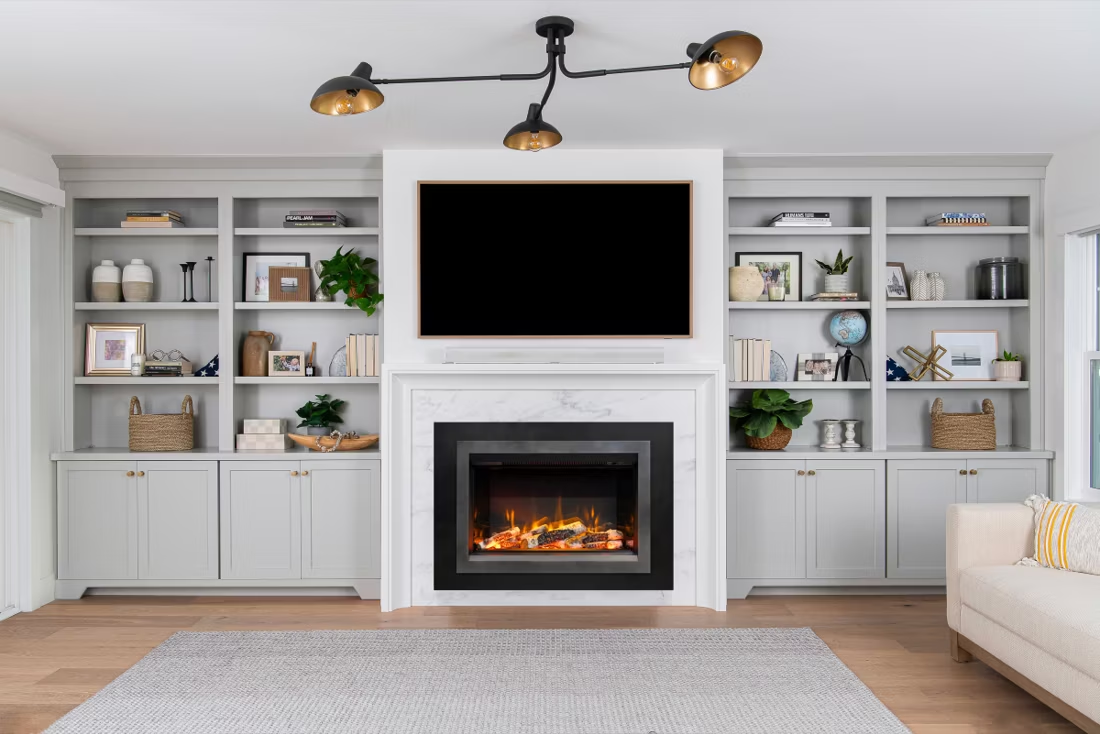
Yes—with an asterisk. Fireplaces are hot and TVs don't like heat. Either put a mantel between them to deflect rising warmth, or choose a fireplace with heat-management technology that creates a cool zone on the wall above—the wall stays around 125 degrees, barely warm, while the room still gets full heat. If you like clean lines and don't want a mantel, heat management is the answer.
Does an electric fireplace need a vent or chimney?
No—that's its superpower. An electric fireplace needs a wall and an outlet, period. No vent pipe, no gas line, no clearances to design around, which is why it works in bedrooms, offices, apartments, and walls where venting a gas or wood unit would be impractical or impossible. Installation is typically the simplest and least expensive of any fireplace type.
Can a fireplace actually lower my heating bill?
Yes—by creating a comfort zone. A furnace heats every square foot of the house just to warm the one room you're in; a gas fireplace on low burns roughly a sixth of the gas a typical furnace does. Set the furnace around 55–60 degrees as a baseline, then heat the rooms your family actually uses. Families who heat this way commonly save $20–$60 a month.
How much should I budget for a fireplace?
For an average home—covering the fireplace, the vent pipe, and basic installation—a budget between $3,900 and $5,500 gives you a lot of options across wood, gas, and pellet. By the time you add finish work, gas line, and electrical, the average complete installation lands between $5,000 and $12,000 all-in. In a remodel or new build, a good rule is to put about 2.5% of the total project cost toward the fireplace.
Find your electric fireplace in Glascock County.
Tell me a bit about your home and I'll match you with a trusted local dealer and send over a free Project Guide & Parts List—the exact parts for your electric fireplace project in Glascock County, including any electrical work, and the dealer I'd recommend for the install.
Find Your Fireplace →