
Warmth on Demand for South Florida's Short Cool Season.
No chimney, no gas line, no venting—just a real-looking flame that suits Wellington's equestrian estates and mild winters. Find the right unit and connect with a trusted local dealer.
Every Project Starts From One of These Five Situations
Ambiance first, heat second—and that's exactly right here.
Wellington sits at just 15 feet of elevation in Palm Beach County, in climate zone 2A, where heating degree days total around 230 for the entire year—among the lowest of any U.S. city, and a fraction of what a place like Duluth, MN sees in a single hard month. Winter lows average 56 degrees. Nobody here is heating a home through a January cold snap the way a Midwest or Mountain West family does. What Wellington does have is a booming equestrian real estate market—the Winter Equestrian Festival and Wellington International draw estate buyers who want a fireplace as a design centerpiece in a formal living room, den, or barn office, not as survival infrastructure.
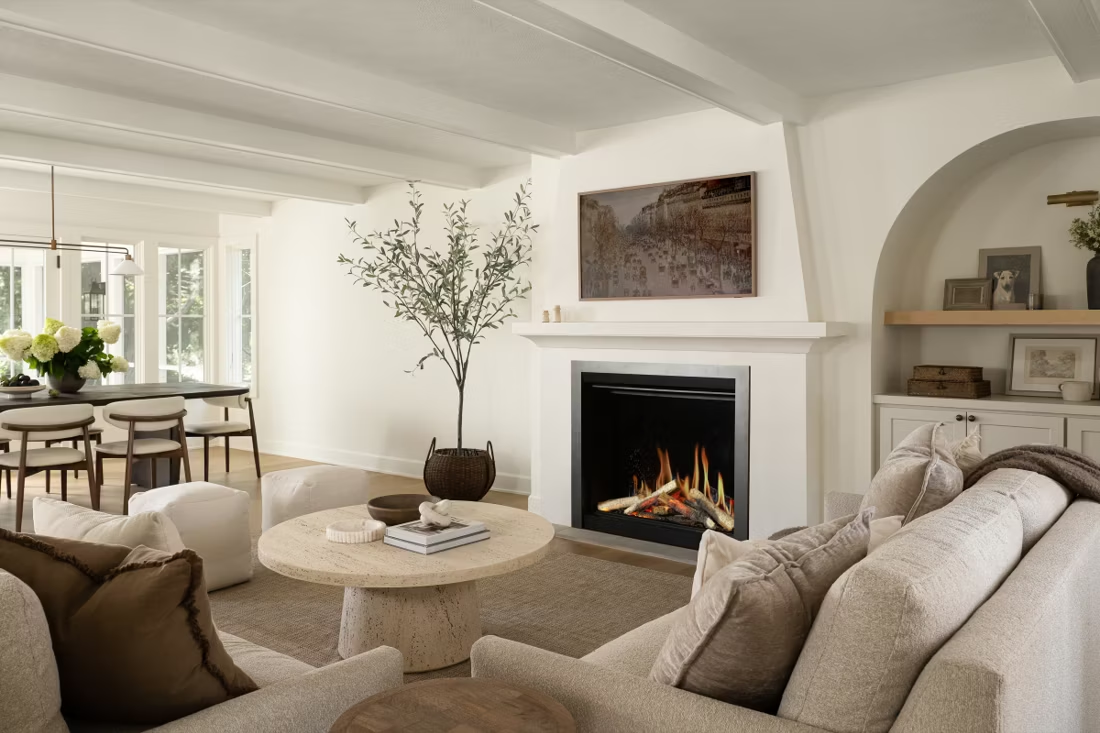
That's exactly the environment electric fireplaces are built for. A wall-mounted linear unit or a media-console insert delivers a convincing flame—many now use LED and water-vapor ("Opti-myst") technology—with the heating element switched off entirely for ten months of the year and switched on for the occasional 45-degree evening. Florida Power & Light serves virtually every home in Wellington, and at roughly $0.1371 per kWh, running a 1,500-watt electric insert costs about 21 cents an hour—cheap enough that homeowners don't think twice about running the flame effect alone for ambiance during a dinner party in July.
Three steps. No salesperson until you're ready.
Tell us about your project
Your zip code, your situation, and the fuel you're leaning toward—or let the answers point you to one.
See what's actually available
The brands dealers within 100 miles genuinely carry—real options, never a catalog mirage.
Get your dealer & Project Guide
A trusted local dealer, plus the free Project Guide & Parts List that names every component of the job.
Frequently Asked Questions
How much does an electric fireplace installation cost in Wellington?
Most Wellington installs fall between about $500 and $3,500. A plug-in insert or freestanding electric stove that slides into an existing mantel surround or media console sits at the low end and typically needs no electrician—just a standard outlet. A built-in wall unit or a linear electric fireplace recessed into new drywall and framing, common in the newer equestrian estates around Grand Prix Village and South Shore, runs higher once an electrician adds a dedicated 120V or 240V circuit and a contractor frames the surround. Because there's no venting, no gas line, and no chimney to build, electric is consistently the least expensive fireplace category to install in Wellington.
Do I actually need an electric fireplace to heat with, or is it just for looks?
In Wellington, it's almost always the latter, and that's a legitimate reason to buy one. With only about 230 heating degree days a year and winter lows averaging 56, an electric fireplace here is rarely asked to carry real heating load the way it would in a Northeast or Upper Midwest home. Most owners run the flame effect year-round for atmosphere in a formal room and flip on the heating element for the handful of nights each winter when it dips into the 40s. If you want a unit that can meaningfully warm a room during those cooler stretches, look for models rated at 4,600–5,200 BTU (roughly 1,500 watts)—a local dealer can confirm which units in a given style actually deliver that output versus flame-only decorative units.
Do I need a permit to install an electric fireplace in Wellington?
A simple plug-in insert or freestanding electric stove that uses an existing outlet doesn't require a permit. A built-in wall unit that requires a new dedicated circuit, however, falls under the Village of Wellington's Building Division and needs an electrical permit, pulled by a licensed electrician. If your project also involves new framing or a mantel surround built into a wall, that portion may fall under general building permitting as well. Most local dealers coordinate this directly with a licensed electrician as part of the installation quote, so you're not managing separate contractors.
What's the difference between an electric insert, a wall-mounted unit, and a mantel package?
An electric insert is a flame unit sized to slide into an existing fireplace opening, media console cutout, or custom-built cabinetry—the most common retrofit choice for Wellington homes with a masonry or gas fireplace shell that's no longer used. A wall-mounted (linear) unit recesses into drywall for a flush, modern look and is popular in newer equestrian-style estates with contemporary interiors. A mantel package pairs a freestanding or insert-style unit with a decorative surround, giving the look of a traditional fireplace without any construction. For a formal living room in a South Shore or Palm Beach Polo estate, a linear wall unit tends to read as the most upscale option; for a den or media room, an insert into existing built-ins is usually the simpler retrofit.
Electric vs. gas—which makes more sense for a Wellington home?
Gas is a real option here too, but it usually means propane rather than natural gas, since there's no natural gas utility serving most of Wellington—a propane tank and regular delivery are part of the equation. Gas delivers more real heat output and a more traditional flame, which some equestrian estate buyers want for a formal room. Electric wins on installation simplicity (no gas line, no venting, no tank), lower upfront cost, and flexibility to place a unit almost anywhere in the house, including interior walls with no exterior access at all. For a home where the fireplace is primarily a design statement and occasional-use amenity—the more common case in Wellington's climate—electric is usually the more practical and less expensive path.
Will my electric fireplace still work during a hurricane-related power outage?
No—this is the one real limitation worth planning around in Palm Beach County. Because electric fireplaces run entirely on grid power (or a home generator), they go dark the moment FPL service drops, which happens during named storms most Wellington households have experienced firsthand. If backup heat or a working fireplace during an outage matters to you—for instance, a barn office or guest cottage you want functional off-grid—a propane gas fireplace with battery-backup ignition is worth considering as a second unit. Most homeowners here treat the electric fireplace purely as a daily-use, grid-powered feature and aren't relying on it for storm resilience.
How much does it cost to run an electric fireplace on my FPL bill?
At Florida Power & Light's residential rate of about $0.1371 per kWh, a typical 1,500-watt electric fireplace running with the heater on costs roughly 21 cents per hour. Running the same unit with only the LED flame effect on and the heater switched off—which is how most Wellington owners use theirs the majority of the year—costs closer to a penny or two per hour, since the light and motor draw only a small fraction of the wattage. Even running the flame effect nightly for ambiance during dinner adds only a few dollars a month to a typical FPL bill.
Can I get a realistic-looking flame without any heat, for South Florida's hot months?
Yes, and this is actually one of the more common requests from Wellington buyers given how many months a year the AC is already running. Every electric fireplace worth buying has a heater on/off switch independent of the flame display, so you can run the visual effect through a humid July evening without adding any heat to the room. Water-vapor
Since real wood-burning fireplaces are so rare here, can I still get that traditional look?
Yes—a genuine wood-burning fireplace is uncommon in Wellington. Between the humidity, the lack of any real heating need, HOA restrictions common in gated communities like Palm Beach Polo and Grand Prix Village, and the practical reality that most local wood available (oak, mahogany, pine sourced from tree removal rather than managed forest) isn't seasoned or sold the way it would be in a wood-heat region, very few local dealers install real masonry wood fireplaces anymore. Electric units solve this well: a mantel package finished in the same millwork style as an equestrian estate's interior, paired with a realistic flame insert, gives the traditional look homeowners want without the upkeep, insurance considerations, or mismatch with a climate that never really needed wood heat in the first place.
Can I put a TV above my fireplace?
Yes—with an asterisk. Fireplaces are hot and TVs don't like heat. Either put a mantel between them to deflect rising warmth, or choose a fireplace with heat-management technology that creates a cool zone on the wall above—the wall stays around 125 degrees, barely warm, while the room still gets full heat. If you like clean lines and don't want a mantel, heat management is the answer.
Does an electric fireplace need a vent or chimney?
No—that's its superpower. An electric fireplace needs a wall and an outlet, period. No vent pipe, no gas line, no clearances to design around, which is why it works in bedrooms, offices, apartments, and walls where venting a gas or wood unit would be impractical or impossible. Installation is typically the simplest and least expensive of any fireplace type.
Can a fireplace actually lower my heating bill?
Yes—by creating a comfort zone. A furnace heats every square foot of the house just to warm the one room you're in; a gas fireplace on low burns roughly a sixth of the gas a typical furnace does. Set the furnace around 55–60 degrees as a baseline, then heat the rooms your family actually uses. Families who heat this way commonly save $20–$60 a month.
Should the dealer who sells my fireplace also install it?
Ideally, yes. A fireplace project involves vent pipe, gas line, electrical, and often tile or stone. Hire three or four separate trades and you own the liability and the game of telephone between them. One company selling and installing means one accountable party, start to finish—ask about factory training, on-time completion records, and what happens if an inspection fails.
Nearby Dealers
Hearth shops serving Wellington and the surrounding area.
Gas Fire Distributors
Gas Utility Service
Electric Service in Wellington
An electric fireplace's heater draws about 1,500 watts—pennies per hour at local rates.
Florida Power & Light Co
Find your electric fireplace in Wellington.
Tell us a bit about your home and we'll match you with the right electric fireplace, insert, or wall unit—plus a free Project Guide & Parts List and a trusted local Wellington dealer to install it.
Find Your Fireplace →